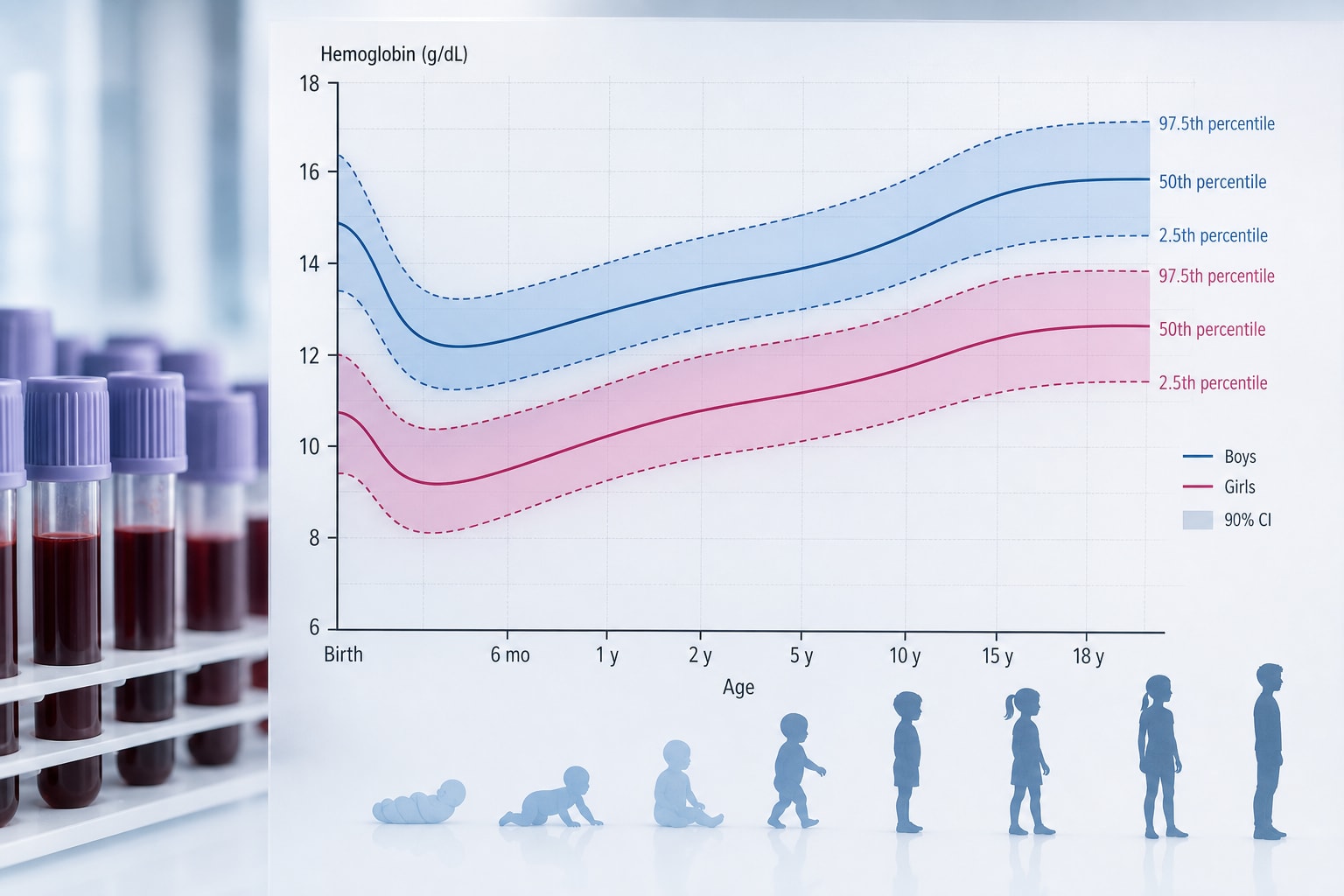
To create sex-specific reference curves (RCs) and optimal curves (OCs) for hemoglobin levels in children, assess differences between RCs and OCs, and develop a web-based tool for clinical assessments.
Approach:
Study Design: Cross-sectional study using data from healthy children in Toronto, Ontario, collected during regular health supervision visits.
Data Collection: Blood samples were analyzed for hemoglobin levels, with exclusion criteria for various health conditions and language barriers.
Statistical Analysis: Quantile regression was used to model hemoglobin as a continuous function of age, estimating sex-specific RCs and OCs.
Key Findings:
Reference curves (RCs) and optimal curves (OCs) provide a more nuanced understanding of hemoglobin levels compared to traditional reference intervals.
The World Health Organization's (WHO) fixed hemoglobin thresholds may not adequately reflect age-related variability in pediatric populations.
The study cohort was ethnically diverse, enhancing the generalizability of the findings.
Interpretation:
Limitations:
Exclusion of children with certain health conditions may limit the applicability of findings to the broader pediatric population.
Fixed thresholds from WHO do not account for variability in hemoglobin levels among younger children.
Conclusion:
The study aims to enhance the understanding of pediatric hemoglobin levels through improved modeling techniques and tools.
by Vid Bijelić, Franco Momoli, Mira Liebman, Beth K. Potter, Cornelia M. Borkhoff, Catherine S. Birken, Jonathon L. Maguire, Patricia C. Parkin, Jemila S. Hamid
Court-documented maltreatment was associated with small differences in GrimAge and DunedinPACE in sixth decade of life, but neither difference was statistically significant.