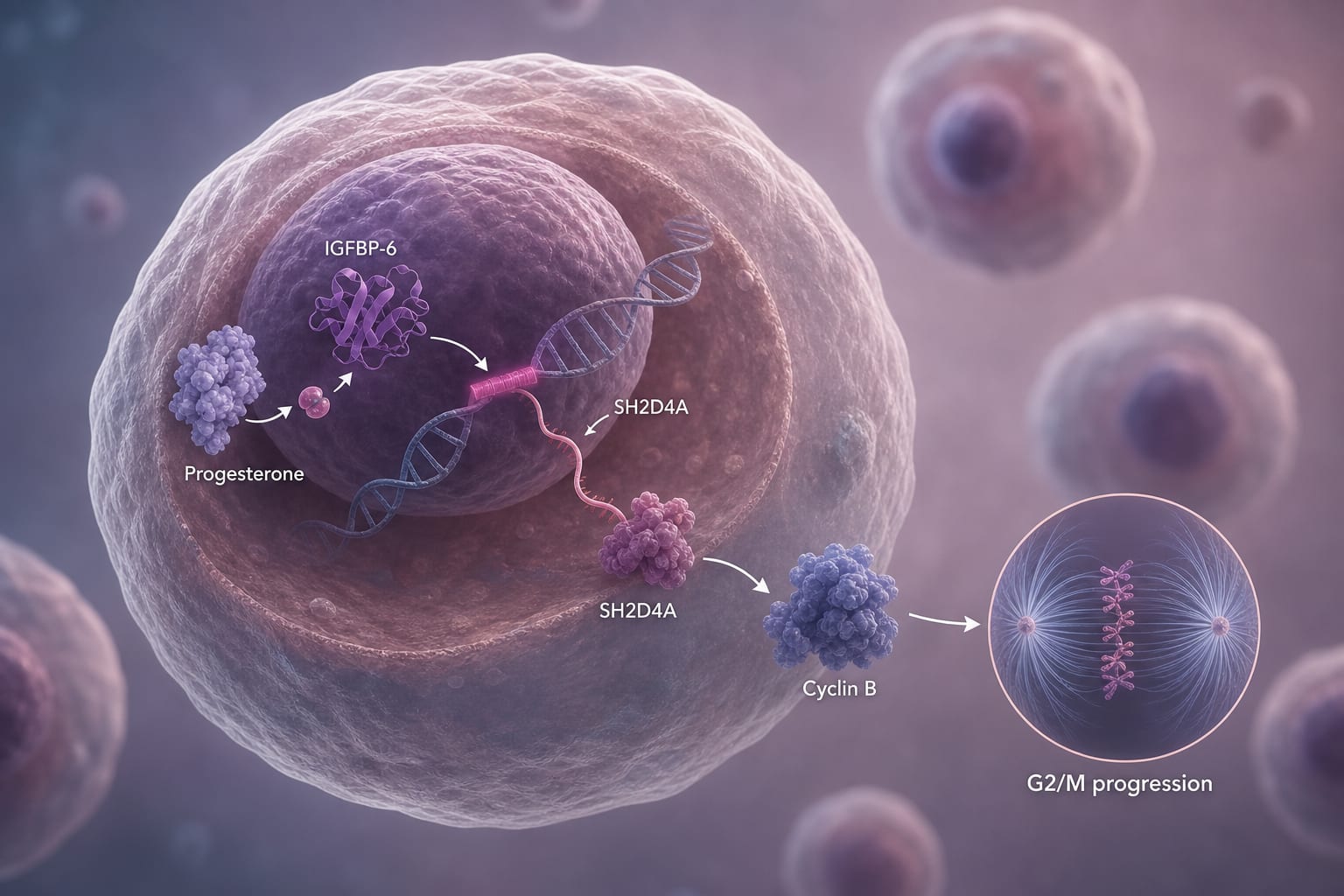
IGFBP-6 regulates SH2D4A expression to promote breast cancer cell cycle progression in response to progesterone
-
By
-
Francisco J. Lariz
-
Diana C. Bautista-Tovar
-
Alejandro Lazo-Loya
-
Kevin D. Houston
-
June 30, 2026
-
Objective:
To investigate the role of IGFBP-6 in regulating progesterone receptor signaling and its impact on cell cycle progression in breast cancer cells.
Approach:
- Proteomic Analysis: Conducted in progesterone-treated T47D breast cancer cells following siRNA-mediated knockdown of IGFBP-6.
- Cell Cycle Analysis: Examined the effects of IGFBP-6 and SH2D4A knockdown on cell cycle progression and protein expression.
- Survival Analysis: Utilized Kaplan-Meier survival plots to assess the impact of SH2D4A expression on patient outcomes in luminal A breast cancers.
Key Findings:
- IGFBP-6 is induced by progesterone and regulates progesterone receptor signaling.
- Knockdown of IGFBP-6 or SH2D4A leads to cell cycle arrest in G1 phase.
- SH2D4A expression is associated with improved survival outcomes in luminal A breast cancer patients.
- Progesterone treatment resulted in downregulation of 29 proteins and upregulation of 14 proteins in IGFBP-6-low cells.
Interpretation:
The study identifies a pathway involving progesterone, IGFBP-6, and SH2D4A related to cell cycle progression in breast cancer cells.
Limitations:
- The study primarily focuses on T47D breast cancer cells, which may limit the generalizability of the findings to other breast cancer types.
- Further research is needed to explore the clinical implications of the identified pathway.
Conclusion:
The results indicate a regulatory mechanism involving IGFBP-6 and SH2D4A in breast cancer cell cycle progression in response to progesterone.