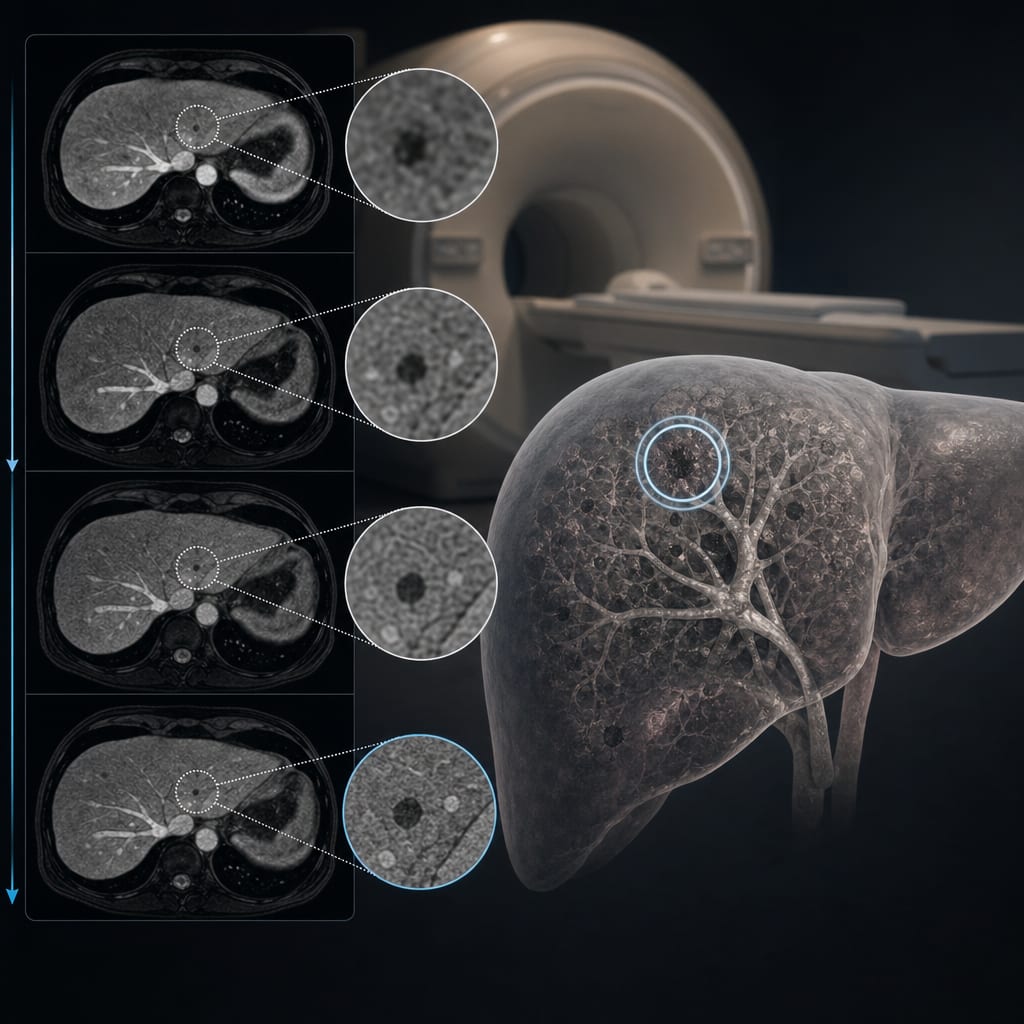
To assess the diagnostic utility of T1ρ mapping for evaluating hepatic fibrosis across the spectrum of chronic liver disease (CLD), including steatotic liver disease (SLD), highlighting its potential advantages over existing methods.
Key Findings:
T1ρ mapping demonstrated potential as a robust non-invasive biomarker for hepatic fibrosis, particularly in patients with steatosis.
T1ρ outperformed conventional T1, ECV, and T2 mapping in assessing liver fibrosis, indicating its superior diagnostic capability.
MRE remains the most accurate non-invasive method for liver fibrosis assessment, serving as a benchmark for comparison.
Interpretation:
The findings suggest that T1ρ mapping could serve as a valuable tool for non-invasive assessment of hepatic fibrosis, particularly in patients with chronic liver disease and steatosis.
Limitations:
The study's sample size and duration may limit generalizability, and potential biases in patient selection should be acknowledged.
Technical demands of T1ρ mapping may restrict its widespread clinical application, necessitating further training and resources.
Conclusion:
T1ρ mapping shows promise as a non-invasive method for assessing hepatic fibrosis, warranting further validation in larger cohorts to confirm its clinical utility.
by Narine Mesropyan, Johannes Chang, Philipp Lutz, Felix Kaiser, Oliver M. Weber, Christoph Katemann, Tatjana Dell, Dmitrij Kravchenko, Can Yueksel, Daniel Kuetting, Claus C. Pieper, Julian A. Luetkens, Alexander Isaak