Interpreting CFH Expression Across Cancers: Why Resolving the Factor H–Like 1 Isoform Matters
-
By
-
Simon J. Clark
-
October 11, 2026
Objective:
The article examines the objective, findings, and clinical context described in Interpreting CFH Expression Across Cancers: Why Resolving the Factor H–Like 1 Isoform Matters.
Approach:
- Pan-cancer study: Zheng et al. integrated public transcriptomic datasets, immune-infiltration analyses, and in vitro experiments to examine CFH across cancers.
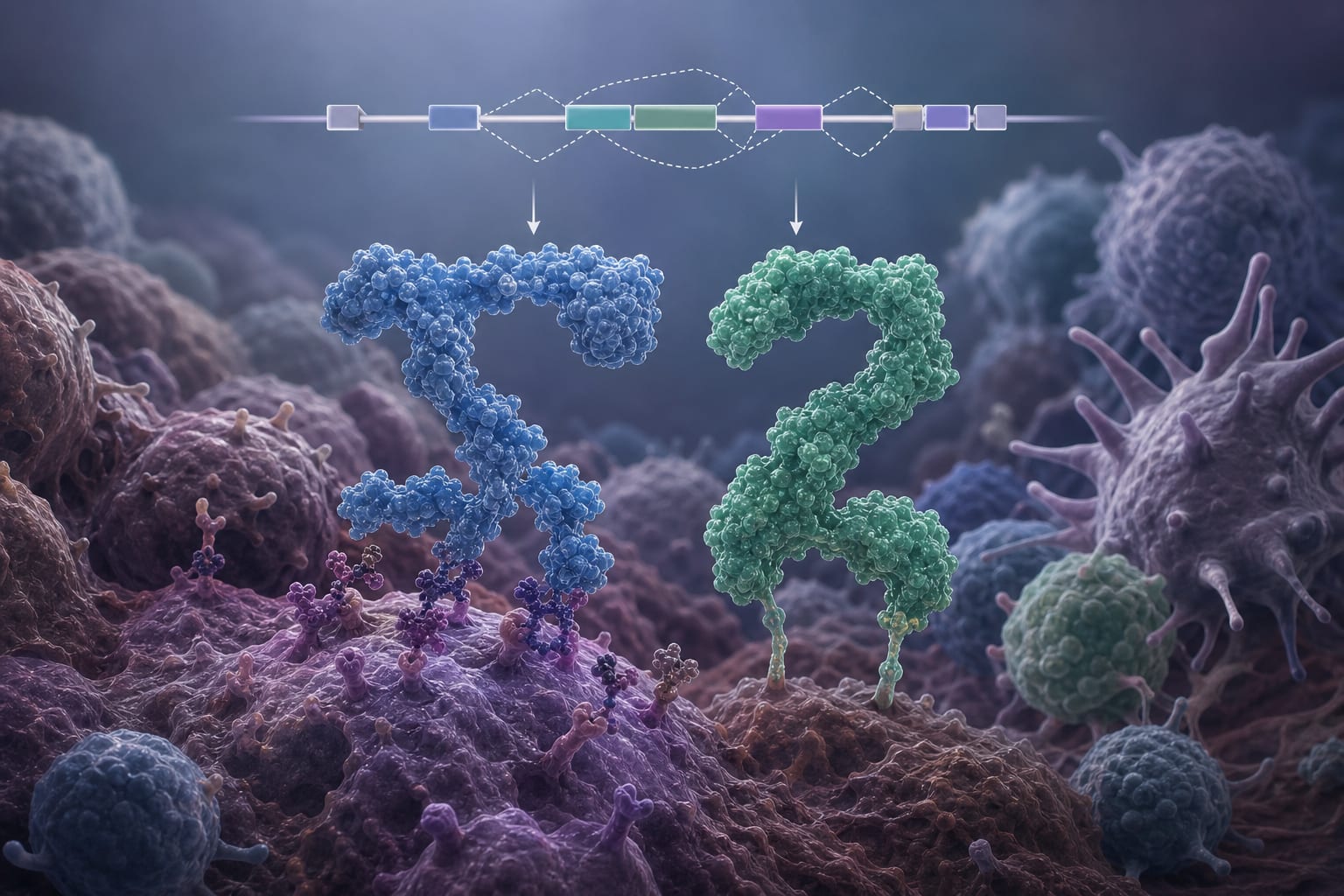
- Isoform assessment: The article reviews how CFH encodes full-length factor H (FH) and the alternatively spliced factor H–like 1 (FHL-1), and assesses the study’s assay and knockdown targets.
Key Findings:
- The study reported associations between CFH transcription and tumour type, clinical stage, survival, immune-cell infiltration, tumour mutational burden, and microsatellite instability.
- CFH knockdown inhibited pancreatic cancer cell proliferation and migration in vitro.
- The qRT-PCR primers and shRNA constructs targeted N-terminal sequences shared by FH and FHL-1; the reported measurements and knockdown therefore were not isoform-specific.
- FHL-1 retains factor I cofactor function but lacks FH’s C-terminal host-recognition domains. The article notes its expression in several tissues and tumour cells, and its association with the extracellular matrix.
Interpretation:
The reported transcriptional, prognostic, and functional associations reflect combined FH/FHL-1 expression rather than full-length FH alone. The article argues that this ambiguity may complicate interpretation of CFH-based measurements across tumour types and between tissue and circulation.
Limitations:
- The described assays do not distinguish FH from FHL-1, limiting isoform-specific interpretation.
- The context provides no source URL or detailed cohort-level estimates for the Zheng et al. study.
Conclusion:
The article proposes isoform-resolved methods, including splice-junction-specific qPCR, long-read RNA sequencing, and differentiating proteomic techniques, for future biomarker-focused research.
Sources:
Based on findings from:
Diagnostic interpretation of CFH expression in pan-cancer analyses: the importance of factor H–like 1 isoform resolution
Simon J. Clark. Bmc Cancer, 2026.
https://link.springer.com/article/10.1186/s12885-026-17134-4
This content is an AI-generated, fully rewritten summary based on a published scholarly article. It does not reproduce the original text and is not a substitute for the original publication. Readers are encouraged to consult the source for full context, data, and methodology.