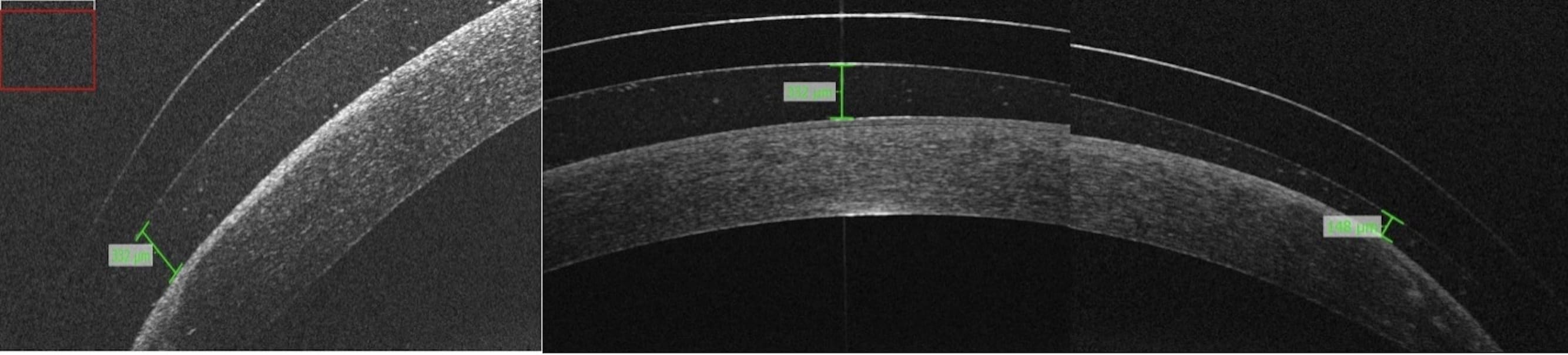
To evaluate the fitting of a protruding, tilted graft using an oblate semiscleral contact lens guided by corneal tomography and anterior segment optical coherence tomography (AS-OCT).
Approach:
Case Description: A 52-year-old male with a 20-year-old post-PK graft exhibiting tilt and elevation was evaluated for contact lens fitting after previous attempts with GP, soft toric, and hybrid lenses failed.
Lens Selection: The ROSE K2 XL Oblate lens was chosen for its reverse-geometry design and customizable features. Initial fitting with a 7.4 mm BC lens showed bearing issues, leading to a final BC selection of 7.1 mm.
Follow-Up: At follow-up, nasal clearance was monitored over time, showing initial clearance of 192 µm, settling to 149 µm after 2 weeks, and maintaining 148 µm at 14 weeks.
Key Findings:
The oblate semiscleral lens effectively vaulted the highest elevation point of the cornea.
Selecting a BC based on mean corneal power alone caused apical clearance issues.
The patient achieved 14 hours of daily wear with excellent comfort and stable visual performance.
Interpretation:
The study highlights the need to consider the highest elevation point of the cornea in fitting contact lenses for irregular corneas post-PK.
Limitations:
The case report is based on a single patient, limiting generalizability.
Long-term outcomes beyond 14 weeks were not assessed.
Conclusion:
The oblate semiscleral lens design provided an effective fitting strategy for complex corneal grafts, ensuring optimal corneal health and patient comfort.