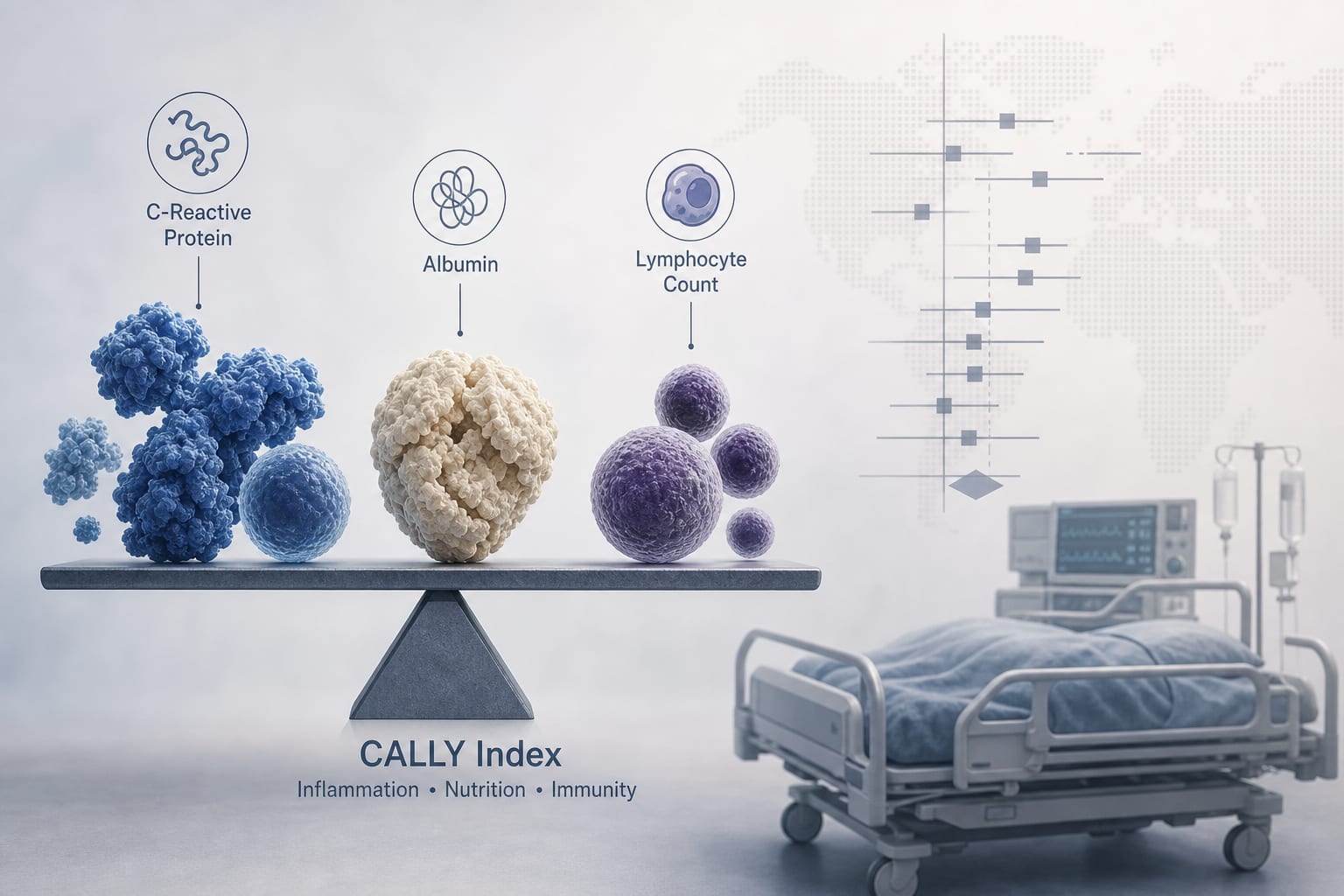
To clarify the relationship between the CALLY index and prognosis in septic patients through a comprehensive meta-analysis.
Key Findings:
The CALLY index did not significantly differ between survivors and non-survivors overall (pooled SMD = -0.22, 95% CI: -1.18 to 0.74).
Higher CALLY index correlated with survival in Chinese cohorts (SMD = -1.04, 95% CI: -1.69 to -0.39) but with mortality in the Turkish cohort (SMD = 1.39, 95% CI: 1.02 to 1.75).
Multivariate analysis indicated a significant association between a higher CALLY index and lower mortality risk (HR = 0.48, 95% CI: 0.33–0.69).
The diagnostic accuracy of the CALLY index for predicting mortality was moderate (sensitivity = 0.59, specificity = 0.77).
Significant heterogeneity was observed across all pooled analyses.
Interpretation:
The CALLY index shows potential as a low-cost biomarker for sepsis, but its variable association with mortality across different ethnic groups necessitates further validation in diverse populations.
Limitations:
Inconsistent findings across studies may limit generalizability.
Heterogeneity in study populations and methodologies could affect results.
Limited number of studies included in the meta-analysis.
Potential publication bias may influence the results.
Conclusion:
The CALLY index may serve as a useful prognostic tool in sepsis, but further large-scale, multinational studies are needed to confirm its efficacy and explore its applicability across different populations.
Older age, male sex, underweight status, reduced activities of daily living, and mild consciousness disturbance were associated with postextubation pneumonia in elective surgical patients.