Documented risk-based antithrombotic management and 30-day outcomes after endoscopic hemostasis for non-variceal upper gastrointestinal bleeding: a retrospective cohort study - Summary - MDSpire
Conexiant’s news site is now MDSpire News. Learn more
Advertisement
Assessment of Risk-Adjusted Antithrombotic Strategies and 30-Day Clinical Outcomes Following Endoscopic Treatment for Non-Variceal Upper Gastrointestinal Bleeding: A Retrospective Cohort Analysis
To assess associations between documented compliance with a predefined risk-based antithrombotic management framework and 30-day rebleeding, thromboembolism, and net adverse clinical events (NACE) following therapeutic endoscopy for non-variceal upper gastrointestinal bleeding (NVUGIB).
Approach:
Study Design: Retrospective cohort analysis conducted at a single center, comprising 150 distinct index admissions from January 2021 to December 2025.
Participants: 100 patients documented as adherent to the antithrombotic management framework, and 50 classified as non-adherent.
Analysis Methods: Primary analyses used Firth penalized logistic regression; sensitivity analyses employed multiple imputations and propensity-score overlap weighting.
Key Findings:
Adherence to the management framework was associated with lower rebleeding rates (5.2% vs 17.8%) and NACE rates (12.0% vs 34.0%).
Adjusted odds ratios for rebleeding and NACE were 0.03 (95% CI 0.002–0.43) and 0.04 (95% CI 0.007–0.20), respectively.
Overall, 9.2% experienced rebleeding, 10.7% thromboembolism, 4.0% death, and 19.3% NACE within 30 days.
Interpretation:
Documented adherence to a risk-based management framework correlated with fewer adverse events within 30 days.
Limitations:
Reliance on clinical documentation for exposure classification may lead to residual confounding and misclassification.
Conclusion:
In this cohort, adherence to a documented risk-based management framework was associated with improved short-term outcomes.
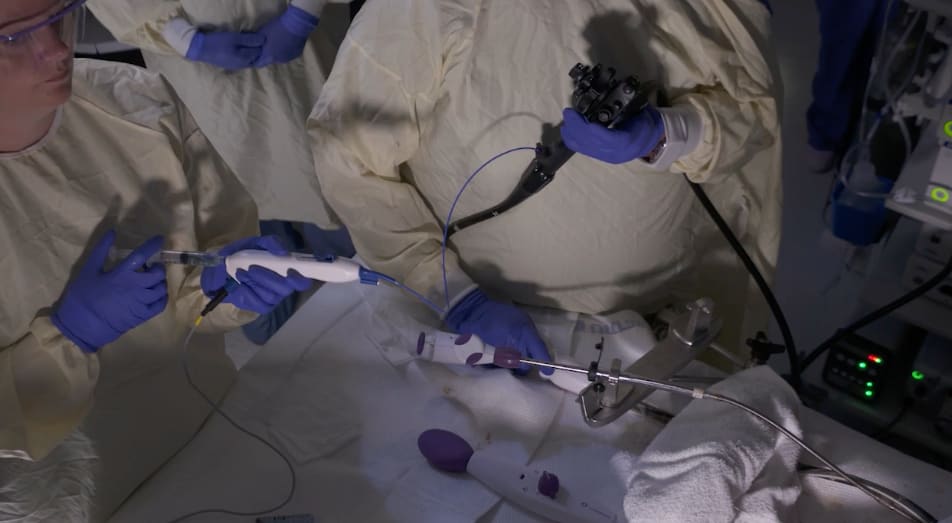
In this video Dr. Molham Abdulsamad of Geisinger Health demonstrates how Lumendi’s DiLumen™ C1 overtube and IgE Grasper improve access, stability and provide independent, multidirectional traction during resection of an ascending colon polyp adjacent to the hepatic flexure.