Completion rate and safety of non-invasive brain stimulation for upper limb dysfunction after stroke: a systematic review and network meta-analysis - Summary - MDSpire
Conexiant’s news site is now MDSpire News. Learn more
Advertisement
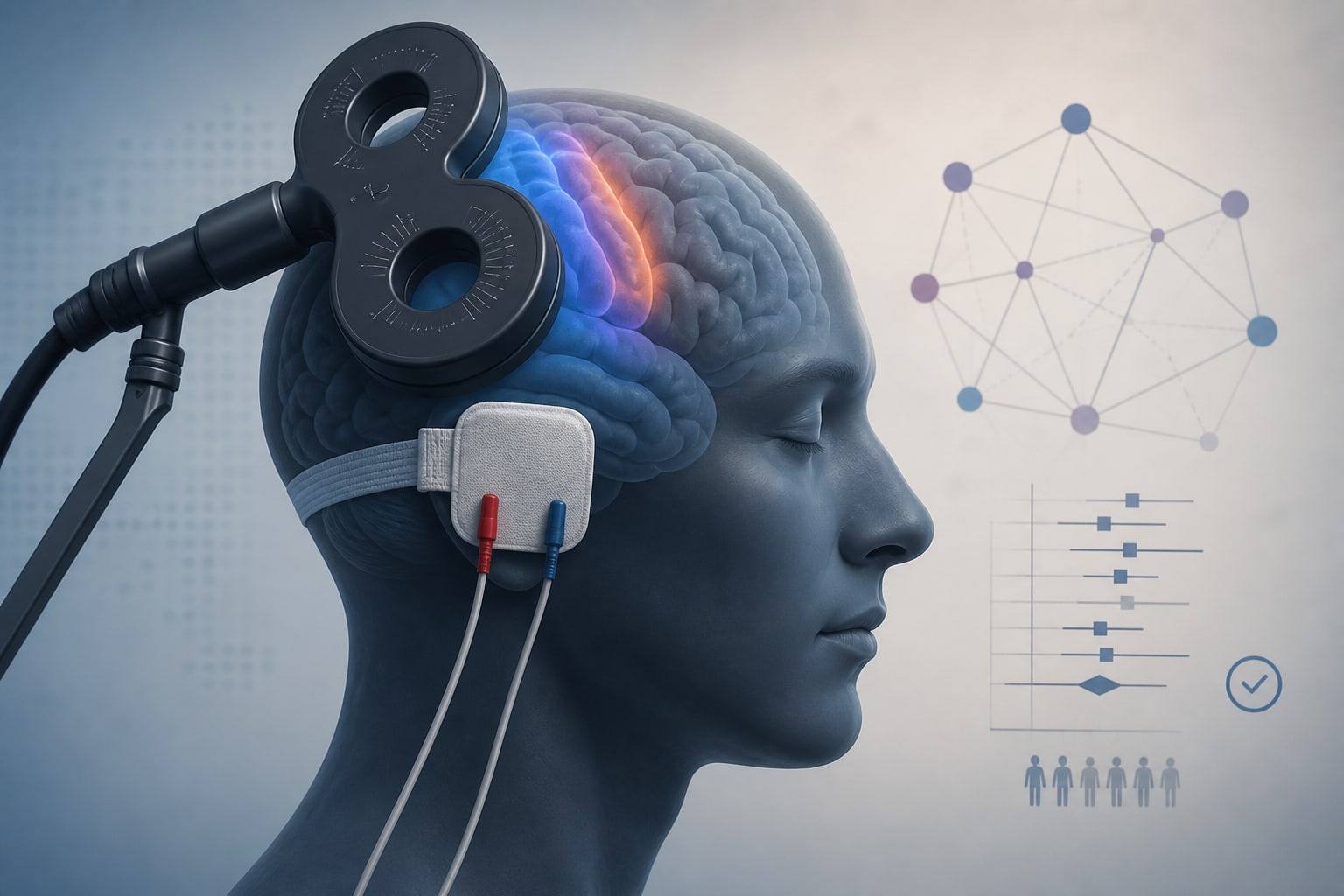
Evaluation of Treatment Completion and Safety Profiles of Non-Invasive Brain Stimulation for Upper Limb Impairment Post-Stroke: A Systematic Review and Network Meta-Analysis
To comprehensively assess and compare treatment completion rates across non-invasive brain stimulation (NIBS) modalities for upper limb rehabilitation in stroke patients.
Approach:
Statistical Analysis: Completion rates were pooled using random-effects single-arm meta-analyses with the Freeman-Tukey double arcsine transformation; Bayesian random-effects network meta-analysis estimated relative risks (RRs) and 95% credible intervals (CrIs).
Key Findings:
The overall pooled completion rate for NIBS interventions was 94.9%.
No NIBS intervention showed a statistically significant difference from sham/control in completion rates.
The adverse event (AE) rate across intervention groups was 16.4%, with mild headache and skin tingling being the most common.
Completion rates were higher for tDCS (96.8%) compared to rTMS (93.9%).
Chronic stroke phase had the highest completion rate (97.1%), while the mixed phase had the lowest (89.1%).
Intermittent theta burst stimulation (iTBS), bilateral rTMS (BL-rTMS), and dual transcranial direct current stimulation (Dual-tDCS) were the highest-ranked interventions.
Limitations:
The findings are hypothesis-generating rather than definitive due to minimal absolute completion-rate differences.
Four interventions were informed by only one study, limiting the robustness of the rankings.
Every pairwise credible interval included 1.00, indicating no clear superiority among interventions.
Conclusion:
Stroke phase may be an important consideration in designing adherence strategies.
Baptist Health will bring together leading physicians, researchers and healthcare professionals from South Florida and across the country for the 14th Annual Baptist Health Miami Neuroscience Symposium, taking place Nov. 4-6, 2026, at Hilton Miami Dadeland and virtually via Zoom.