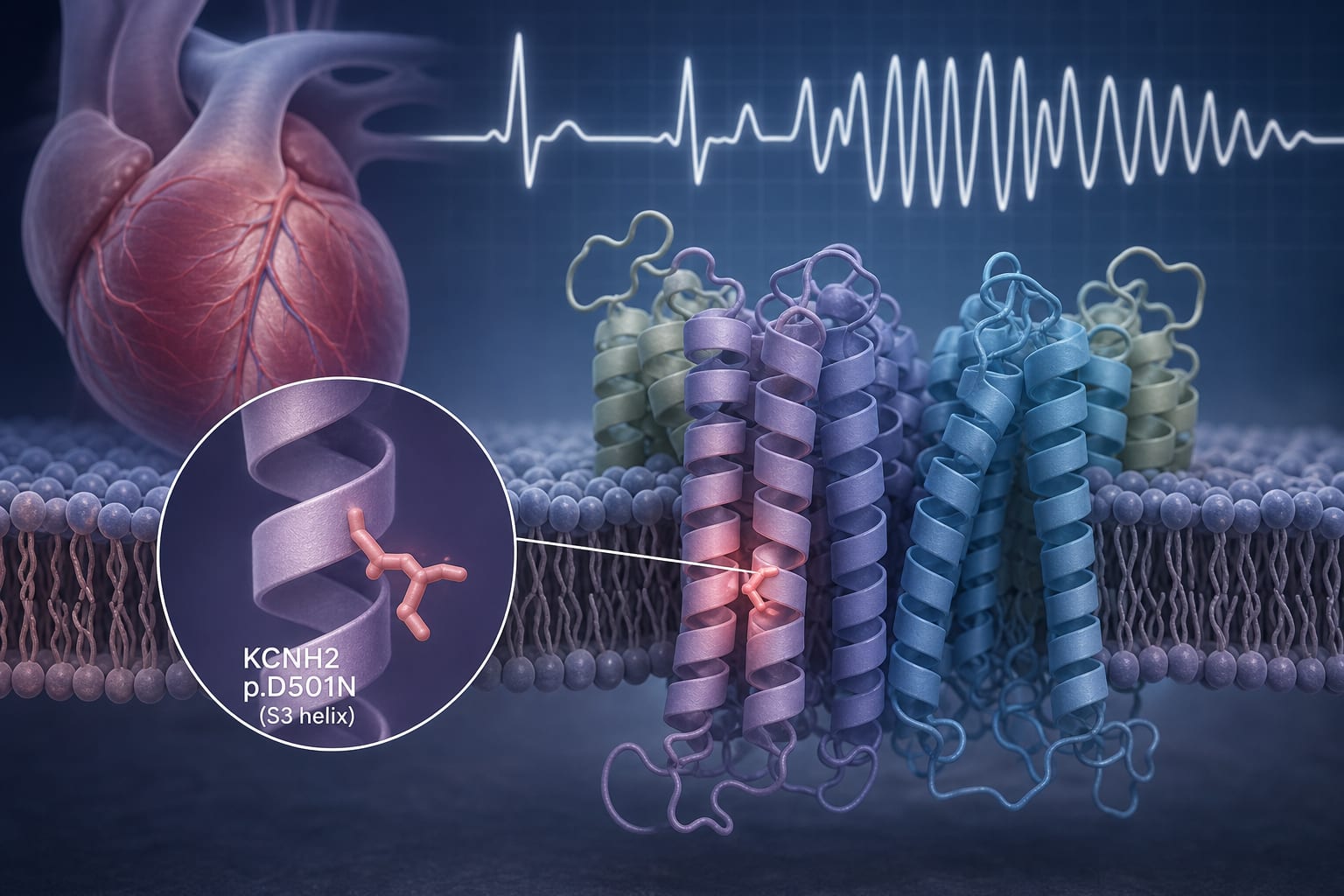
To report a case of a 16-year-old girl with early-onset malignant LQT2 associated with the KCNH2 p.D501N mutation and to elucidate the molecular pathogenic mechanism of this mutation through whole-exome sequencing and bioinformatics analysis.
Approach:
Key Findings:
The proband presented with a prolonged QT interval, TdP, VT, and VF.
The KCNH2 p.D501N mutation is predicted to be deleterious and alters the secondary structure of the Kv11.1 protein, increasing alpha helices and decreasing random coil.
The mutation leads to significant changes in the physicochemical properties of the Kv11.1 protein, potentially impairing cardiac IKr current.
Interpretation:
The KCNH2 p.D501N mutation significantly alters the structure and properties of the Kv11.1 protein.
Limitations:
The study is based on a single case report, limiting generalizability.
Long-term clinical follow-up data may not be representative of broader populations.
Conclusion:
The findings suggest that the KCNH2 p.D501N mutation is associated with early-onset malignant LQT2.