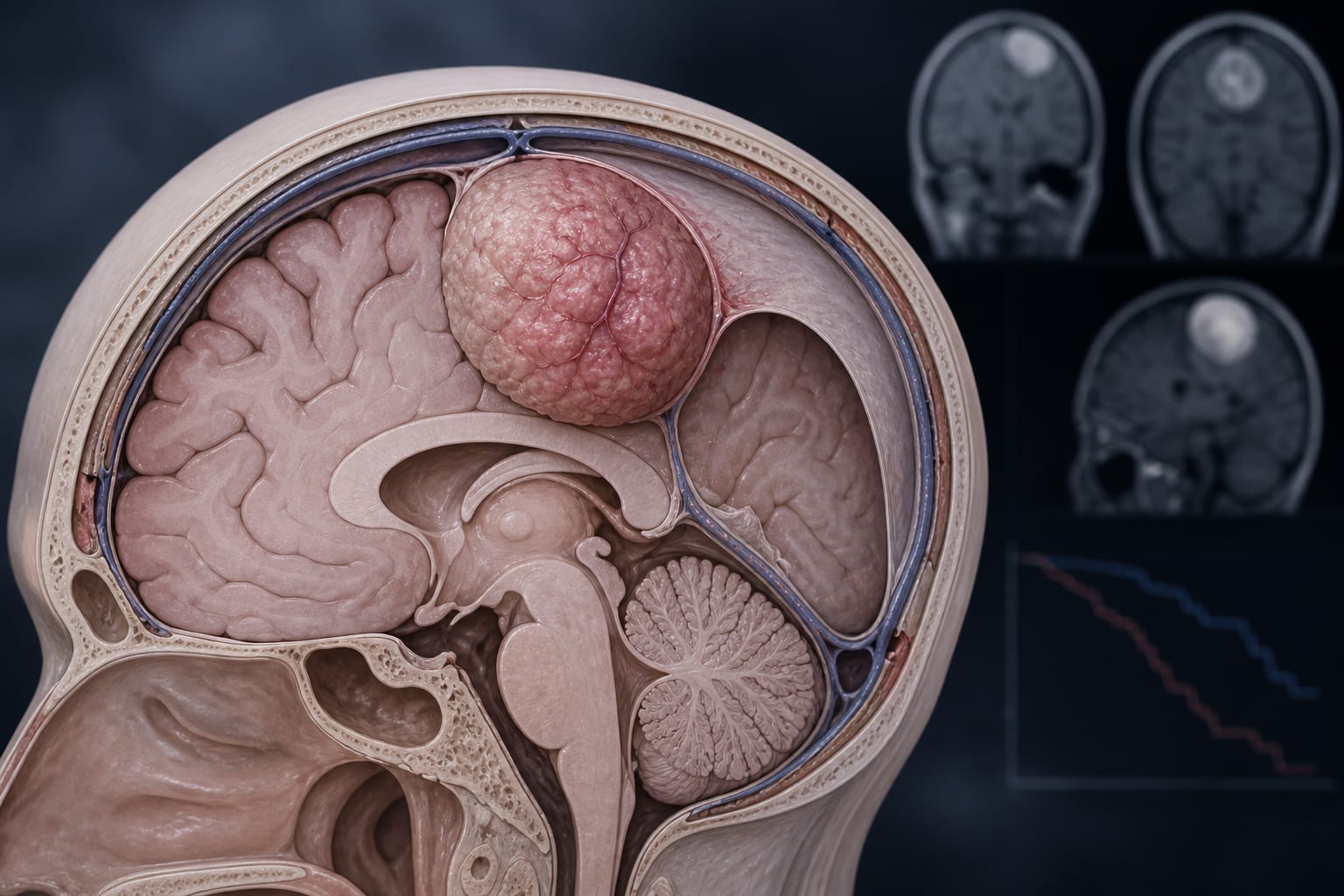
To characterize radiation-induced (RI) meningiomas and identify factors associated with recurrence, comparing outcomes with those of propensity-score-matched sporadic meningiomas.
Approach:
Study Design: Retrospective study of patients who underwent resection of RI meningiomas between 2007 and 2023. RI meningiomas were diagnosed according to Cahan’s criteria.
Data Collection: Demographic, clinical, radiological, and pathological information was collected from institutional records.
Outcome Measures: Progression-free survival (PFS) was measured from surgery to the first radiographically confirmed recurrence or progression.
Statistical Analysis: Propensity score matching was used to compare RI and sporadic meningiomas while balancing selected prognostic factors, including age, WHO grade, and Simpson grade.
Key Findings:
RI meningiomas can develop years or decades after cranial irradiation.
In the matched analysis, RI meningiomas were associated with earlier recurrence than sporadic meningiomas.
The study evaluated factors associated with recurrence in RI meningiomas; findings should be interpreted in light of the retrospective design and available data.
Interpretation:
The results indicate that RI meningiomas may have different recurrence patterns from sporadic meningiomas. Further research is needed to clarify the biological factors underlying these differences.
Limitations:
The retrospective design may introduce selection and information biases.
Pathology specimens were not systematically rereviewed, which may have affected grading consistency.
Conclusion:
In this retrospective, propensity-score-matched study, RI meningiomas were associated with earlier recurrence than sporadic meningiomas. Further studies are needed to confirm these findings and better characterize the factors associated with recurrence.
by Leon Schmidt, Dragan Jankovic, Santhosh Thavarajasingam, Reem Fakak, Michael Kosterhon, Alice Dauth, Marc Brockmann, Clemens Sommer, Florian Ringel, Darius Kalasauskas