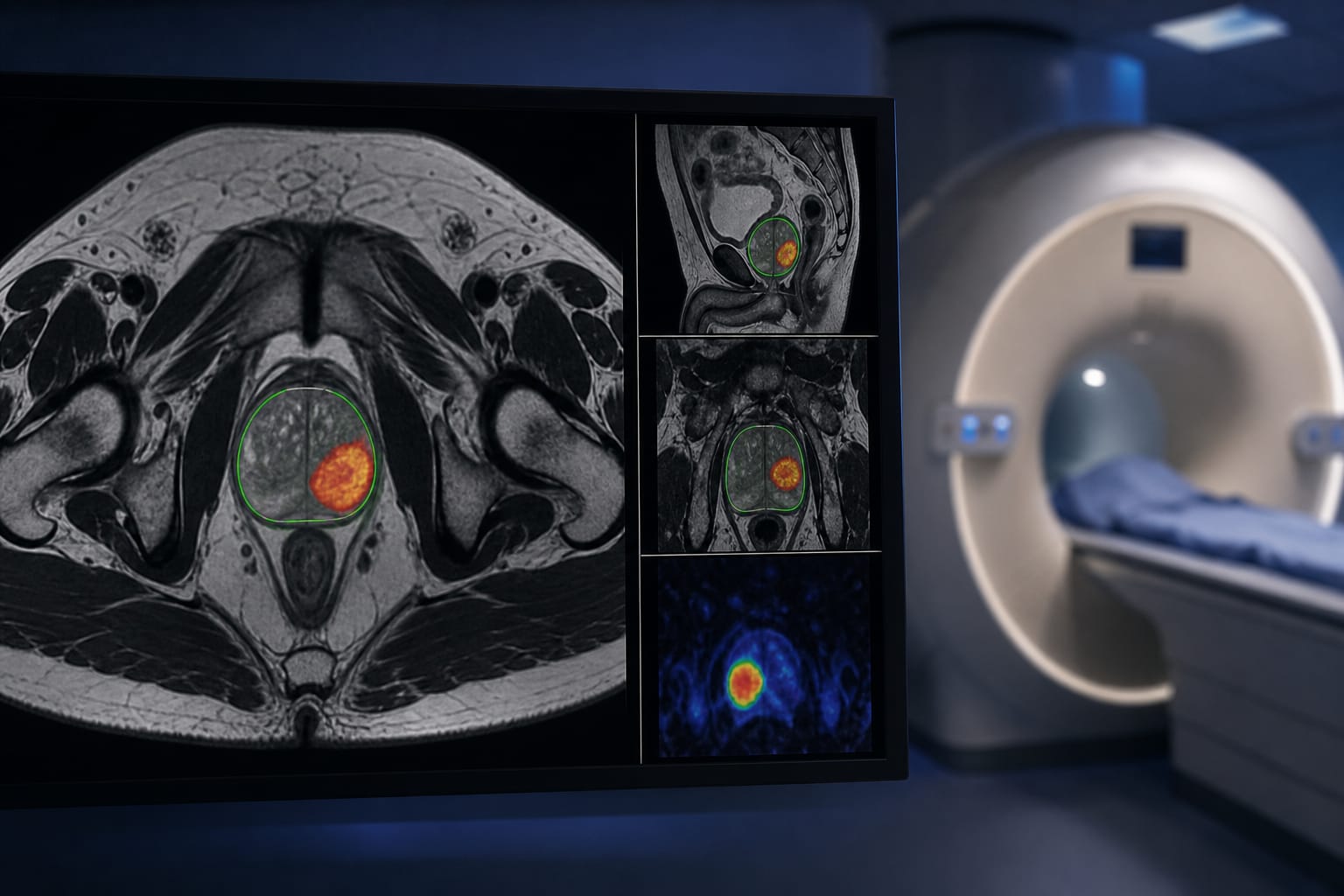
Performance of MRI-Based vs Clinical T Staging in Localized Prostate Cancer - Summary - MDSpire

Performance of MRI-Based vs Clinical T Staging in Localized Prostate Cancer

  • By

  • Arthur Peyrottes

  • Michael Baboudjian

  • Thibaut Long-Depaquit

  • Morgan Rouprêt

  • Thierry Roumeguere

  • Alexandre Peltier

  • Guillaume Ploussard

  • Romain Diamand

  • iTNM Consortium

  • Julien Anract

  • Grégoire Assenmacher

  • Francesco Barletta

  • Eric Barret

  • Edoardo Beatrici

  • Daniel Benamran

  • Vincent Benard

  • Nathan Bergier

  • Léa Bollen

  • Claudio Brancelli

  • Norbert de Brek

  • Laurent Brureau

  • Marie Chicaud

  • Mathieu Coscarella

  • Charles Dariane

  • Igor Duquesne

  • Mariaconsiglia Ferriero

  • Gaelle Fiard

  • Giorgio Gandaglia

  • Alexander Giesen

  • Ruben De Groote

  • Ruth Himmelsbach

  • Serge Holz

  • Steven Joniau

  • Marvin Jourdan

  • Romain Lefranc

  • Stéphan Lévy

  • Thibaut Long Depaquit

  • Charles Mazeaud

  • Benoit Mesnard

  • Stefano Moretto

  • Yann Neuzillet

  • Myky Nguyen

  • Marco Oderda

  • Jonathan Olivier

  • Dimitri Paillusson

  • Frédéric Panthier

  • Maxime Pattou

  • Andreas Røder

  • Maj Sanson-Stern

  • Alberto Sasia

  • Pietro Scilipoti

  • August Sigle

  • Hein Vincent Stroomberg

  • Fayek Taha

  • Gabrielle Tissot

  • Julien Van Damme

  • Thibaut Waeckel

  • Olivier Windisch

  • July 15, 2026

Share

Objective:

To evaluate the performance of MRI-based staging compared with traditional DRE-based staging in men undergoing radical prostatectomy and assess whether MRI could replace DRE staging in contemporary risk estimation models.

Approach:
  • Study Design: Multicenter, retrospective case-control study involving patients with histologically confirmed localized or locally advanced prostate cancer who underwent radical prostatectomy across 31 institutions in Europe.
  • Patient Selection: Included patients aged 18 or older who underwent preoperative multiparametric MRI and systematic biopsies, excluding those with prior therapy for prostate cancer or missing key variables.
  • Staging Comparison: Both DRE-based clinical staging and MRI-based staging were performed, allowing direct comparison of clinical T stage (cT) and MRI-derived T stage (iT).
  • Outcome Measures: Primary outcome was distant metastasis-free survival (DMFS); secondary outcomes included biochemical recurrence-free survival (BCRFS) and overall survival (OS).
Key Findings:
  • MRI may upstage a substantial proportion of patients compared with DRE.
  • The impact of MRI-derived staging on clinically relevant outcomes remains unclear.
  • Prior studies on this topic have limitations such as small sample sizes and lack of long-term follow-up.
Interpretation:

Limitations:
  • Retrospective design may introduce bias.
  • Limited long-term follow-up data.
  • Potential variability in MRI interpretation across centers.
Conclusion:

The study seeks to provide insights into the comparative effectiveness of MRI and DRE in staging localized prostate cancer.

Original Source(s)

Related Content