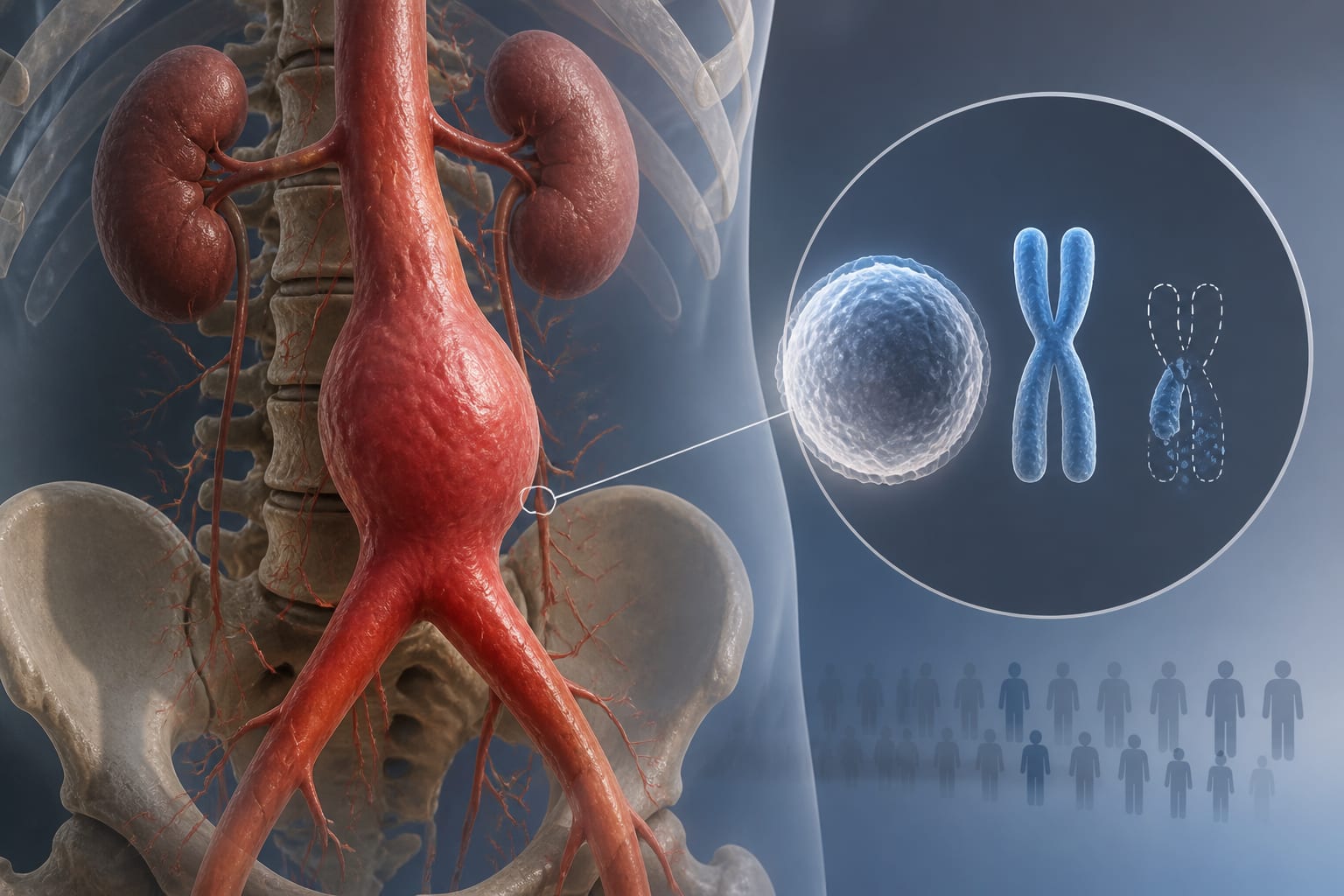
To assess whether hematologic loss of chromosome Y (LOY) is associated with abdominal or thoracic aortic aneurysm (AAA or TAA) incidence in men.
Approach:
Study design: Observational cohort analyses used UK Biobank (UKB) and Mass General Brigham Biobank (MGBB) data.
LOY assessment: Microarray data were used to classify LOY by cell fraction as low (>0% to 17%).
Outcomes and analysis: Aneurysms were identified using diagnostic and procedure codes; MGBB diagnoses were additionally checked against radiology reports. UKB incidence analyses used competing-risks regression, and MGBB validation used adjusted logistic regression.
Key Findings:
In 221,486 UKB men, adjusted AAA risk increased across LOY categories: sHR 1.12 (95% CI, 0.96–1.34) for low, 1.40 (1.07–1.84) for mid, and 1.73 (1.27–2.35) for high LOY.
In UKB, continuous LOY was associated with AAA risk (sHR 1.02 per 1% cell-fraction increase; 95% CI, 1.01–1.04). No significant association with TAA was observed.
In 14,569 MGBB men, high-CF LOY was associated with AAA (aOR 1.38; 95% CI, 1.02–1.87); lower-category estimates were not statistically significant. No TAA association was observed.
Sensitivity analyses including prevalent cases supported the UKB AAA association and found no TAA association.
Interpretation:
The authors report a burden-dependent association between LOY and AAA, but not TAA, across two cohorts. The observational design does not establish causality.
Limitations:
The observational design prevents causal inference.
The small number of TAA cases produced wide confidence intervals and limited statistical power; an association at the highest LOY burden could not be excluded.
The biological mechanisms underlying the reported association remain unknown.
Conclusion:
The authors characterize LOY as a novel, common AAA risk factor among older men.
by Taylor Nordan, Tiffany R. Bellomo, Md Mesba Uddin, Liying Xue, So Mi Jemma Cho, Kaavya Paruchuri, Marie Billaud, Peter Libby, Pradeep Natarajan, Tetsushi Nakao
November 2, 2026 | Gennaro Giustino, MD, a structural interventional cardiologist at Atlantic Health Morristown Medical Center, specializes in advanced structural heart interventions for patients with complex valvular disease, including recurrent mitral regurgitation after prior surgical repair.
New multisociety guidance identifies menstrual irregularities as potential early markers of cardiovascular risk, extending prevention efforts into adolescence.