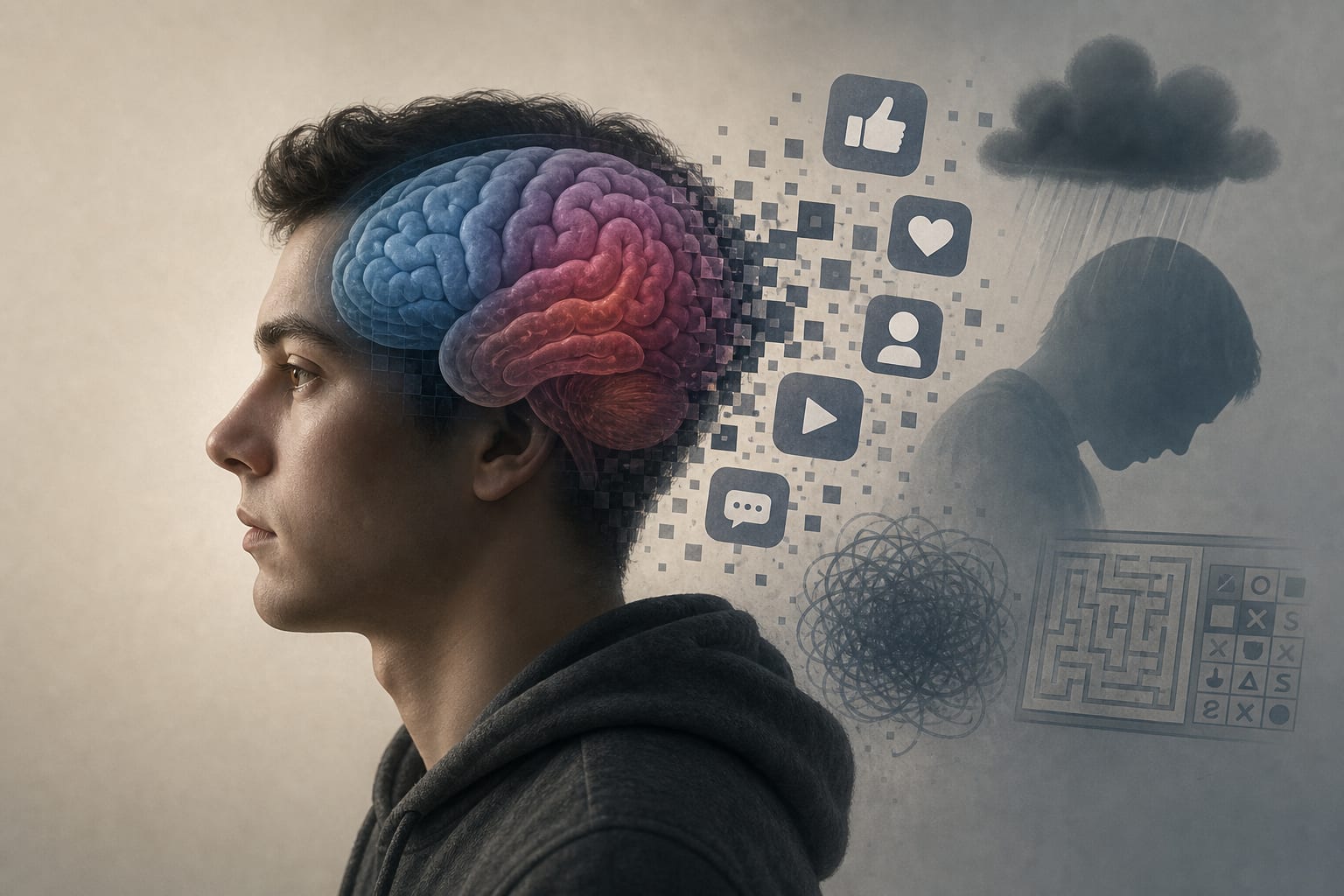
To investigate impulsivity and compulsivity among excessive social media users compared to non-excessive users using neurocognitive tasks, focusing on their behavioral implications.
Key Findings:
Excessive social media users showed lower ability to delay gratification on the EDT, indicating impulsivity.
They made fewer non-perseverative errors on the WCST, suggesting high flexibility, which contradicts evidence for compulsivity.
On the GO/NO-GO task, excessive users made more omission errors to 'Facebook' signs, indicating impaired selective attention.
Higher subjective ratings of anxiety, depression, impulsivity, and compulsivity were reported among excessive users.
Interpretation:
The findings support the behavioral addiction model due to impulsivity, while showing impaired selective attention and lack of evidence for compulsivity in excessive social media users, suggesting a need for further exploration of these constructs.
Limitations:
Small sample size may limit generalizability.
Cross-sectional design does not establish causation.
Self-reported measures may introduce bias.
Potential self-selection bias in participant recruitment.
Conclusion:
Further research is needed to clarify whether excessive social media use should be classified as a behavioral addiction or an impulse control disorder, particularly in light of the findings regarding impulsivity and selective attention.