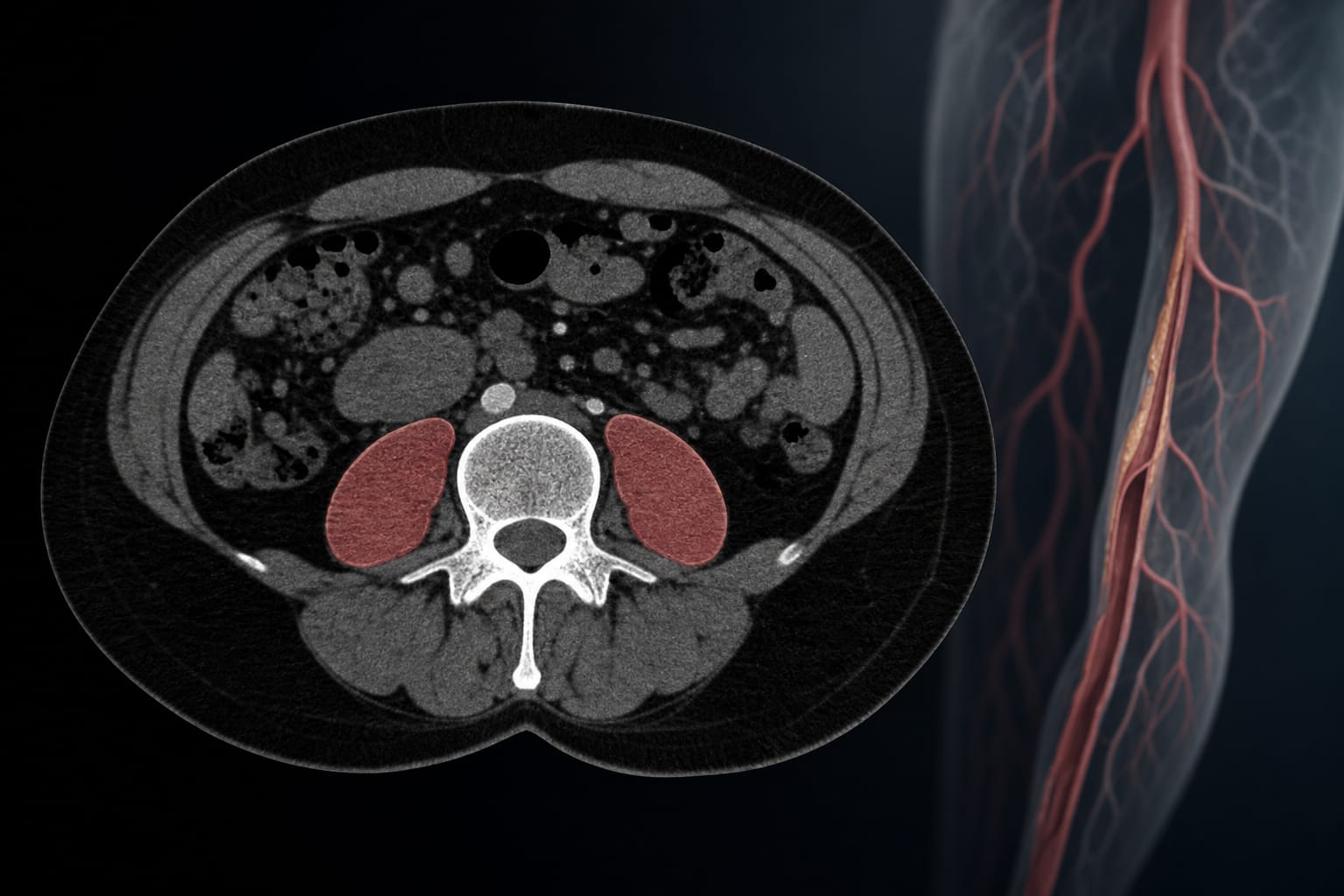
To evaluate whether reduced psoas major muscle area is associated with short- and long-term mortality following revascularization in patients with peripheral arterial disease (PAD).
Approach:
Systematic Search: A systematic search of MEDLINE, Scopus, and Web of Science identified observational studies assessing psoas muscle morphometrics in adults undergoing surgical or endovascular revascularization for PAD.
Study Inclusion: Seven retrospective cohort studies (n = 2,290 patients) met the inclusion criteria.
Quality Assessment: Study quality was assessed using the NHLBI tool.
Meta-Analysis: Random-effects meta-analyses were performed for 1-month and 1-year mortality.
Key Findings:
Pooled estimate for 1-month mortality suggested a possible increase in early mortality among sarcopenic patients, but this association was not statistically significant (RR = 2.45; 95% CI 0.58–10.36; p = 0.22).
Significant association found between reduced psoas major muscle area and increased 1-year mortality (RR = 2.37; 95% CI 1.51–3.73; p < 0.001).
Confidence intervals were wide, indicating uncertainty regarding the magnitude and consistency of the association across future settings.
Interpretation:
A reduced psoas major muscle area was associated with increased 1-year mortality in patients undergoing lower-limb revascularization for PAD.
Limitations:
Short-term mortality findings were inconclusive due to limited power.
Insufficient data prevented quantitative synthesis of limb outcomes.
Heterogeneity in imaging methodologies and sarcopenia definitions.
Conclusion:
Psoas morphometry may have value in preoperative risk stratification, but standardized definitions and prospective studies are needed.
According to Agilent Technologies, the expanded indication covers esophageal and gastric tumor types and applies to patients being considered for nivolumab or nivolumab and hyaluronidase-nvhy.