Spatial organization of the tumor immune microenvironment in LAR+ triple-negative breast cancer - Summary - MDSpire

Spatial organization of the tumor immune microenvironment in LAR+ triple-negative breast cancer

  • By

  • Donatella Lucchetti

  • Alba Di Leone

  • Giulia Sabbatinelli

  • Federica Toma

  • Franco Antonio

  • Beatrice Cellini

  • Filomena Colella

  • Erica Pazzaglia

  • Chiara Parrillo

  • Luciano Giacó

  • Angela Santoro

  • Alessia Piermattei

  • Rita Colonna

  • Gianluca Franceschini

  • Alessandro Sgambato

  • May 22, 2026

  • 0 min

Share

Objective:

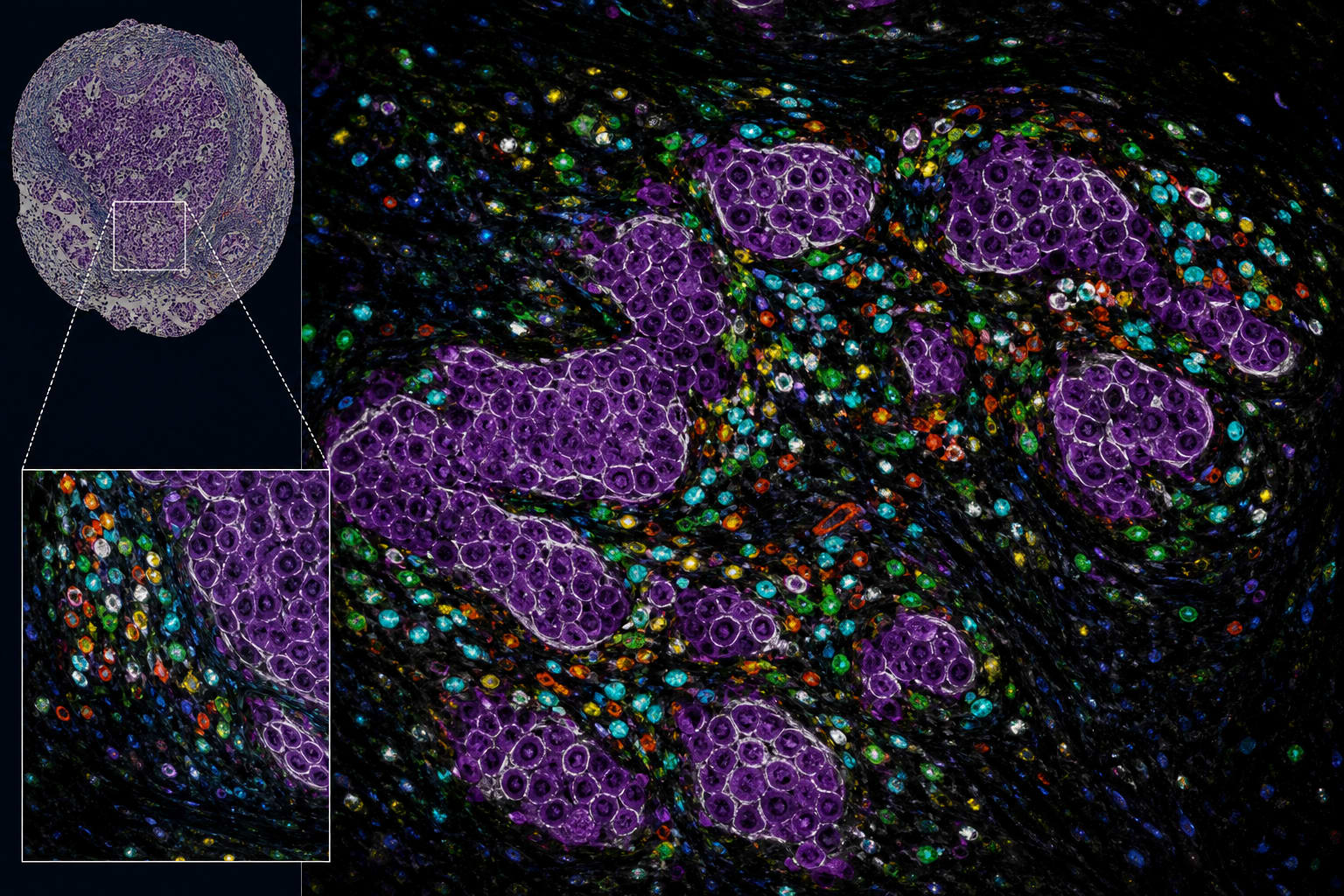
To characterize the immune microenvironment in LAR+ TNBC and explore its spatial organization and cellular composition in relation to treatment response.

Key Findings:
  • Patients achieving pCR had higher pre-treatment densities of immune subsets such as CD20+PD-1+, CD4+FOXP3+, and CD8+PD-1+TIM3+ cells.
  • Spatial analyses indicated that tumor cells in Responders were initially closer to PD-L1+ tumor cells, with proximity decreasing post-treatment.
  • In Non-Responders, immunosuppressive tumor cells moved closer to tumor cells after treatment.
  • Neoadjuvant therapy in Responders was associated with spatial repositioning of CD4+ and CD8+ T cells toward tumor cells.
Interpretation:

Distinct immune compositions and spatial arrangements in the TIME of LAR+ TNBC may correlate with different pathological outcomes, with persistent immunosuppressive niches in Non-Responders.

Limitations:
  • Small sample size limits generalizability of findings.
  • Inclusion of immune checkpoint inhibitors in a subset of patients achieving pCR may confound results.
Conclusion:

Findings indicate that immune enrichments and spatial remodeling patterns differ between pathological outcomes in LAR+ TNBC.

Original Source(s)

Related Content