Efficacy and safety of abaloparatide, denosumab, teriparatide, oral bisphosphonates, and intravenous bisphosphonates in the treatment of postmenopausal osteoporosis: a systematic review and Bayesian network meta-analysis - Summary - MDSpire
Advertisement
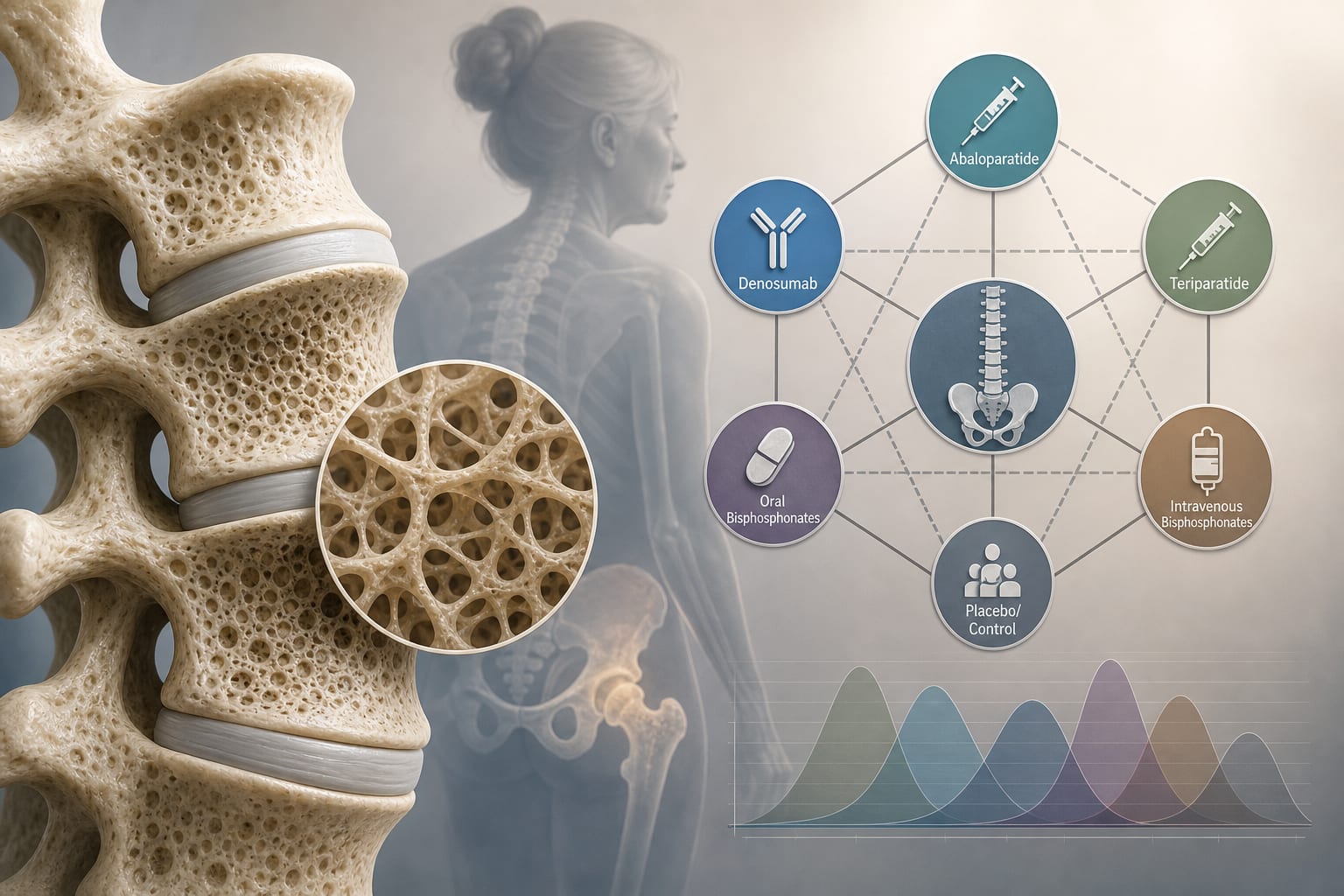
Efficacy and safety of abaloparatide, denosumab, teriparatide, oral bisphosphonates, and intravenous bisphosphonates in the treatment of postmenopausal osteoporosis: a systematic review and Bayesian network meta-analysis
To evaluate the relative efficacy and safety of ABA, TER, OBP, IBP, DEN, and PLA/CTRL in postmenopausal women with osteoporosis.
Approach:
Study Design: Bayesian network meta-analysis of randomized controlled trials (RCTs).
Primary Outcomes: Changes in lumbar spine, femoral neck, and total hip bone mineral density (BMD).
Safety Outcomes: All adverse events (AEs) and serious adverse events (SAEs).
Data Synthesis: Data synthesized using SUCRA rankings; network consistency assessed via node-splitting and deviance information criteria (DIC).
Key Findings:
ABA showed the greatest improvement in lumbar spine and femoral neck BMD, followed by TER.
ABA had the highest effect on total hip BMD.
IBP and DEN provided moderate benefits compared to PLA/CTRL.
TER and OBP had a lower risk for AEs.
ABA and PLA/CTRL showed a lower risk for SAEs.
Interpretation:
Anabolic agents significantly improved BMD at the spine and femoral neck, while antiresorptive agents were more effective for hip BMD.
Limitations:
Limited comparative studies specifically in postmenopausal women.
Existing studies often involve only pairwise comparisons or small sample sizes.
Conclusion:
ABA and TER are effective for improving spinal and femoral neck BMD, while ABA is superior for total hip BMD. Safety profiles were favorable for TER, OBP, and ABA.