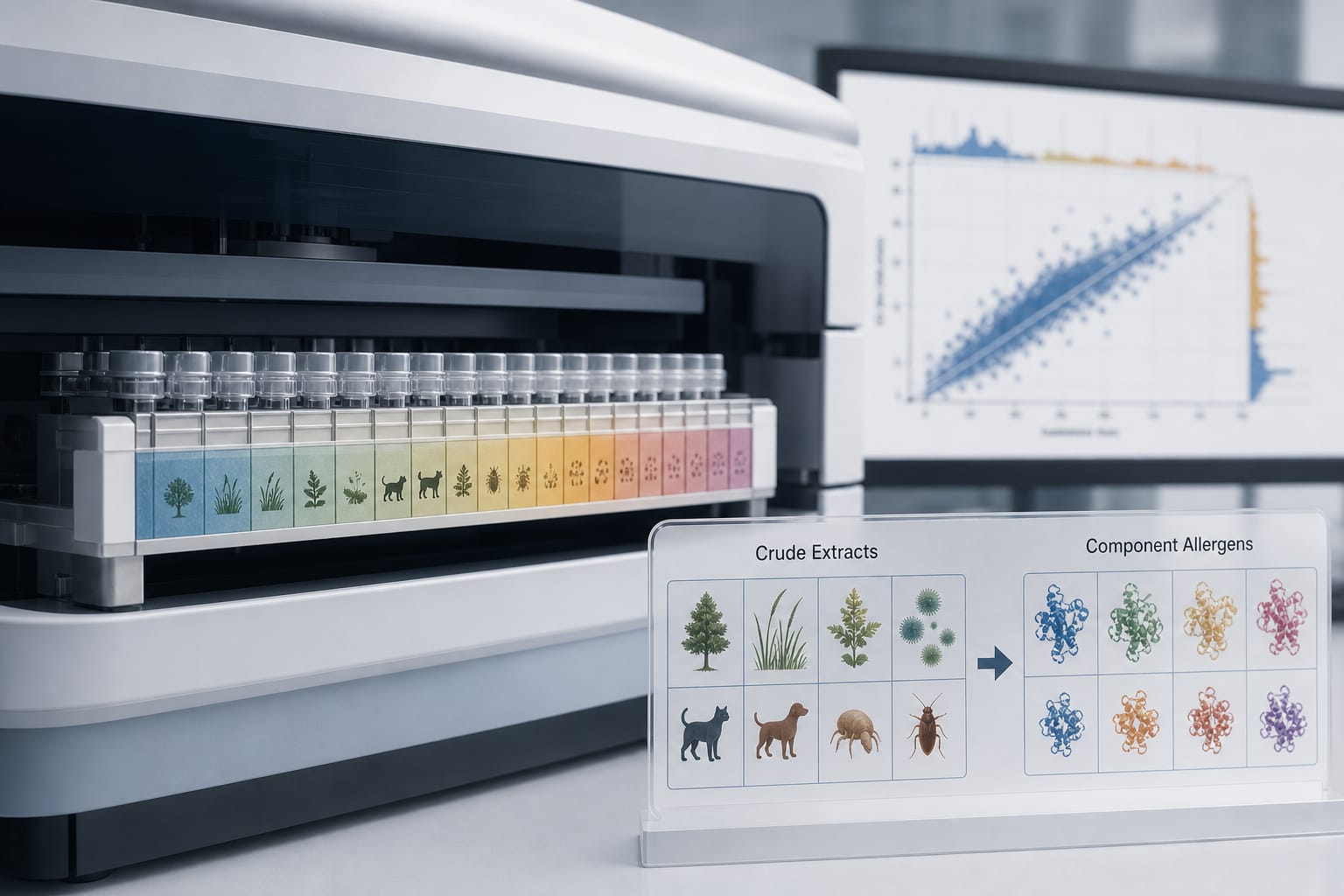
Concordance between crude extract and component allergens in a multiple allergen simultaneous test: a large-scale retrospective analysis - Summary - MDSpire
Advertisement
Concordance between crude extract and component allergens in a multiple allergen simultaneous test: a large-scale retrospective analysis
To evaluate the agreement between crude extract and corresponding component allergen results using a MAST panel in a large clinical laboratory cohort.
Approach:
Study Design: Retrospective analysis of deduplicated MAST results from a high-volume referral laboratory over a two-month period.
Data Analysis: Positivity rates assessed using a cutoff of class 2 or higher (≥0.70 IU/mL); concordance defined as both crude extract and at least one component allergen being positive, or both being negative.
Statistical Evaluation: Agreement evaluated using percent agreement and Cohen’s kappa coefficient.
Key Findings:
A total of 19,949 patients were included.
The highest positivity rates were observed for Dermatophagoides farinae (31.8%), D. pteronyssinus (29.9%), rDer f 2 (24.2%), and cat epithelium (12.2%).
Overall percent agreement exceeded 90% for most allergen pairs, primarily driven by high negative agreement.
Cohen’s kappa revealed substantial agreement (κ ≥ 0.6) for ten allergens including D. farinae, cat dander, and birch pollen, whereas eight allergens including D. pteronyssinus and milk showed poor agreement (κ < 0.1) due to low component allergen positivity despite positive crude extract results.
Interpretation:
Limitations:
Study limited to a specific two-month period and a single high-volume referral laboratory.
Findings may not be generalizable to other settings or populations.