To externally evaluate a previously reported posttransplant survival score and its component factors in an independent Asian cohort undergoing transplantation after low-intensity induction.
Approach:
Cohort: Retrospective study of 46 adults with newly diagnosed myelodysplastic neoplasm/AML or AML who received low-intensity induction followed by a first allogeneic transplant at National Taiwan University Hospital.
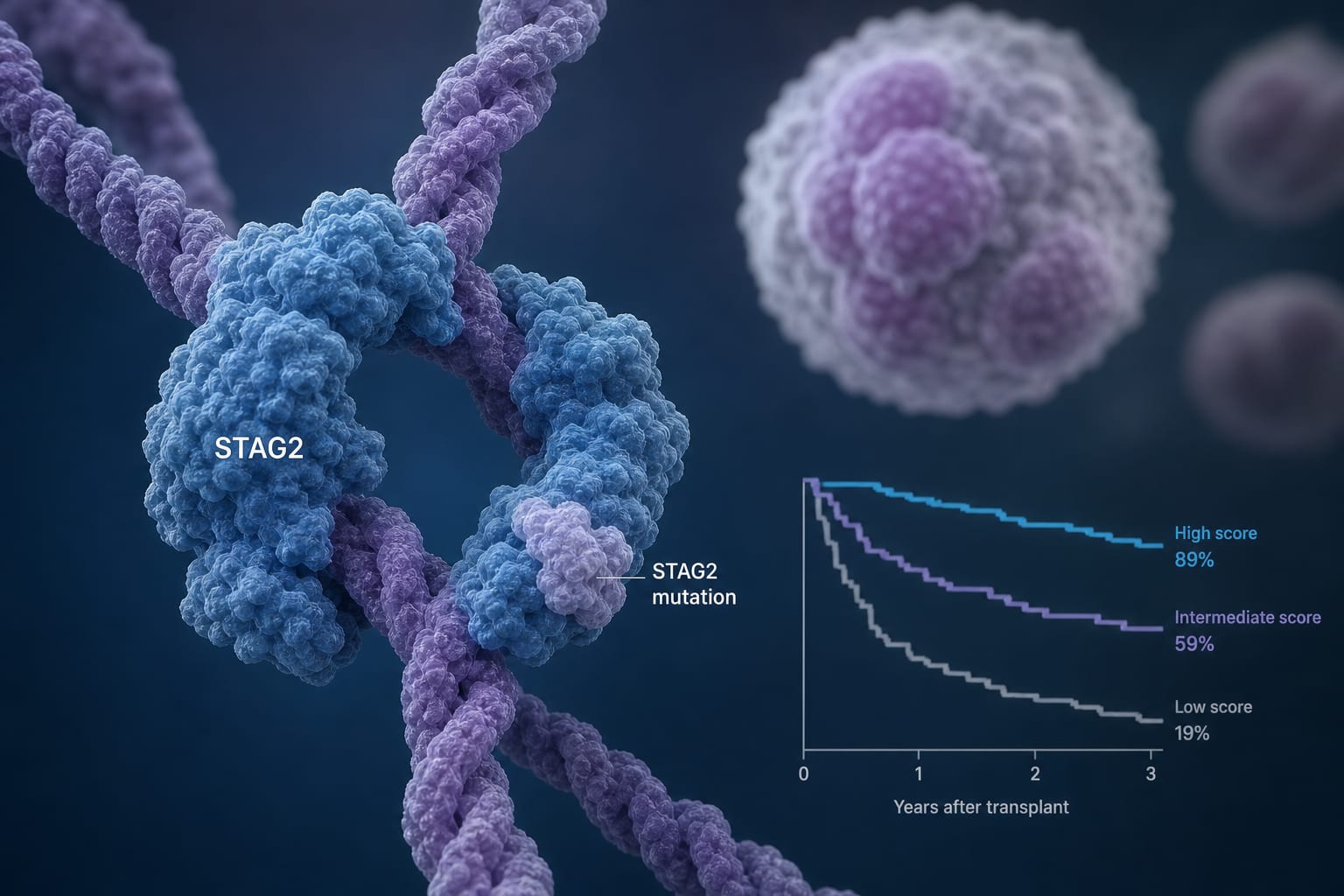
Analysis: Overall survival was measured from transplantation. Investigators assessed STAG2 and DNMT3A mutations, age, and the previously published three-factor score, which assigns one point each for age under 65 years, wild-type STAG2, and wild-type DNMT3A.
Key Findings:
Six patients had STAG2 mutations; none died during a median follow-up of 34.7 months. Two-year overall survival was 100% with STAG2 mutation versus 39.2% with wild-type STAG2 (p = 0.028).
Age category and DNMT3A mutation were not associated with overall survival (p = 0.17 and p = 0.75, respectively).
The composite score did not stratify survival in this cohort (p = 0.42).
The posttransplant relapse rate was numerically higher with wild-type STAG2 than with STAG2 mutation (37.5% vs. 0%; p = 0.16).
Interpretation:
The authors report that the favorable association between STAG2 mutation and posttransplant survival was reproduced, whereas the age and DNMT3A associations and composite score did not stratify survival in this cohort. Because only six patients had STAG2 mutations and only one received venetoclax-free therapy, the study cannot determine whether the association reflects venetoclax sensitivity or intrinsically more indolent disease.
Limitations:
Small retrospective cohort, including only six patients with STAG2 mutations.
Only one patient with STAG2 mutation received venetoclax-free therapy.
The cohort had a different age distribution from the original study and included patients transplanted with refractory disease.
Conclusion:
STAG2 mutation was associated with favorable posttransplant survival in this cohort; the previously reported age and DNMT3A associations and composite score did not stratify survival.
Researchers develop targeted lipoplex platform that generates CAR T and NK cells directly within tumors, improving survival in preclinical breast cancer models