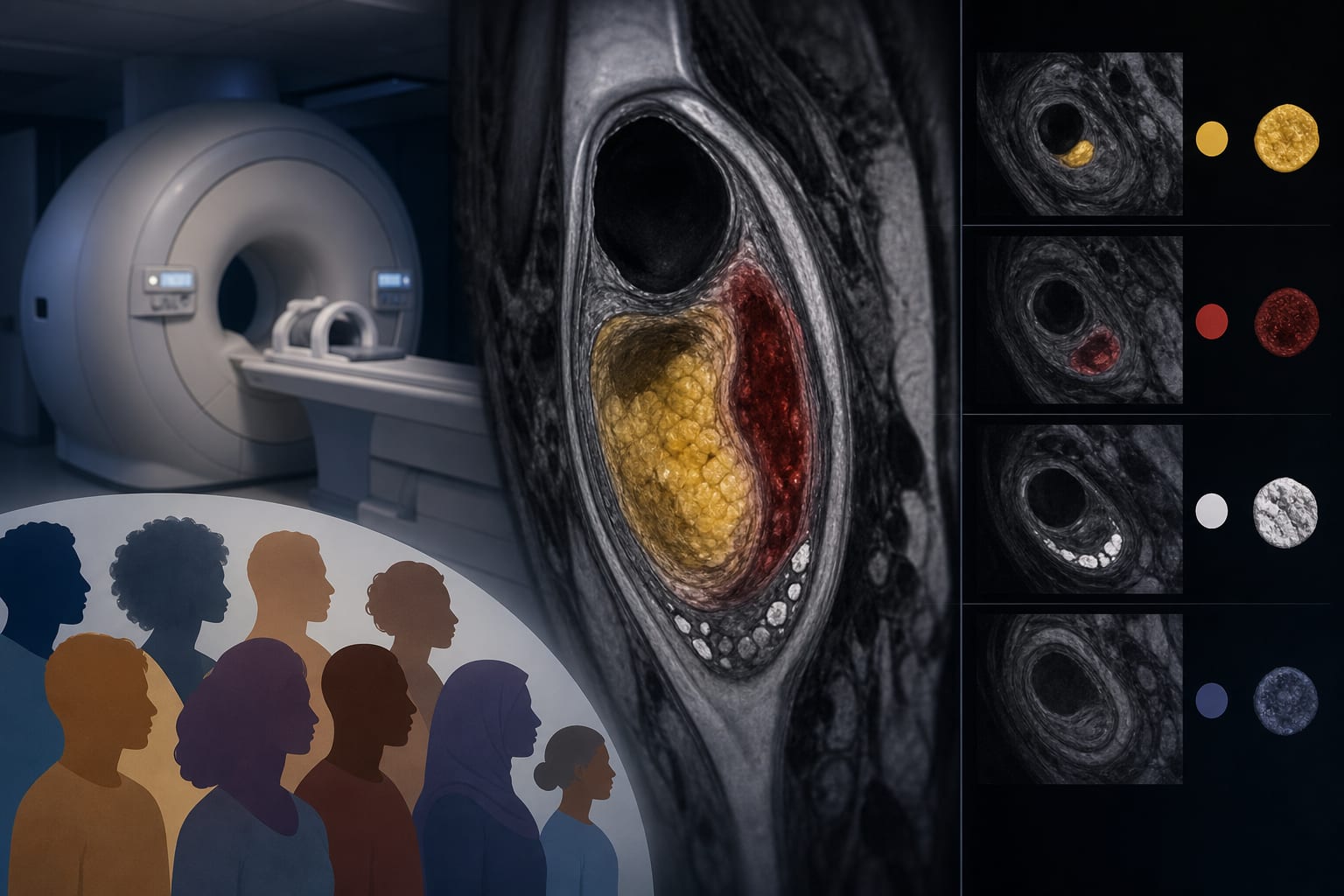
To identify associations between specific cardiovascular risk factors, including BMI and blood pressure, and the presence of calcification, lipid-rich necrotic core (LRNC), and intraplaque hemorrhage (IPH) in midlife participants.
Approach:
Study Design: A multi-ethnic, population-based cohort study embedded in the HELIUS study, including 356 participants with cardiovascular risk factors assessed 8.4 years prior to MRI.
MRI Protocol: Carotid MRI was performed using a 3 Tesla Philips Ingenia scanner with specific sequences to visualize carotid arteries and assess plaque characteristics.
Image Analysis: Image analysis was conducted by two blinded readers, with discrepancies resolved by a third reader. Reliability measures were calculated for plaque characteristics.
Risk Factor Assessment: Cardiovascular risk factors were assessed through fasting plasma samples and clinical measurements, including BMI and blood pressure.
Key Findings:
The study included a diverse cohort with participants from Dutch, Moroccan, and South-Asian Surinamese backgrounds.
MRI findings were analyzed for plaque characteristics, including calcification, LRNC, and IPH.
Reliability measures for plaque presence and characteristics showed a Cohen’s Kappa of 0.96 for plaque presence, 0.93 for calcification, and 0.89 for LRNC.
Interpretation:
The study aims to enhance understanding of the associations between cardiovascular risk factors and plaque composition in a midlife, multi-ethnic population.
Limitations:
The study's findings may not be generalizable beyond the specific ethnic groups included.
The reliance on MRI and specific imaging protocols may limit the applicability of results to other imaging techniques.
Potential biases in participant selection may affect the generalizability of the findings.
Conclusion:
This study provides insights into the relationship between cardiovascular risk factors and carotid plaque composition in a diverse midlife population.
by Esther M. C. Vriend, Thomas A. Bouwmeester, Daniel Bos, Didier Collard, Eric P. Moll van Charante, Henrike Galenkamp, Renske Merton, Aart J. Nederveen, Pim van Ooij, Oscar H. Franco, Bert-Jan H. van den Born