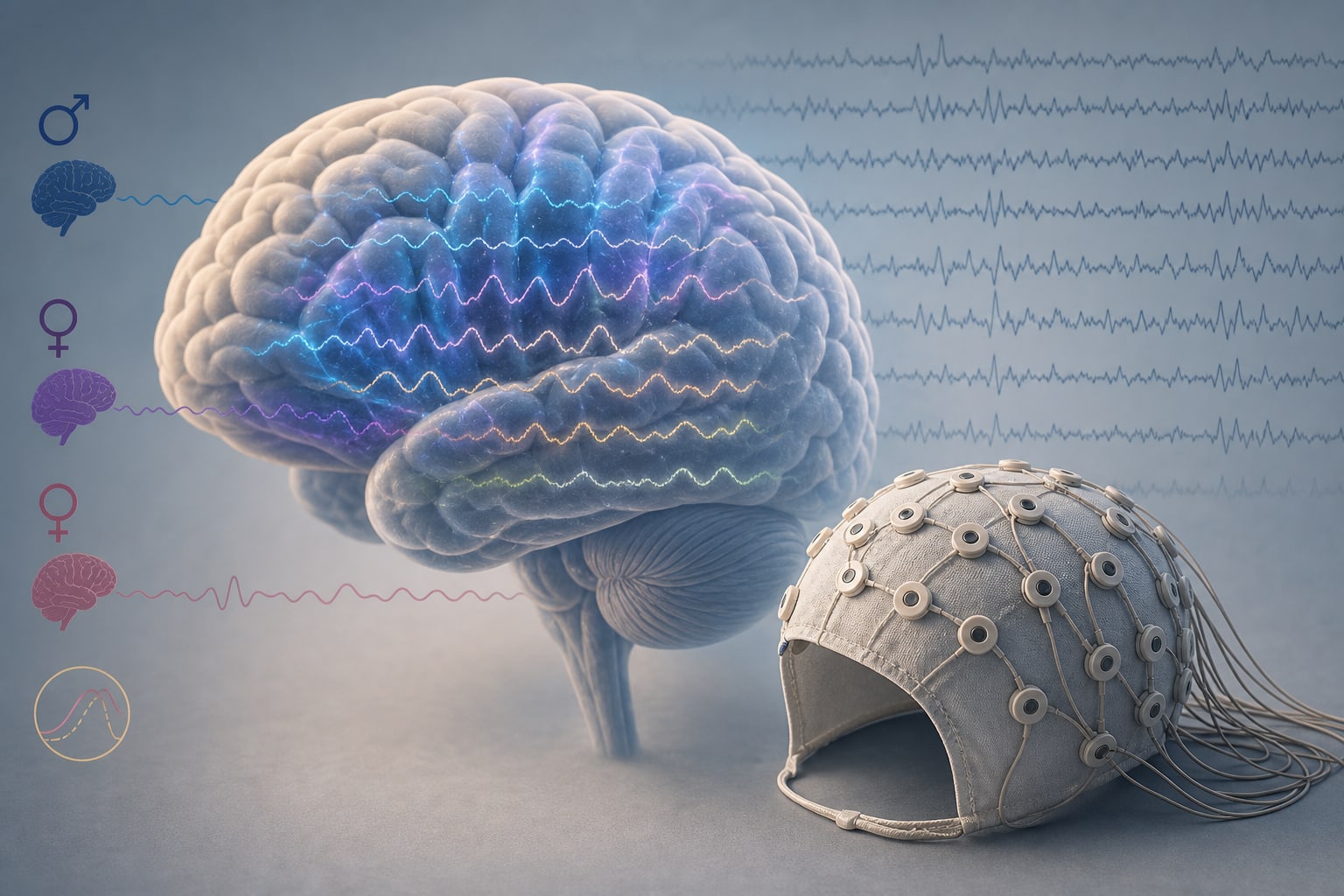
To examine associations between sex hormone concentrations and resting-state EEG spectral power in healthy young adults, focusing on differences between sexes and across menstrual cycle phases.
Approach:
Participants: 57 healthy adults (26 men, 31 women) were studied, with women assessed during menstrual and pre-ovulatory phases.
Methods: EEG spectral power was analyzed across seven frequency bands: delta, theta, alpha, beta, and gamma, using a non-parametric cluster-based permutation framework.
Key Findings:
Sex differences in spectral power were more prominent than differences between menstrual cycle phases.
No significant differences were observed between the two female groups.
Widespread sex differences were found in high-frequency bands, especially in frontal and central-left regions.
No hormone-EEG associations in males survived FDR correction.
In females, estradiol was associated with posterior high gamma power, and progesterone with theta and high beta power.
Interpretation:
Sex hormones influence resting-state EEG oscillations through long-term organizational effects and acute receptor-mediated modulation.
Limitations:
The sample size was relatively small, which may limit the generalizability of the findings.
The study focused only on healthy young adults, which may not represent other populations.
Conclusion:
The findings highlight the importance of considering both sex and hormonal status in electrophysiological research.
by Angelika K. Sawicka, Aleksandra M. Zieminska, Natalia Zalewska, Adrianna Czerwińska, Katarzyna M. Michalak, Barbara Naparło, Nastaran Hamedi, Jesús S. García-Salinas, Anna B. Marcinkowska, Michal T. Kucewicz, Paweł J. Winklewski