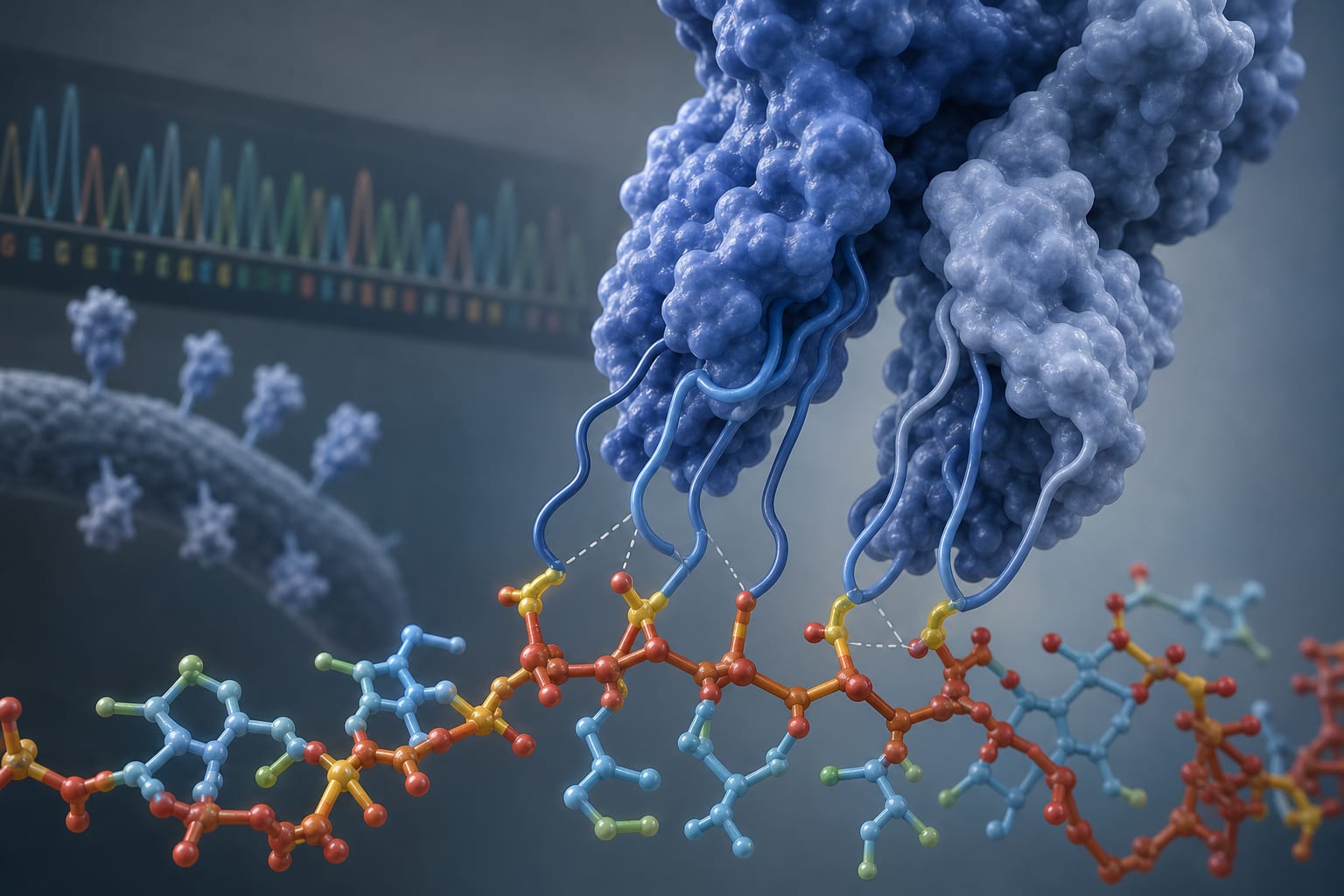
To determine whether selection against phosphorothioate-modified antisense oligonucleotides (PS-ASOs) induces reproducible repertoire remodeling and the emergence of shared CDR3 physicochemical signatures associated with PS-ASO recognition.
Key Findings:
Marked reduction in repertoire diversity from Round 1 to Round 2, indicating clonal dominance.
Identification of a shared enriched set of 113 CDR3-VH clonotypes with a defined physicochemical profile.
Increased positive charge, recurrent aromatic residue patterns, constrained CDR3-VH length distribution, higher theoretical pI, and reduced hydrophobicity were observed.
The scFv clone 12F2 showed preferential binding to PS-ASOs and produced a detectable intracellular signal after PS-ASO transfection.
Interpretation:
Remove or rephrase to eliminate unsupported conclusions.
Limitations:
The study primarily focuses on early selection stages and may not capture later evolutionary dynamics.
The findings are based on specific PS-ASO targets and may not generalize to all modified oligonucleotides.
Conclusion:
Revise to reflect only findings from the source without unsupported claims.
by Riccardo Galasso, Francesco Coppolino, Alessia Berbiglia, Grete Francesca Privitera, Agata Famà, Giuseppe Valerio De Gaetano, Germana Lentini, Concetta Beninati