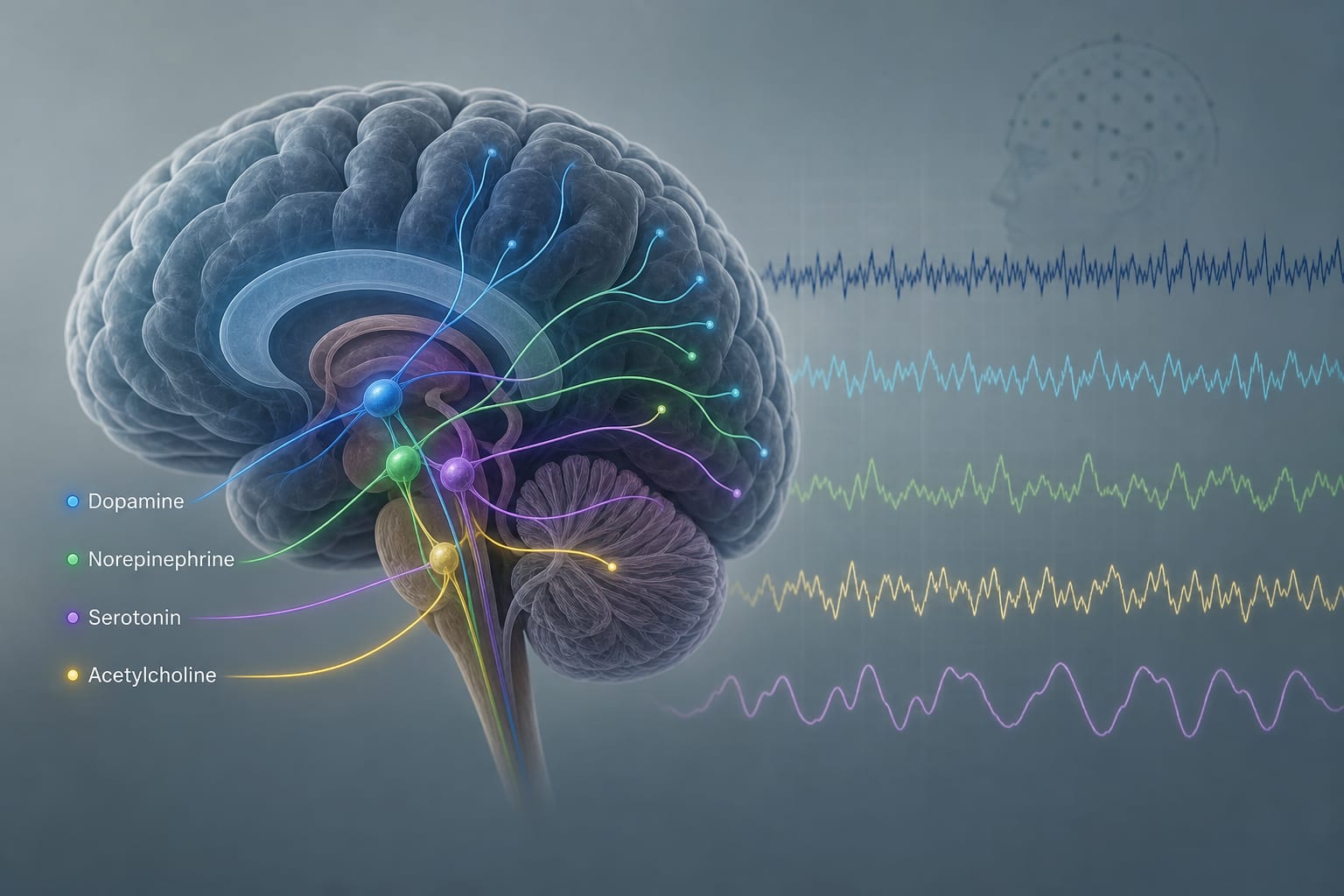
To determine if modeling EEG spectral power changes according to distinct neurotransmitter systems enhances understanding of psychotropic drug effects.
Approach:
Key Findings:
Dopamine antagonists associated with higher delta and theta power at central locations and lower alpha power at occipital and temporal locations.
Dopamine agonists linked to higher delta activity at occipital locations and increased frontal gamma power.
Serotonin antagonists showed elevated slow-wave and alpha power; agonists linked to increased frontal alpha and decreased occipital alpha.
Norepinephrine antagonists and agonists positively related to delta power, with antagonists showing a broader topographical pattern.
Histamine antagonists and mixed agents associated with lower delta, theta, and alpha power.
Acetylcholine antagonists linked to higher delta, theta, and alpha power across locations.
Interpretation:
Modeling psychotropic medication effects on EEG at the neurotransmitter receptor level enhances mechanistic interpretability.
Limitations:
Study relies on a large but heterogeneous dataset, which may introduce variability in results.
Potential confounding factors were not accounted for in the analysis.
Conclusion:
The neurotransmitter-centric framework improves upon traditional drug class-based approaches.
April Jasper, OD, FAAO, and Dori Carlson, OD, MAL, FAAO, sat down for a conversation on how ODs can recognize burnout in themselves and ways they can find their way back to well-being.