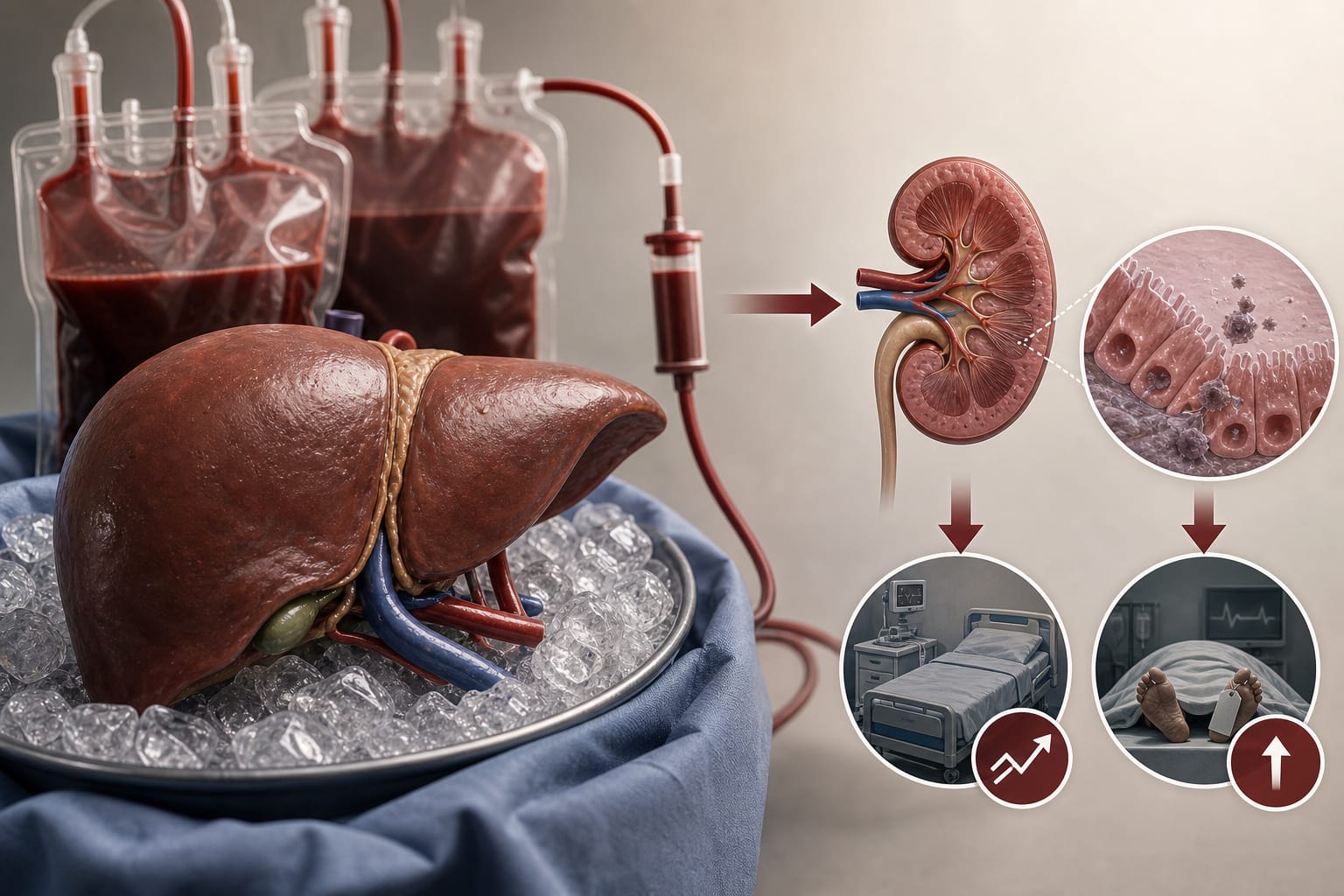
Intraoperative allogeneic blood transfusion is not associated with postoperative acute kidney injury and in-hospital mortality in liver transplantation patients: a propensity score matching analysis - Summary - MDSpire
Advertisement
Intraoperative allogeneic blood transfusion is not associated with postoperative acute kidney injury and in-hospital mortality in liver transplantation patients: a propensity score matching analysis
To identify independent risk factors for intraoperative blood transfusion in liver transplant patients and to explore the effect of intraoperative blood transfusion on postoperative acute kidney injury (AKI) and in-hospital mortality.
Approach:
Key Findings:
Independent risk factors for intraoperative blood transfusion included sex, weight, liver cancer, alcoholic hepatitis, Child-Pugh classification, anhepatic phase, and intraoperative bleeding.
In the unmatched cohort, intraoperative blood transfusion was associated with increased risk of postoperative AKI (OR 2.993, 95% CI 2.061–4.347) and in-hospital mortality (OR 2.692, 95% CI 1.313–5.522).
In the matched cohort, intraoperative blood transfusion was associated with increased risk of postoperative AKI (OR 1.861, 95% CI 1.053–3.290) but not with in-hospital mortality (OR 1.000, 95% CI 0.281–3.562).
After multivariable regression in the matched cohort, intraoperative blood transfusion was no longer an independent risk factor for postoperative AKI and hospital mortality.
Interpretation:
Intraoperative allogeneic blood transfusion does not influence postoperative acute kidney injury and in-hospital mortality in liver transplantation patients based on the study findings.
Limitations:
The study is retrospective and may have confounding variables that could affect the results.
Findings need validation through multicenter, prospective studies.
Conclusion:
The majority of patients received no more than 8 units of blood, suggesting that intraoperative blood transfusion may not significantly impact postoperative outcomes.
In a small open-label randomized trial, 2 platelet-rich plasma injections were associated with greater 6-month improvements in pain and function than corticosteroid injection or oral aceclofenac among patients awaiting knee arthroplasty.