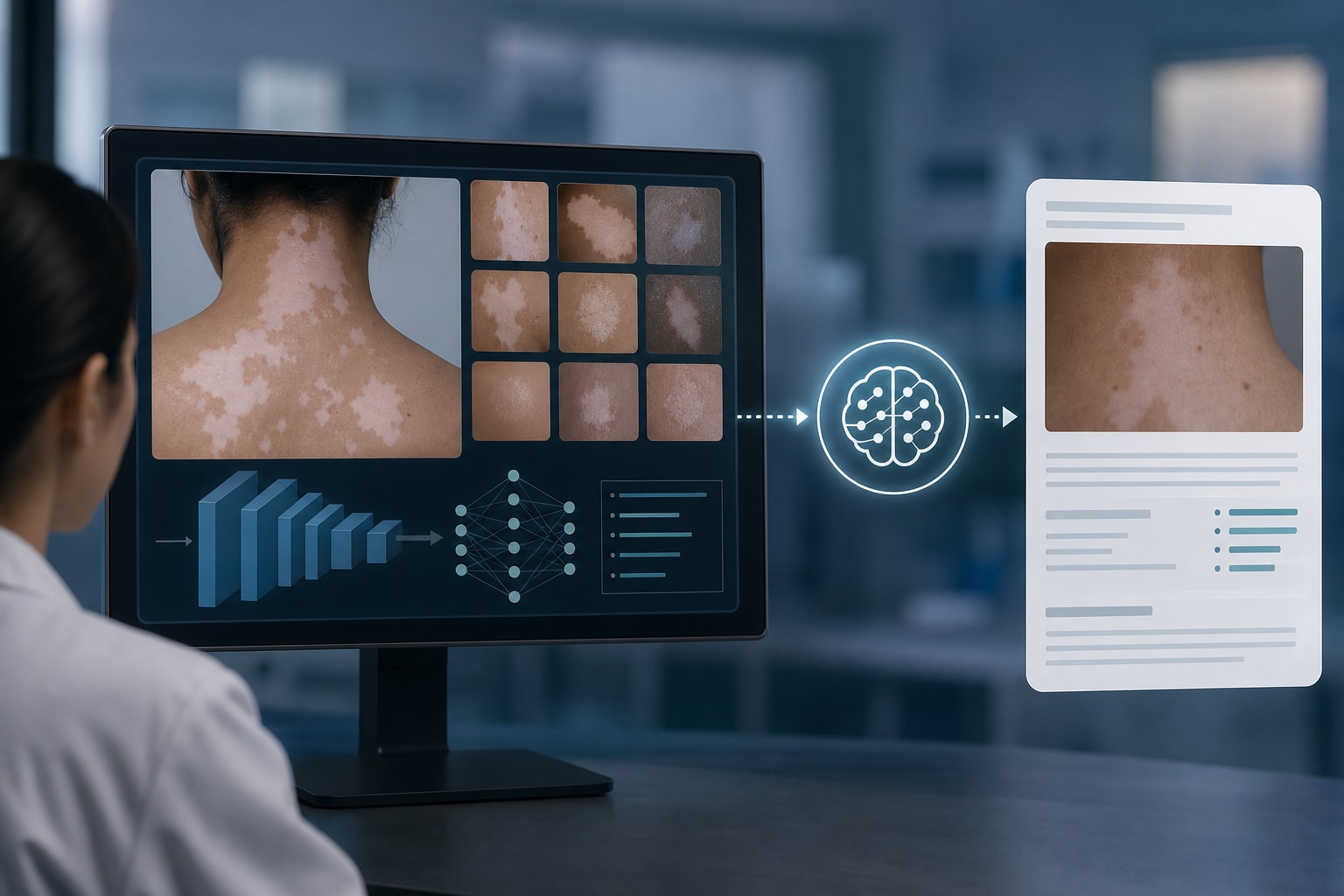
A two-stage workflow for vitiligo diagnosis: clinical characteristic classification and large language model (LLM)–based report generation - Summary - MDSpire

A two-stage workflow for vitiligo diagnosis: clinical characteristic classification and large language model (LLM)–based report generation

  • By

  • Kaiqiao He

  • Tianle Xu

  • Yining Feng

  • Yafei Lu

  • Xinju Wang

  • Linhan Jiang

  • Sen Guo

  • Yuanmin He

  • Wei Dai

  • Wei Zhang

  • Jianglin Zhang

  • Hongbing Lu

  • Dong Huang

  • Shuli Li

  • June 1, 2026

  • 0 min

Share

Objective:

To develop and validate an AI-assisted diagnostic system that integrates a large language model (LLM) for differentiating vitiligo from ten other hypopigmentary disorders, while providing interpretable characteristics and structured clinical reports.

Key Findings:
  • The model achieved an AUC of 0.9906 for distinguishing vitiligo, with sensitivity of 98.29% and specificity of 93.73%.
  • The model demonstrated 88.12% accuracy in identifying typical location and 86.78% in recognizing edge morphology.
  • In comparative tests, the AI model significantly outperformed dermatologists in diagnostic sensitivity.
Interpretation:

The AI system provides clinically interpretable results and generates structured reports, enhancing diagnostic transparency and supporting clinical decision-making.

Limitations:
  • The study may have limitations related to the retrospective design and the specific geographic regions involved.
Conclusion:

This study presents a clinically interpretable AI system for accurately discriminating vitiligo from similar disorders, potentially assisting in resource-limited settings.

Original Source(s)

Related Content