Harmonization of social and physical health measures across prospective clinical studies of combat exposed service members and veterans: the total brain diagnostics program - Summary - MDSpire
Advertisement
Harmonization of social and physical health measures across prospective clinical studies of combat exposed service members and veterans: the total brain diagnostics program
To address the research gap in comprehensive longitudinal data on psychosocial and functional changes in veterans and active-duty service members with Traumatic Brain Injury (TBI), highlighting the need for improved understanding of these changes.
Approach:
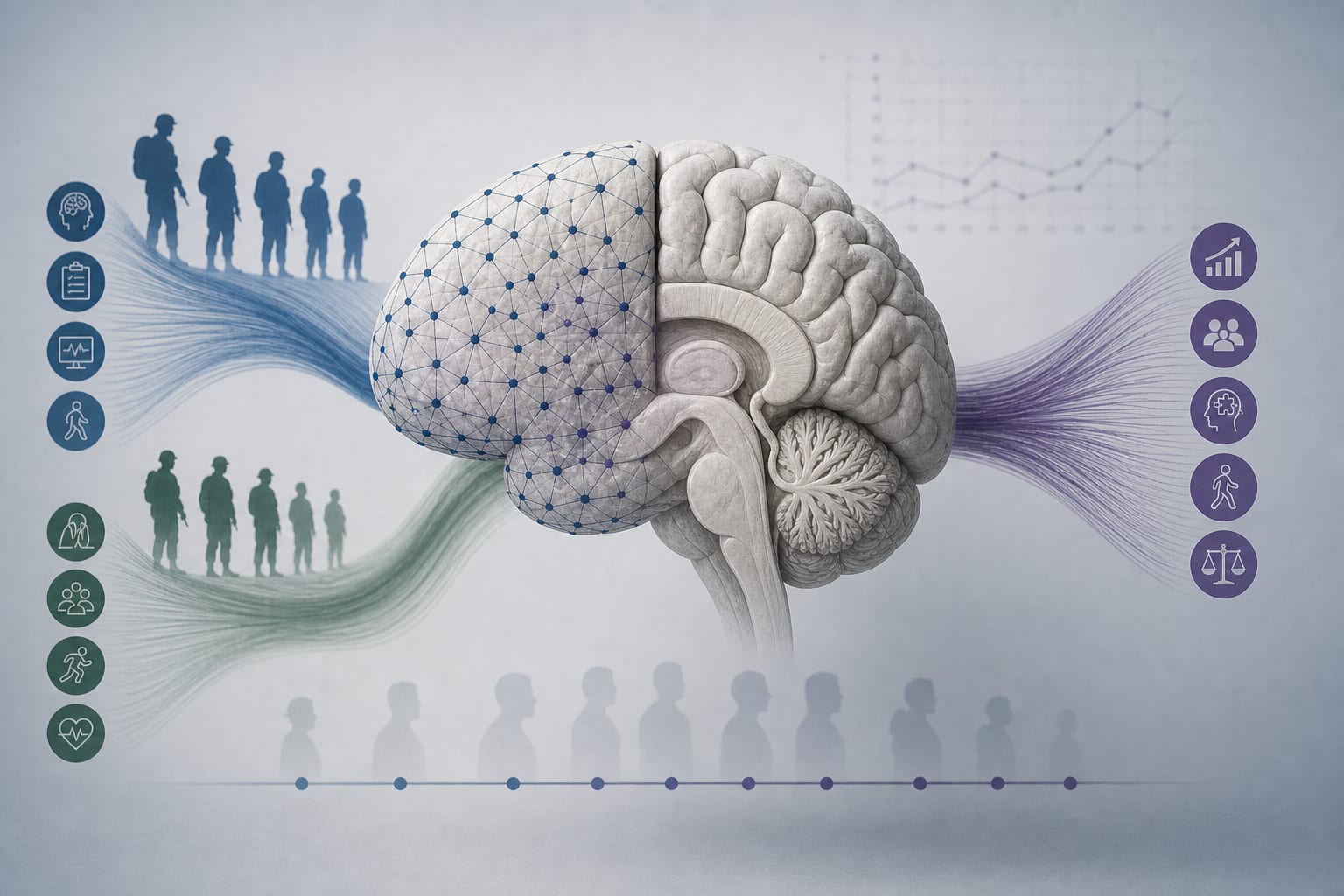
Data Sources: Utilized data from the Long-term Impact of Military-relevant Brain Injury Consortium (LIMBIC) and the Translational Research Center for TBI and Stress Disorders (TRACTS), which provide extensive datasets on veterans and service members.
Harmonization Methods: Formed a multidisciplinary team to create a comprehensive list of measures, organized them into clinically meaningful domains, and harmonized data through both direct methods (full measures) and indirect methods (recoding and aligning categorical levels).
Statistical Analysis: Calculated descriptive statistics to summarize data and conducted Principal Component Analysis (PCA) to assess shared variance and suitability for pooled analysis.
Key Findings:
73 variables related to psychosocial function, sensorimotor, pain, and clinical health factors were harmonized.
No differences in sex or ethnicity distributions between the LIMBIC and TRACTS studies.
Pain intensity and headache disability were higher in the LIMBIC cohort.
PCA analysis indicated data suitability for pooled analysis.
Interpretation:
The harmonization of baseline psychosocial and physical health data facilitates the detection of clinical phenotypes.
Limitations:
The initial effort focused only on baseline data.
Potential site-level effects may influence shared variance.
Conclusion:
The principles established for harmonization can be applied to longitudinal data to improve understanding of TBI impacts on veterans and service members.
by Shannon M. Nugent, Kate Clauss, Sara Vlajic, Maya E. O’Neil, Samuel R. Walton, Kelly M. Reavis, Christine Clermont, Alyssa Currao, Cree Foeller, Catherine B. Fortier, Sreekanth Kamineni, Arielle R. Knight, Aubrey A. Knoff, Landon B. Lempke, Helal Mobasher, William C. Walker, William P. Milberg, David X. Cifu