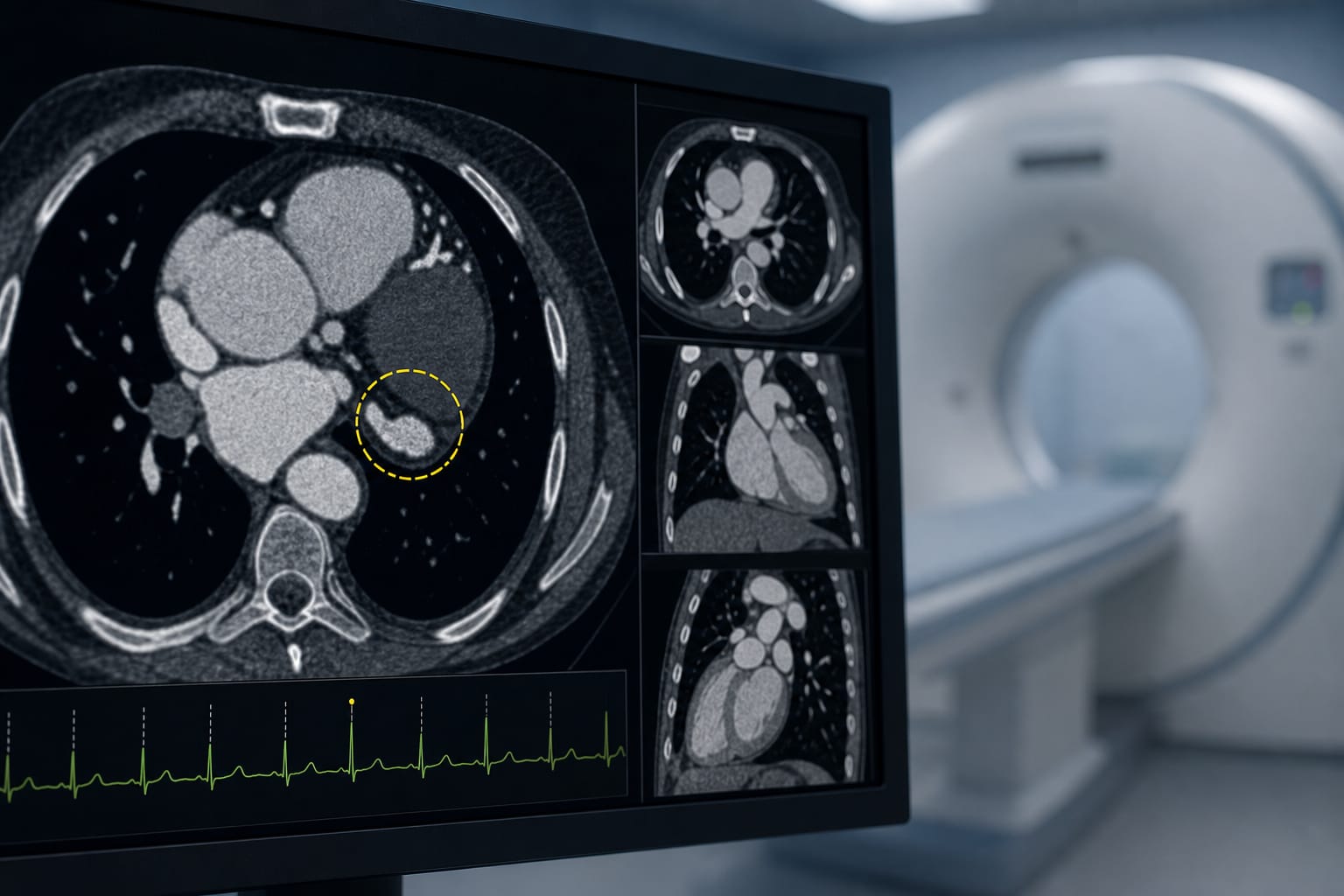
To determine the diagnostic yield of hyperacute ECG-gated cardiac CT compared to transthoracic echocardiogram (TTE) in detecting intra-cardiac thrombus in patients with ischemic stroke.
Approach:
Study Design: A prospective observational analysis of patients undergoing ECG-gated cardiac CT as part of hyperacute stroke imaging at a stroke center in Sydney, Australia.
Patient Selection: Included patients over 18 years with a confirmed diagnosis of ischemic stroke who underwent cardiac CT between November 2022 and December 2024.
Imaging Protocol: Utilized a 256-slice CT scanner for imaging acquisition as part of the hyperacute stroke assessment.
Key Findings:
Intra-cardiac thrombus was identified in 26% of ischemic stroke patients via cardiac CT.
Cardiac CT had a higher detection rate of intra-cardiac thrombus compared to TTE (29% vs. 2%; p < 0.001).
Patients with intra-cardiac thrombus had a higher prevalence of premorbid hypertension (94% vs. 67%; p = 0.03), heart failure (33% vs. 2%; p < 0.001), atrial fibrillation (56% vs. 24%; p = 0.01), and intracranial arterial occlusion (83% vs. 49%; p = 0.01).
Poor functional outcomes at 3 months were more common in patients with intra-cardiac thrombus (67% vs. 28%; p = 0.03).
Interpretation:
The study suggests that ECG-gated cardiac CT is more effective than TTE in detecting intra-cardiac thrombus in hyperacute ischemic stroke patients.
Limitations:
The analysis on functional outcomes is hypothesis generating and limited by a small sample size; further investigation is needed with a larger cohort and multivariable adjustment.
Conclusion:
Cardiac CT should be evaluated in hyperacute stroke imaging protocols due to its higher diagnostic yield for intra-cardiac thrombus.
by Daniel S. Green, Timmy Pham, Dennis J. Cordato, Longting Lin, Daniel Akrawi, Callan Gavaghan, Chilan Nguyen, Aaron Gaekwad, Alan McDougall, Carlos Garcia-Esperon, Anthony Kaplan, Christopher Blair, Melissa Leung, Mark W. Parsons