Pathological diagnosis of thyroid nodules directly from ultrasonography by a weakly supervised deep learning framework - Summary - MDSpire

Pathological diagnosis of thyroid nodules directly from ultrasonography by a weakly supervised deep learning framework

  • By

  • Xiao-Wen Hou

  • Mei-Ling He

  • Meng-Yue Ye

  • Jian-Xin Ji

  • Liu-Ying Wang

  • Wei Zhang

  • Yue Zhao

  • Zhen-Zhao Sun

  • Hui-Ru Jiang

  • Ping Li

  • Ji-Hong Wang

  • Fan-Chao Shi

  • Shu-Xin Sun

  • Lei Cao

  • June 1, 2026

  • 0 min

Share

Objective:

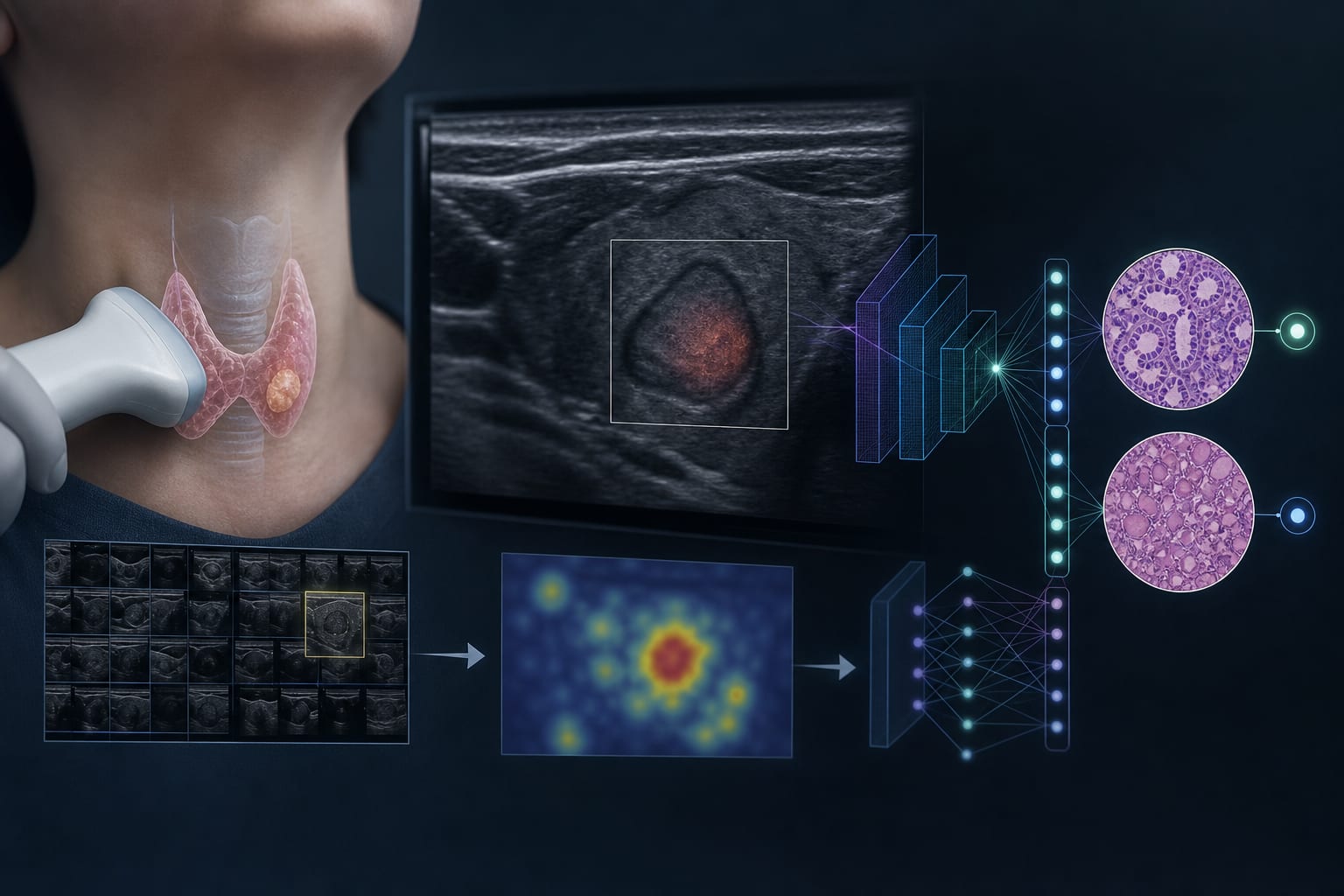
To develop a dual attention-guided deep learning framework for inferring histological status directly from thyroid ultrasonography without expensive image-level annotations.

Key Findings:
  • ThyUS2Path achieved AUCs of 0.754 ± 0.035 and 0.735 ± 0.029 in cross-validation.
  • The algorithm outperformed Maxpool and Meanpool methods significantly.
  • Good prediction performance was observed in the external test set with AUROCs of 0.70~0.80 and AUPRCs of 0.78~0.83.
Interpretation:

The approach provides a feasible method to link ultrasound phenotypes with histological reports, potentially enhancing non-invasive thyroid cancer diagnosis.

Limitations:
  • The study is retrospective and may be limited by the datasets used.
  • The performance may vary with different populations or imaging conditions.
Conclusion:

ThyUS2Path demonstrates potential in augmenting clinicians' capabilities in thyroid cancer diagnosis through non-invasive methods.

Original Source(s)

Related Content