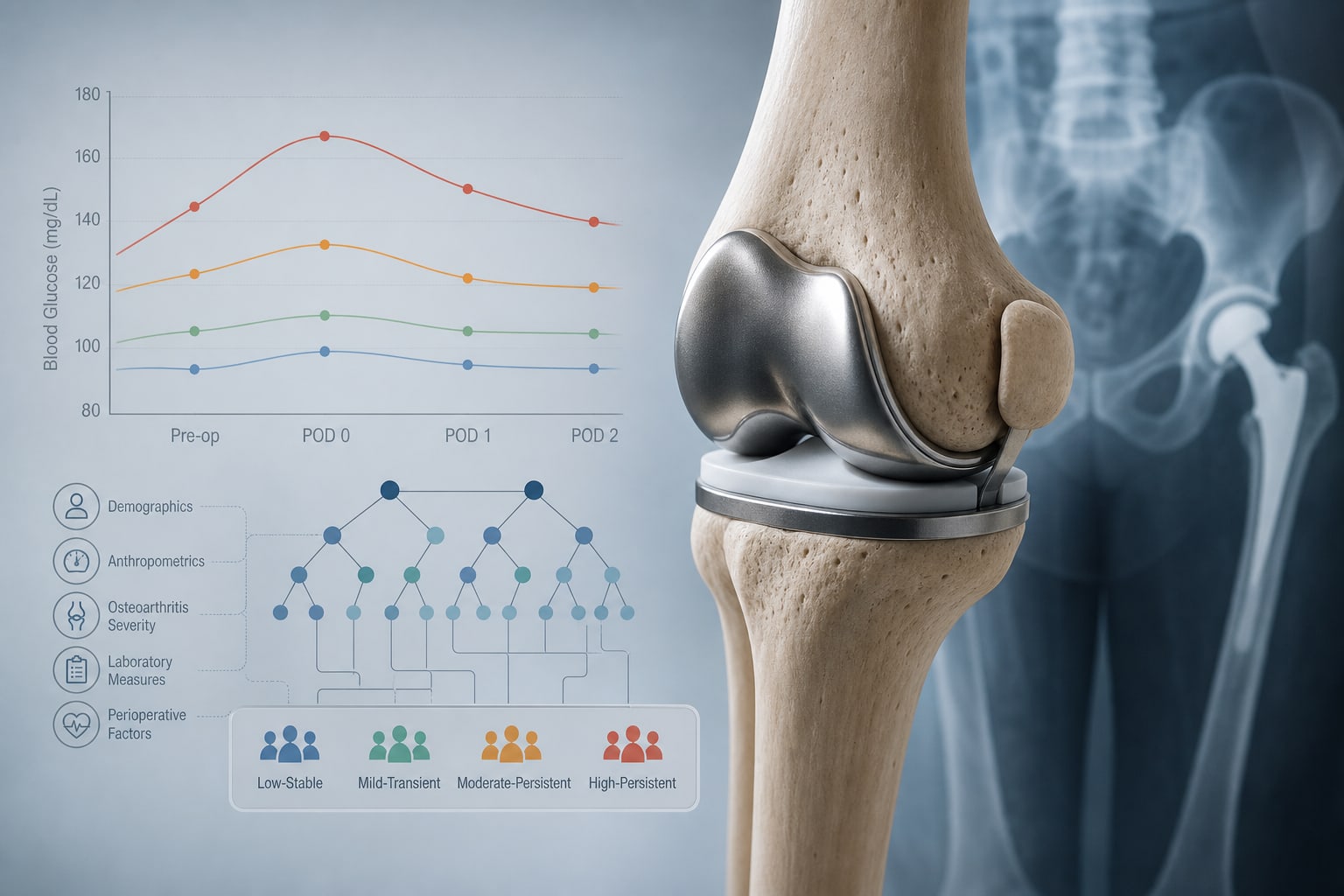
To classify the blood glucose trajectories using group-based trajectory models (GBTM) and construct a random forest model to identify predictive factors to forecast different blood glucose trajectories in non-diabetic patients with total joint arthroplasty (TJA).
Approach:
Study Design: A prospective observational study conducted from September 2022 to May 2024 at West China Hospital, Sichuan University.
Participants: Non-diabetic patients aged 18 to 80 years undergoing unilateral elective primary TJA for end-stage osteoarthritis.
Data Collection: Blood glucose levels were measured preoperatively and on postoperative days (PODs) 0 to 2, alongside socio-demographic and clinical data.
Analysis: GBTM was used to identify blood glucose trajectory subgroups, and a random forest model was constructed to analyze predictors.
Key Findings:
Three distinct blood glucose trajectory groups were identified: Group 1 (Normal, stable: 49.5%), Group 2 (Slightly increased with minor fluctuations: 41.7%), Group 3 (Hyperglycemia with significant fluctuations: 8.8%).
Predictors for blood glucose trajectories included age, RBC count one day post-surgery, hypertension, diclofenac use, intraoperative blood transfusion volume, and Huaxi Emotional-distress Index (HEI).
The random forest model achieved an overall accuracy rate of 78.3% with a Kappa coefficient of 0.600.
Interpretation:
The study classified blood glucose trajectories in TJA patients and identified predictive factors, but the model has limited ability to identify patients with hyperglycemic trajectories.
Limitations:
The classification threshold of the random forest model limits its ability to accurately identify hyperglycemic patients.
Conclusion:
The study provides insights into blood glucose trajectories in TJA patients.
Acidic gum beat sugar-free at cranking out nitric oxide from beetroot juice — exactly backward from what test-tube studies predicted. Also this week: a sleep gene that ignores amyloid, and jackfruit sap moonlighting as a bone-building drug delivery system.