Comparative study of three treatment approaches on overall survival and treatment response in nasopharyngeal carcinoma patients: network meta-analysis of RCTs (4221 patients) - Summary - MDSpire
Advertisement
Comparative study of three treatment approaches on overall survival and treatment response in nasopharyngeal carcinoma patients: network meta-analysis of RCTs (4221 patients)
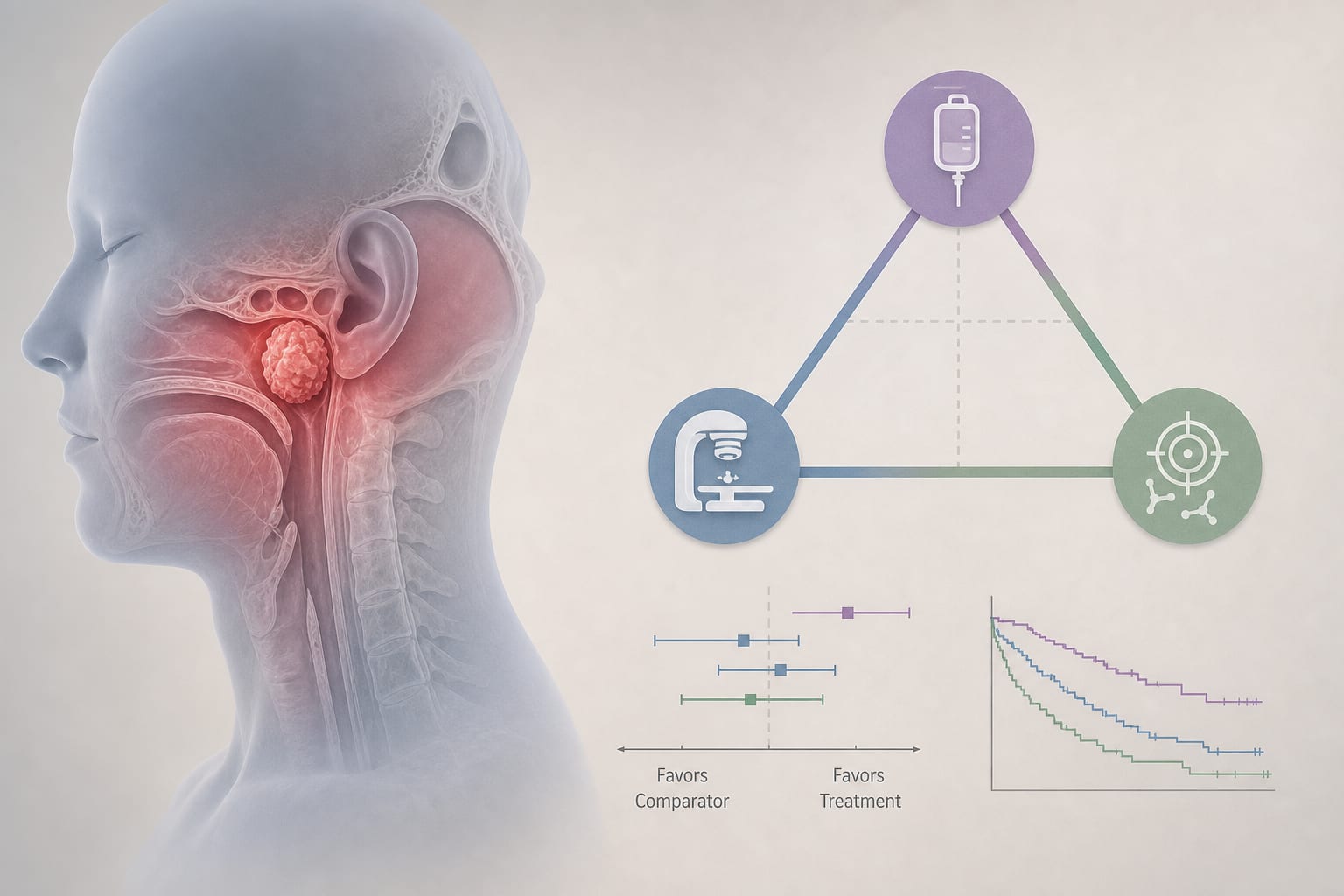
To systematically compare the relative efficacy of induction chemotherapy, targeted therapy, and radiotherapy on overall survival and treatment response in nasopharyngeal carcinoma (NPC) patients.
Approach:
Study Design: Systematic review and network meta-analysis of randomized controlled trials (RCTs) following PRISMA-NMA and Cochrane Manual guidelines.
Data Sources: Search conducted across six databases (PubMed, Embase, Web of Science, Cochrane Library, EBSCO, and CNKI) for RCTs published from January 1998 to June 2025.
Analysis Methods: Traditional meta-analysis and heterogeneity assessment using RevMan 5.3; network meta-analysis using STATA 17.0.
Key Findings:
Induction chemotherapy (IC) showed a statistically significant survival benefit compared to the control group (HR = 0.37, 95% CI: 0.02, 0.71).
Targeted therapy (TD) ranked first in the probability of being the best treatment for overall survival (SUCRA = 98.1%).
No statistically significant differences were observed among interventions for progression-free survival (PFS) or objective response rate (ORR).
TD demonstrated the greatest advantage in cumulative recurrence risk reduction (SUCRA = 98.0%, OR = 0.26, 95% CI: 0.12, 0.58).
Interpretation:
Induction chemotherapy offers the greatest advantage in improving overall survival for NPC patients, while targeted drugs are most effective in reducing recurrence risk.
Limitations:
The study only included RCTs published up to June 2025, which may limit the generalizability of findings.
No statistically significant benefits were observed for PFS or ORR among the interventions.
Conclusion:
This study provides evidence-based support for individualized treatment decisions in nasopharyngeal carcinoma.
Dr. Alicia Morgans of Dana-Farber Cancer Institute reported at #ASCO26 that ARACOG found darolutamide was associated with less decline in cognitive testing than enzalutamide, which may help guide treatment choice.