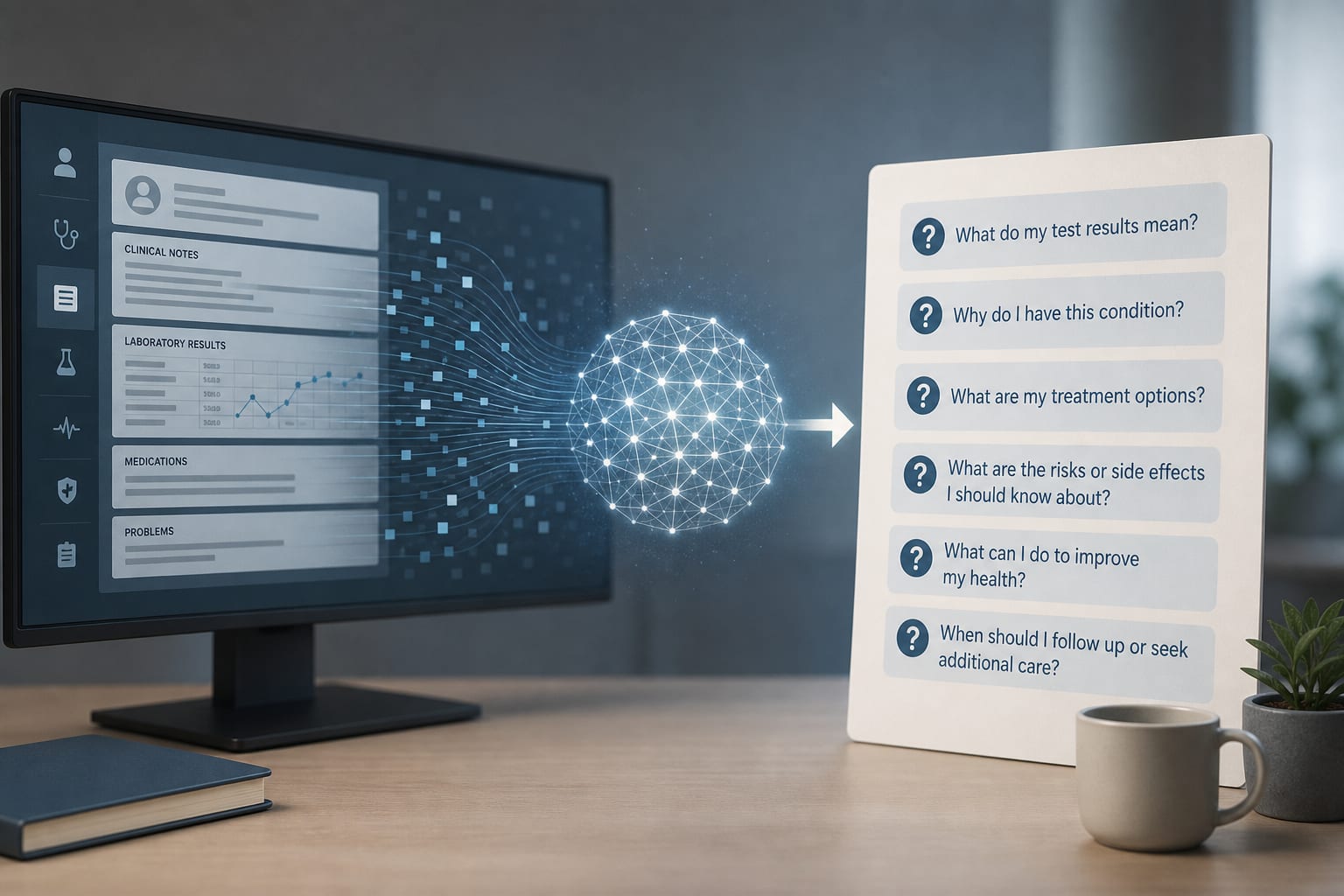
To explore the use of large language models (LLMs) in generating patient-friendly question prompt lists (QPLs) from electronic health record (EHR) data.
Approach:
Introduction to EHR and Patient Portals: Examines the impact of the 21st Century Cures Act on patient access to EHR data and the challenges in interpreting laboratory results.
Question Prompt Lists (QPLs): Describes the advantages of QPLs in enhancing patient communication and decision-making, while addressing the limitations of traditional, static QPLs.
Role of Large Language Models: Discusses the potential of LLMs to improve patient education and communication, supported by evidence of their effectiveness in generating accurate responses.
Key Findings:
Patient portals have increased access to laboratory results but often lack contextual information for understanding.
LLMs can generate more accurate responses to laboratory result inquiries compared to peer responses.
Iterative prompt engineering can enhance the quality of LLM-generated messages in patient-clinician communication.
Interpretation:
The study suggests that LLMs have the potential to create tailored QPLs that reflect a patient's clinical context, enhancing the effectiveness of patient visits.
Limitations:
LLMs may produce superficial or incorrect answers to complex medical questions.
The effectiveness of LLM-generated QPLs in real clinical settings is yet to be fully evaluated.
Conclusion:
LLMs could significantly improve patient engagement and understanding during clinical visits by generating personalized inquiry prompts based on EHR data.