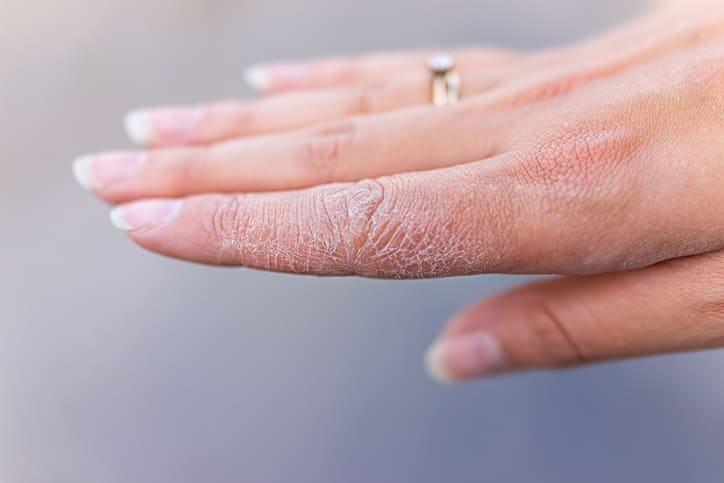
To assess associations between palmar skin characteristics, hand scaling, and in vitro activity against selected pathogens.
Approach:
Study design and participants: Cross-sectional study of 49 healthy adults aged 20–49 years, with hand assessments conducted after standardized handwashing and acclimation.
Measurements: Investigators measured palmar lactic acid, ceramides, amino acids, skin acidity, temperature, and sweat rate; assessed hand scaling; and tested skin-surface extracts against influenza A/H3N2, Escherichia coli, and Staphylococcus aureus.
Analysis: Associations were evaluated using Spearman and partial correlations, with adjustment for multiple comparisons.
Key Findings:
Higher palmar lactic acid was associated with lower hand-scaling scores (Spearman r = −0.63).
Greater in vitro pathogen-inactivation activity was associated with less scaling for influenza A (r = −0.57), S aureus (r = −0.49), and E coli (r = −0.41); associations remained significant after multiple-comparison correction.
Lactic acid remained associated with greater activity against all three pathogens in adjusted analyses. Its association with lower scaling remained significant in two models and showed a trend in a third.
Total ceramide and amino acid content were not significantly associated with scaling, although three ceramide classes (NS, ADS, and AS) showed inverse associations.
Lactic acid was positively associated with sweat rate. Skin pH was associated with antibacterial activity against E coli and S aureus, but not influenza A.
Interpretation:
The authors proposed that lactic acid may be a shared correlate of hand scaling and pathogen-inactivation activity. The analyses could not establish whether it mediated the relationship or whether changing lactic acid would affect skin condition or pathogen transmission.
Limitations:
The cross-sectional design does not establish causality, and the small sample may limit detection of weaker associations and generalizability.
Potential confounders included moisturizer use, environmental and occupational exposures, hand hygiene, dermatologic conditions, and skin microbiome composition.
Scaling was assessed by one assessor without formal intra-rater reliability testing.
Lactic acid measurements reflected water-extractable surface content, not secretion rates; antimicrobial activity was tested on extracts in vitro rather than on intact skin.
All authors were employed by Kao Corporation; the company provided salary support.
Conclusion:
The authors stated that potential implications for hand dryness and contact transmission merit further study.