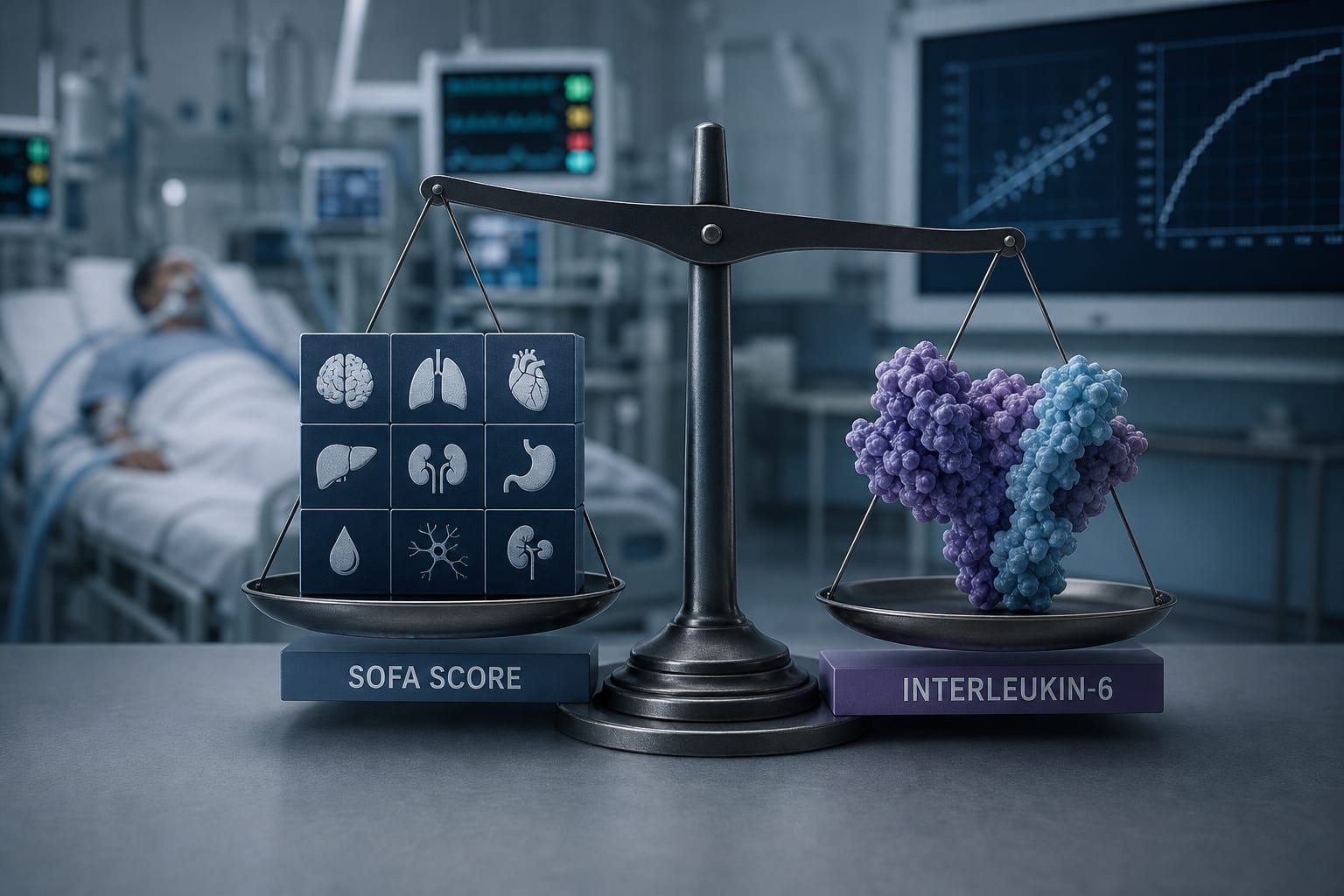
Comparison of SOFA score alone versus SOFA score with interleukin-6 for outcome prediction in ICU patients with sepsis: a prospective observational study - Summary - MDSpire
Advertisement
Comparison of SOFA score alone versus SOFA score with interleukin-6 for outcome prediction in ICU patients with sepsis: a prospective observational study
To compare the SOFA score with the SOFA score and interleukin-6 level in predicting outcomes in ICU patients with sepsis.
Approach:
Study Design: Prospective observational study conducted in a tertiary care ICU involving 40 adult patients with sepsis.
Inclusion Criteria: Adult patients aged 18-50 years with sepsis (Sepsis-3 criteria) and anticipated ICU stay of >72 hours.
Exclusion Criteria: Patients with acute coronary syndrome, terminal malignancy, major burns, elective postoperative ventilation, COVID-19, or inter-ICU transfer.
Measurements: SOFA scores and serum IL-6 levels were measured at admission and at 24-hour intervals up to 72 hours.
Follow-Up: Patients were followed for 15 days and classified as survivors or non-survivors.
Analysis: Prognostic performance assessed using ROC analysis and bootstrap resampling for internal validation.
Key Findings:
60% of patients survived, while 40% died within 15 days.
Non-survivors had significantly higher SOFA scores at admission compared to survivors (median 13 vs. 10, p = 0.006).
IL-6 levels were consistently higher in non-survivors across Days 0-3 (p < 0.05).
The combined SOFA-IL-6 score showed modest improvements in prognostic performance on Days 0-2 compared to SOFA alone (AUC improvements of +0.024 to +0.048).
Interpretation:
On Day 3, both the combined SOFA-IL-6 score and SOFA alone performed equivalently in predicting outcomes, as indicated by statistical analysis.
Limitations:
Small sample size of 40 patients.
Single-center study may limit generalizability.
Conclusion:
Combining the SOFA score with IL-6 showed modest improvements in early prognostication for critically ill patients with sepsis, particularly on Days 0-2.
A large Epic Cosmos analysis linked vaginal estrogen prescribing with lower rates of sepsis, hospital admission, and death following recurrent urinary tract infection, but researchers cautioned that prescribing may also mark broader differences in care.