Comparison between germline and somatic loss-of-function RNF43 mutations reveals different genotype-phenotype associations and provides insights into the genetic mechanisms of colorectal tumourigenesis - Summary - MDSpire

Comparison between germline and somatic loss-of-function RNF43 mutations reveals different genotype-phenotype associations and provides insights into the genetic mechanisms of colorectal tumourigenesis

  • By

  • Claire Palles

  • Luke Freeman-Mills

  • Edward Arbe-Barnes

  • Nathalie Feeley

  • Laura Chegwidden

  • Helen Curley

  • Sara Galavotti

  • Connor Woolley

  • Jeremy Cheadle

  • Dmitri Mouradov

  • Oliver Sieber

  • Silvia Salatino

  • Steve Thorn

  • Anshita Goel

  • Juan Fernandez-Tajes

  • Sulochana Omwenga

  • Sujata Biswas

  • Timothy Maughan

  • Simon J Leedham

  • S:CORT Consortium

  • UK Colorectal Cancer Genomics Consortium

  • CORGI Consortium

  • WGS500 Consortium

  • Viktor Hendrik Koelzer

  • Lai Mun Wang

  • Roland Arnold

  • James Edward East

  • Ian Tomlinson

  • July 1, 2026

  • 0 min

Share

Objective:

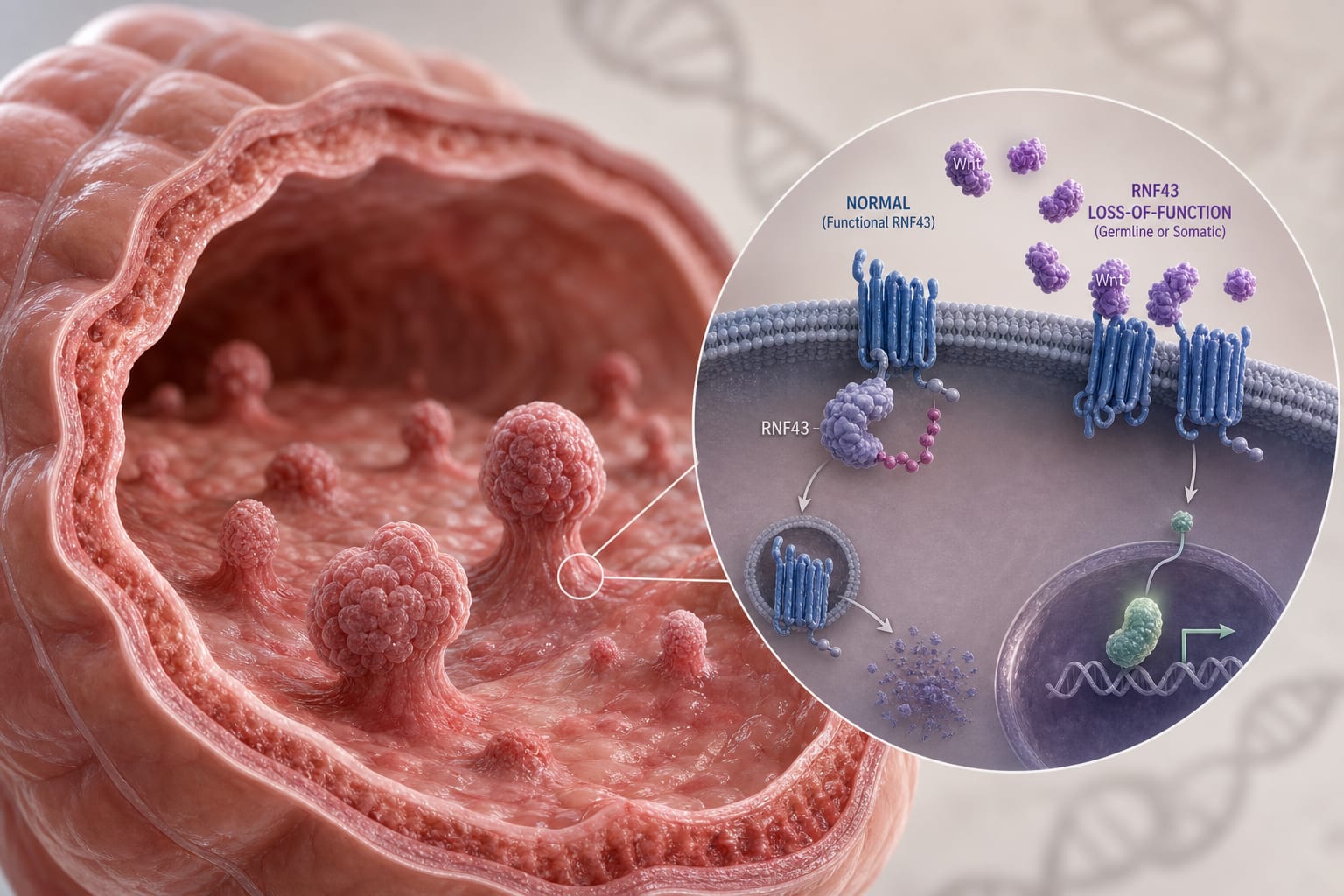
To investigate the specific genetic mechanisms of colorectal tumor development associated with germline and somatic RNF43 mutations.

Key Findings:
  • Germline RNF43 mutations can lead to colorectal cancer (CRC) but with variable phenotypes; some carriers develop CRC without multiple polyps, indicating a need for personalized risk assessment.
  • N-terminal germline mutations are associated with a six-fold increased CRC risk, while C-terminal mutations show weak or non-penetrance, highlighting the importance of mutation location in risk evaluation.
  • Somatic RNF43 mutations in microsatellite instability-positive (MSI+) sporadic CRCs act as classical tumor suppressor alleles, suggesting a complex interplay in tumorigenesis.
Interpretation:

Germline RNF43 mutations are likely more common than previously recognized, but their highly variable phenotypic expression complicates risk assessment and management in clinical settings.

Limitations:
  • The study's findings are based on a limited number of families and may not represent the broader population, potentially introducing selection bias.
  • The complexity of phenotypes associated with RNF43 mutations necessitates careful interpretation and further investigation.
Conclusion:

RNF43 should be considered a CRC predisposition gene for clinical testing, with attention to the genetic complexity involved, and further research is needed to clarify its role in CRC risk management.

Original Source(s)

Related Content