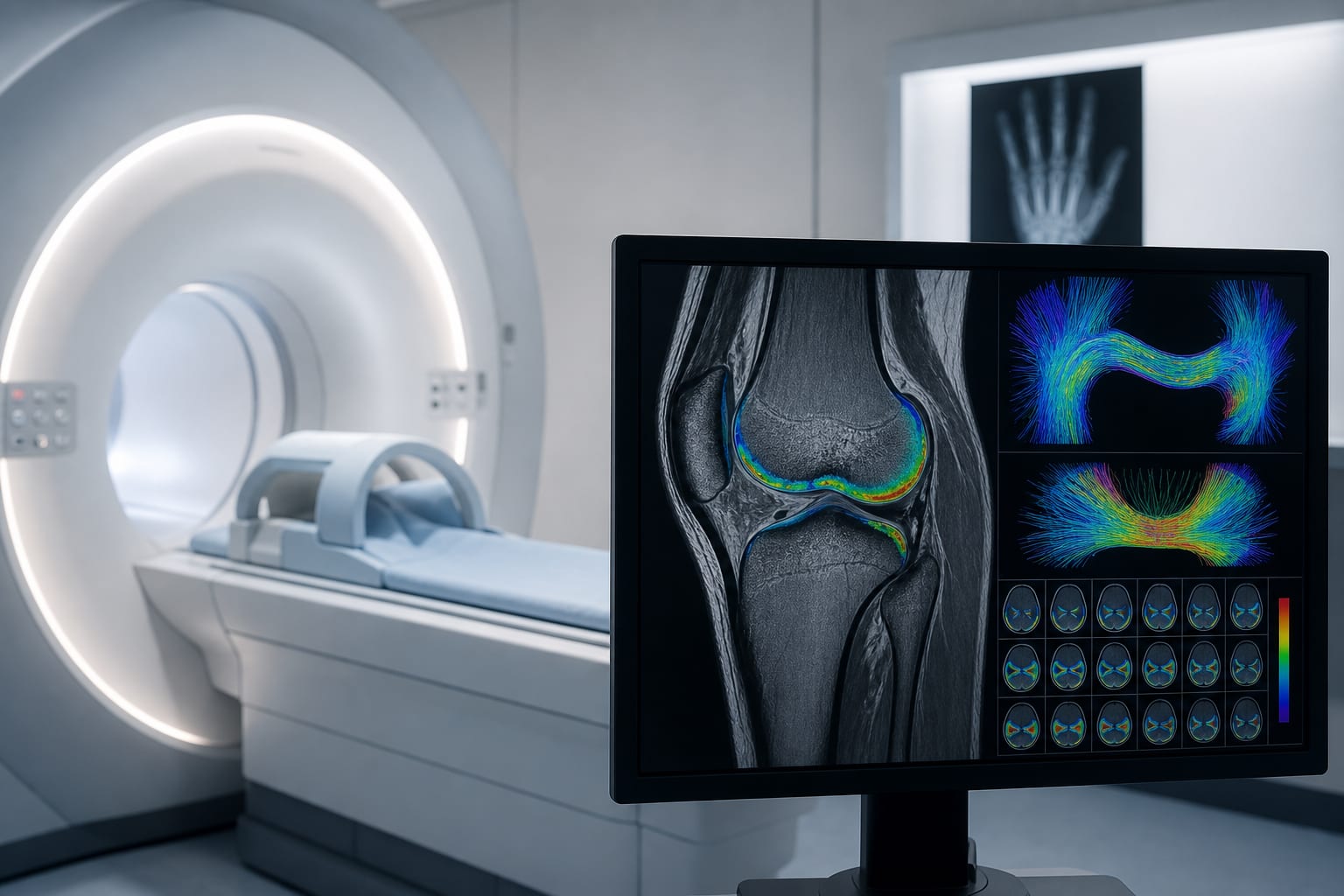
To establish normative diffusion tensor imaging (DTI) biomarkers of pediatric knee cartilage development trajectories and sex-specific differences.
Approach:
Participants: Eighty-four healthy children (43 boys and 41 girls; mean age 9.01 ± 1.84 years) underwent 3.0T MRI of the left knee, including DTI sequences.
Measurements: Fractional anisotropy (FA) and apparent diffusion coefficient (ADC) were measured in various cartilage regions. Bone age was assessed via left-hand radiography.
Statistical Analysis: Spearman correlation coefficients, intraclass correlation coefficients (ICCs), and t-tests were used for data analysis.
Key Findings:
FA values increased significantly with age and bone age (p < 0.001), with stronger correlations to bone age (boys: r = 0.843; girls: r = 0.789).
Girls exhibited higher FA values than boys across all age groups (p < 0.05), particularly within the growth plate cartilage.
ADC values in the growth plate decreased with increasing bone age (girls: r = −0.702; boys: r = −0.511; p < 0.001), with a steeper decline observed in girls.
SNR correlated positively with age and bone age, with excellent reproducibility confirmed (FA/ADC ICC > 0.94).
Interpretation:
DTI biomarkers (FA/ADC) reflect pediatric knee cartilage maturation and correlate best with bone age.
Limitations:
The study focused only on healthy children, limiting generalizability to those with joint abnormalities.
The sample size may not fully represent the broader pediatric population.
Conclusion:
DTI biomarkers enhance quantitative monitoring of cartilage development and pathology in children.