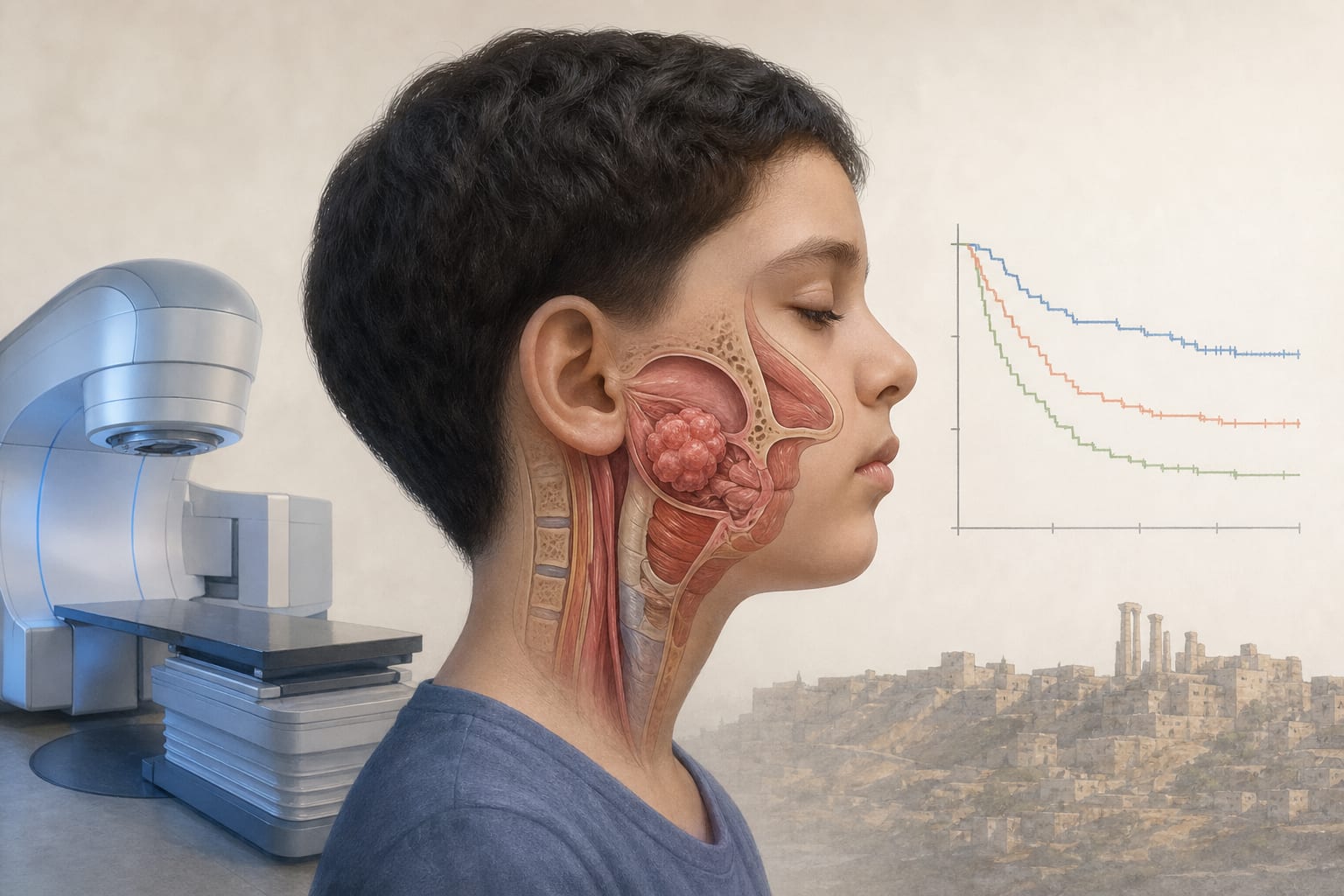
To analyze outcomes of pediatric patients with non-metastatic head and neck rhabdomyosarcoma (HNRMS) in Jordan and compare these outcomes to those reported in international benchmarks.
Approach:
Study Design: Retrospective analysis of pediatric patients under 18 diagnosed with non-metastatic HNRMS from January 2001 to May 2026.
Data Collection: Demographic, pathological, treatment, and outcome data were extracted from medical records.
Risk Stratification: Followed COG protocols with local control decisions made via multidisciplinary team assessment.
Key Findings:
Out of 98 patients, 77 had non-metastatic disease.
Median age at diagnosis was 5.9 years; male-to-female ratio was 1:1.
Most common primary sites were parameningeal (40%) and orbital (26%).
Histology was embryonal in 66% of cases; 71% had tumors >5 cm.
5-year event-free survival (EFS) was 66.1% and overall survival (OS) was 70.1%.
Parameningeal location was significantly associated with adverse survival outcomes.
32% of patients received maintenance therapy, and local excision was performed in 19% of patients.
Interpretation:
Despite higher rates of advanced disease, outcomes comparable to international benchmarks were achieved, indicating potential for effective management in resource-constrained settings.
Limitations:
Retrospective design may limit data completeness and accuracy.
Lack of central pathology review for historical diagnoses.
Conclusion:
The study indicates that outcomes for pediatric HNRMS in Jordan can meet international standards.