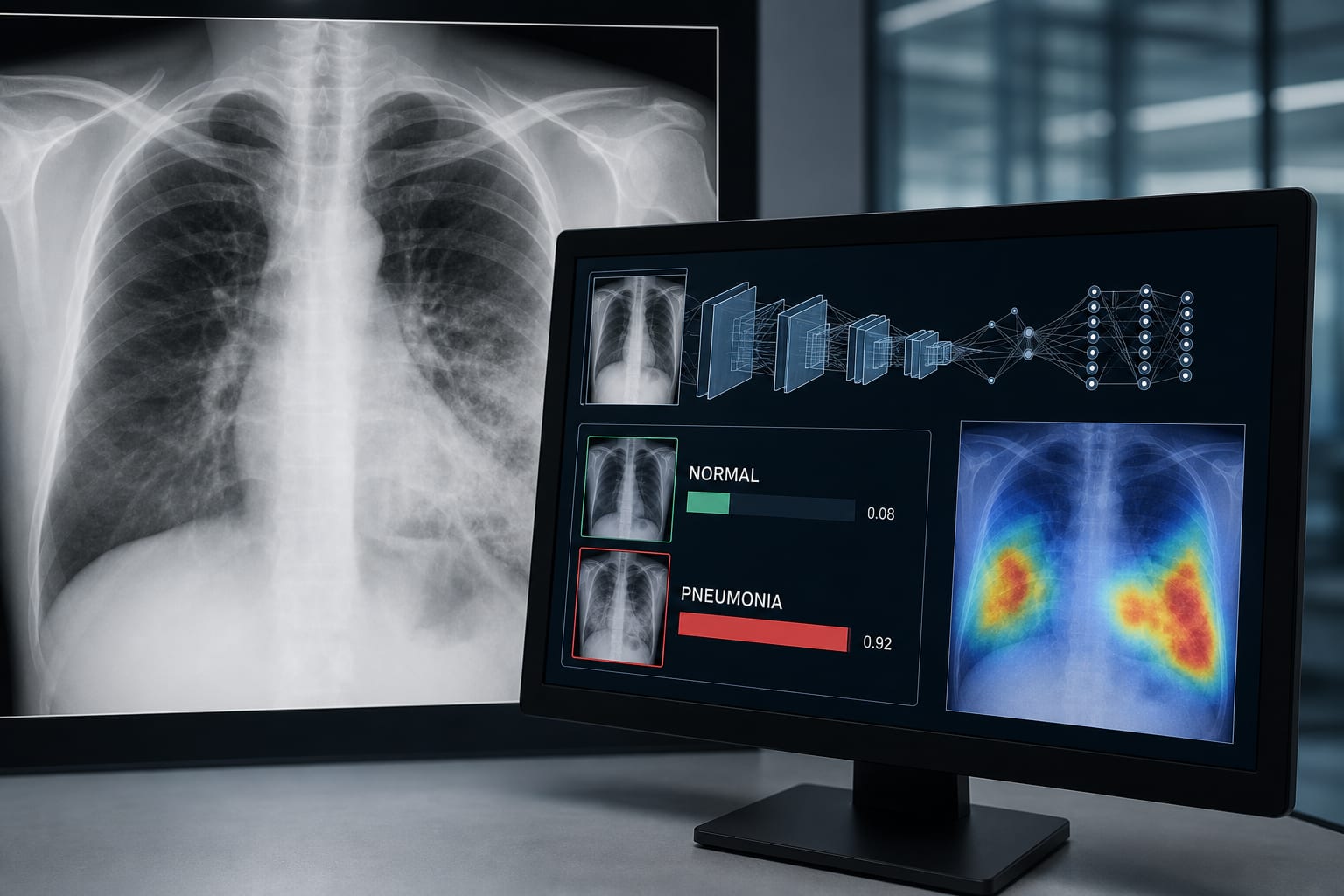
To develop and evaluate deep learning-based models for the automated classification of chest X-ray images into normal and pneumonia categories, enhancing clinical decision support.
Key Findings:
VGG16 achieved the highest test accuracy of 87.1% and AUC of 0.92, indicating strong potential for clinical application.
InceptionV3 performed well with 85.0% accuracy and AUC of 0.84, suggesting reliability in diagnosis.
Xception reached 81.8% accuracy (AUC: 0.82) but had low sensitivity for pneumonia detection, raising concerns for clinical use.
ResNet50 underperformed with 74.2% accuracy and AUC of 0.81, likely due to class imbalance and overfitting, which should be addressed in future studies.
Interpretation:
VGG16 and InceptionV3 models show strong potential for aiding pneumonia diagnosis in chest X-rays, highlighting the effectiveness of deep learning in medical imaging.
Limitations:
The study used a single-center dataset, which may limit generalizability and applicability to broader populations.
Class imbalance and overfitting were significant issues, particularly with ResNet50, affecting its performance.
Future research requires larger, balanced, and multi-center datasets to enhance the robustness of findings.
Conclusion:
VGG16 and InceptionV3 models are promising for clinical decision support in pneumonia diagnosis, necessitating further validation with diverse datasets to ensure reliability across different populations.