Association of achieved LDL-C levels with global coagulability and clinical outcomes in patients with acute coronary syndrome receiving PCSK9 inhibitors: a prospective cohort study - Summary - MDSpire
Conexiant’s news site is now MDSpire News. Learn more
Advertisement
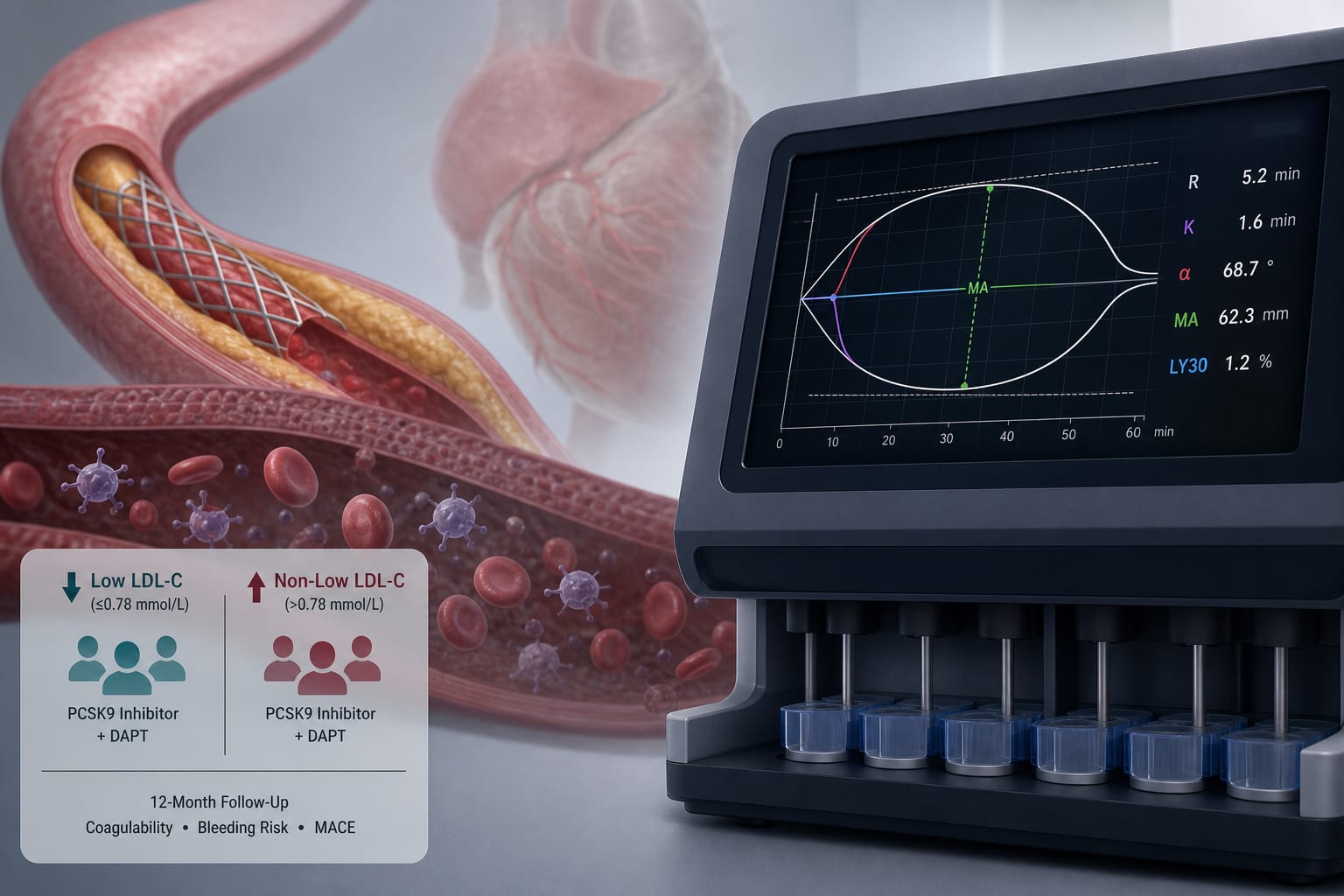
Impact of Target LDL-C Levels on Global Coagulability and Clinical Outcomes in Acute Coronary Syndrome Patients Treated with PCSK9 Inhibitors: Findings from a Prospective Cohort Study
To evaluate the influence of intensively lowering LDL-C via PCSK9 inhibitors on global coagulability and clinical safety, particularly regarding bleeding risk, in post-PCI ACS patients treated with dual antiplatelet therapy.
Approach:
Key Findings:
Clinically relevant bleeding incidence was 6.7% in the Low LDL-C group and 5.0% in the Non-Low LDL-C group, indicating no significant difference in overall bleeding risk (log-rank P = 0.72).
Global coagulability and specific platelet reactivity parameters remained stable with no significant intergroup differences (all P > 0.05).
Major adverse cardiovascular events (MACE) occurred in 6.7% of the Low LDL-C group and 13.3% of the Non-Low LDL-C group (HR 0.48, log-rank P = 0.22).
Interpretation:
Achieving LDL-C levels ≤0.78 mmol/L in ACS patients treated with PCSK9 inhibitors and DAPT did not increase bleeding risk or significantly alter coagulability and platelet reactivity, suggesting that such treatment strategies may be safe in this high-risk population.
Limitations:
The non-inferiority analysis was underpowered due to a sparse number of overall bleeding events (n = 7), which limits the reliability of the safety findings.
Findings are descriptive and exploratory, lacking definitive conclusions that could guide clinical practice.
Conclusion:
These findings support the clinical safety of achieving ultra-low LDL-C levels in high-risk ACS patients treated with PCSK9 inhibitors and DAPT.
As ASE convenes its 37th Scientific Sessions near Denver, the meeting will spotlight echocardiographic AI and big data, contrast-enhanced ultrasound, evolving guidelines, the Feigenbaum Lecture, and the future of the sonographer workforce.