Bifidobacterium infantis-mediated HSV-TK/GCV therapy modulates the tumor microenvironment through site-specific phosphorylation of HIF-1α, mTOR, and PD-L1 - Summary - MDSpire

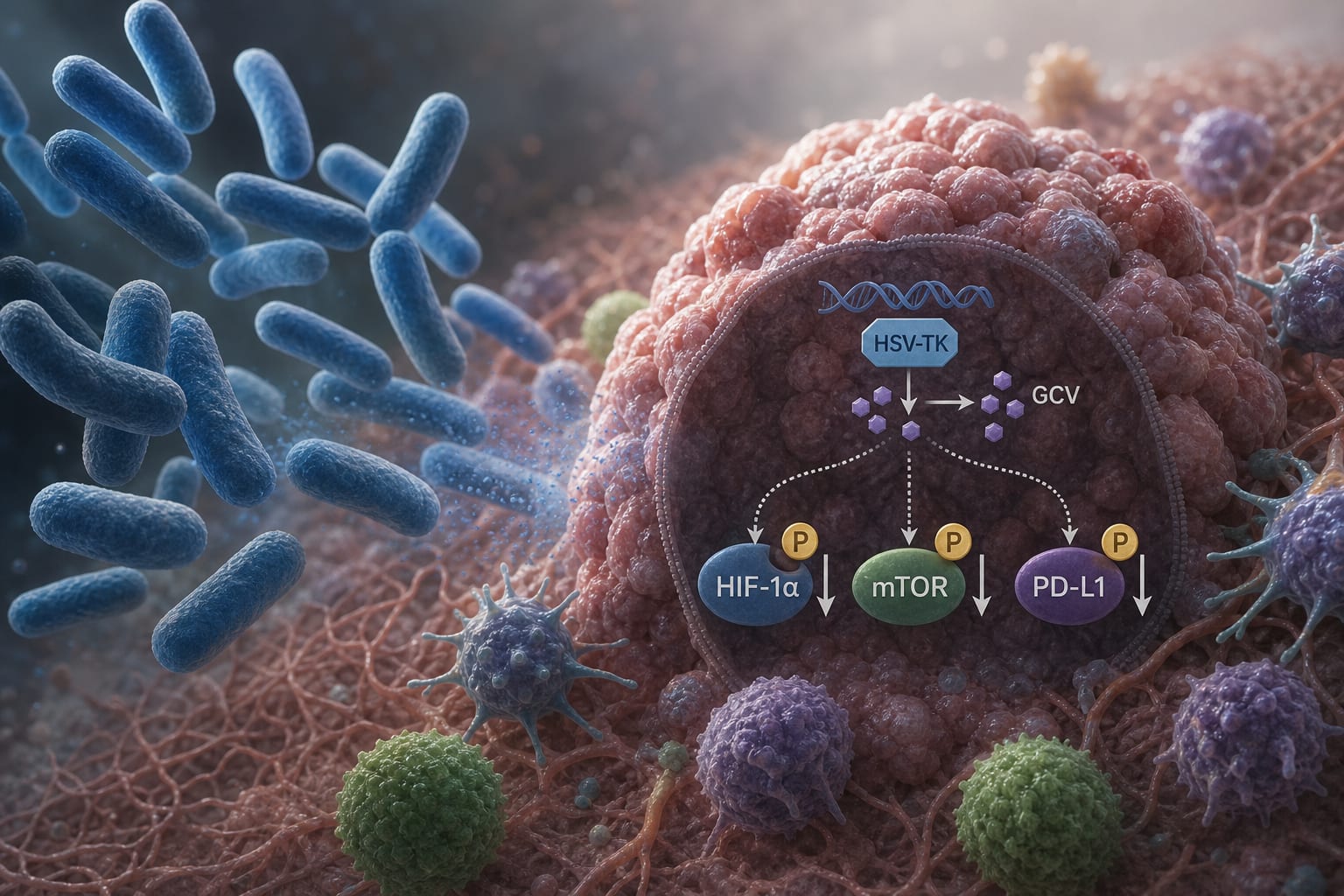
Bifidobacterium infantis-mediated HSV-TK/GCV therapy modulates the tumor microenvironment through site-specific phosphorylation of HIF-1α, mTOR, and PD-L1
  • By

  • Jiaming He

  • Yang Yuan

  • Jing Li

  • Yongping Ma

  • Dilong Chen

  • June 22, 2026

  • 0 min

Share

Objective:

To investigate the effects of Bifidobacterium-mediated HSV-TK/GCV therapy on protein phosphorylation and its implications for tumor treatment.

Approach:
    Key Findings:
    • BF-TK/GCV treatment resulted in 337 differentially abundant phosphopeptides (DAPs), with 108 DAPs significantly altered compared to the BF/GCV group.
    • GO analysis revealed enrichment in protein kinase activity, cell cycle regulation, and DNA replication.
    • BF-TK/GCV differentially regulated the phosphorylation status of HIF-1α, mTOR, PKM2, and PD-L1 in a site-specific manner.
    • BF-TK/GCV suppressed tumor growth and significantly prolonged survival in tumor-bearing mice.
    Interpretation:

    BF-TK/GCV reprograms the phosphoproteome in a site- and pathway-specific manner.

    Limitations:
    • The study primarily focuses on specific tumor models and may not be generalizable to all cancer types.
    • Further research is needed to fully elucidate the long-term effects and mechanisms of BF-TK/GCV treatment.
    Conclusion:

    BF-TK/GCV therapy provides insights into cancer treatment strategies through targeted modulation of protein phosphorylation.

Original Source(s)

Related Content