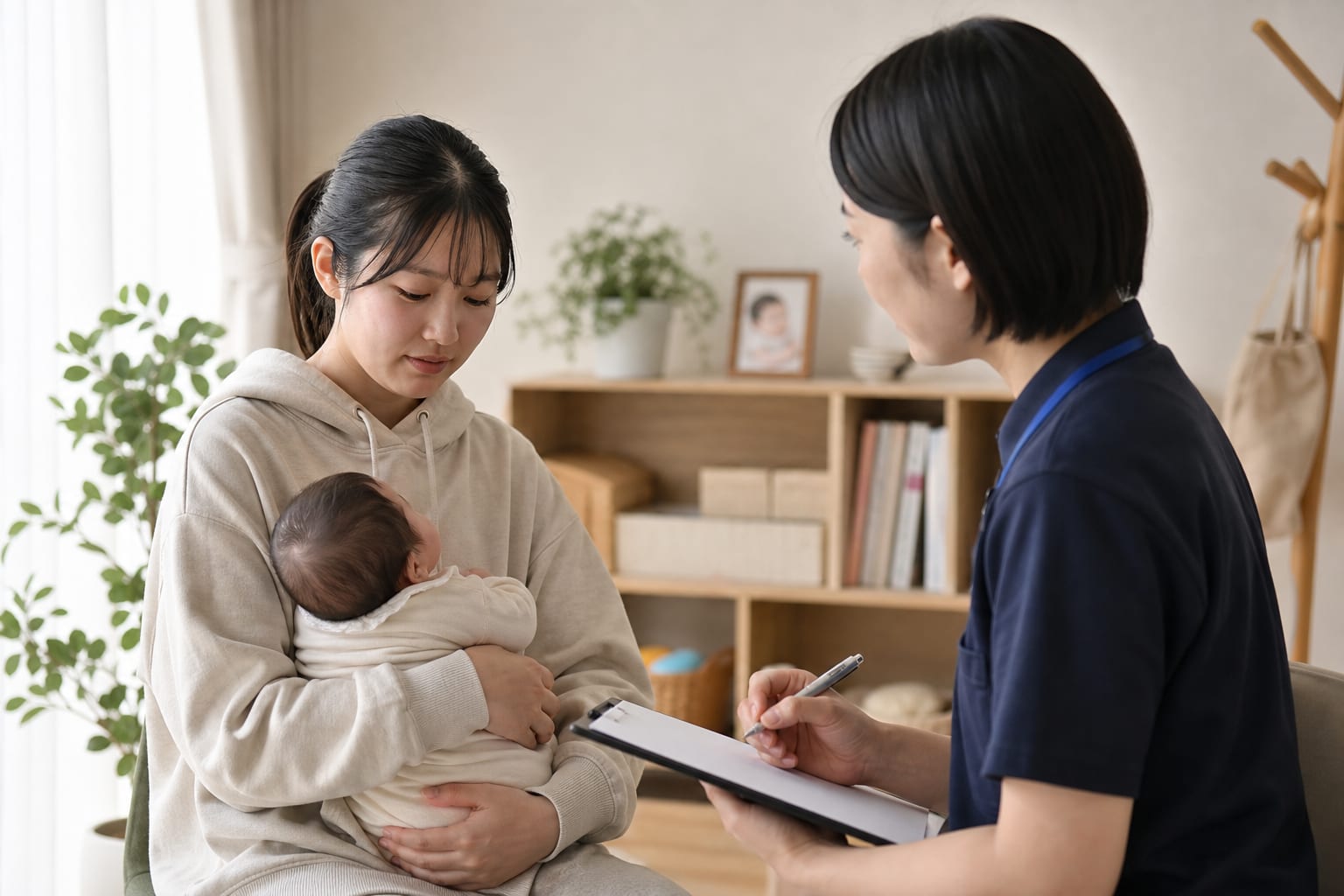
Effect of home visiting support on maternal psychosocial needs and postnatal depression: emulating a target trial - Summary - MDSpire

Effect of home visiting support on maternal psychosocial needs and postnatal depression: emulating a target trial

  • By

  • Kaori Baba

  • Zui C Narita

  • Syudo Yamasaki

  • Tomohiro Shinozaki

  • Junko Niimura

  • Naomi Nakajima

  • Satoshi Yamaguchi

  • Gemma Knowles

  • Jordan Devylder

  • Satsuki Ayaya

  • Shin-ichiro Kumagaya

  • Daniel Stanyon

  • Nao Oikawa

  • Mariko Hosozawa

  • Miharu Nakanishi

  • Shuntaro Ando

  • Kiyoto Kasai

  • Mitsuhiro Miyashita

  • Mariko Hiraiwa-Hasegawa

  • Toshi A Furukawa

  • Vikram Patel

  • Susan M Sawyer

  • Atsushi Nishida

  • June 18, 2026

  • 0 min

Share

Objective:

To evaluate the effect of the co-designed Early Partnership programme on perceived fulfilment of psychosocial needs and postnatal depressive symptoms among first-time adolescent and young adult mothers aged 16–25 years.

Approach:
    Key Findings:
    • The intervention group showed greater improvement in perceived fulfilment of psychosocial needs at 6 months (mean change difference 4.16, 95% CI 1.35 to 6.97) and 12 months (mean change difference 3.93, 95% CI 0.63 to 7.23) postnatally compared to the control group.
    • Postnatal depressive symptoms were lower in the intervention group at 6 months (mean difference -1.54, 95% CI -2.70 to -0.38) and 12 months (mean difference -1.55, 95% CI -2.74 to -0.36) postnatally.
    • Well-being improved at each time point, although estimates were imprecise.
    Interpretation:

    The Early Partnership programme, co-designed with young mothers and delivered by multi-professional teams, was acceptable and effective in improving perceived fulfilment of psychosocial needs and reducing postnatal depressive symptoms.

    Limitations:
    • The study used a historically controlled design, which may introduce biases.
    • Participants were not randomized, potentially affecting the generalizability of the findings.
    Conclusion:

    The findings indicate that a person-centred and relationship-based home visiting model may represent a model of maternal care.

Original Source(s)

Related Content