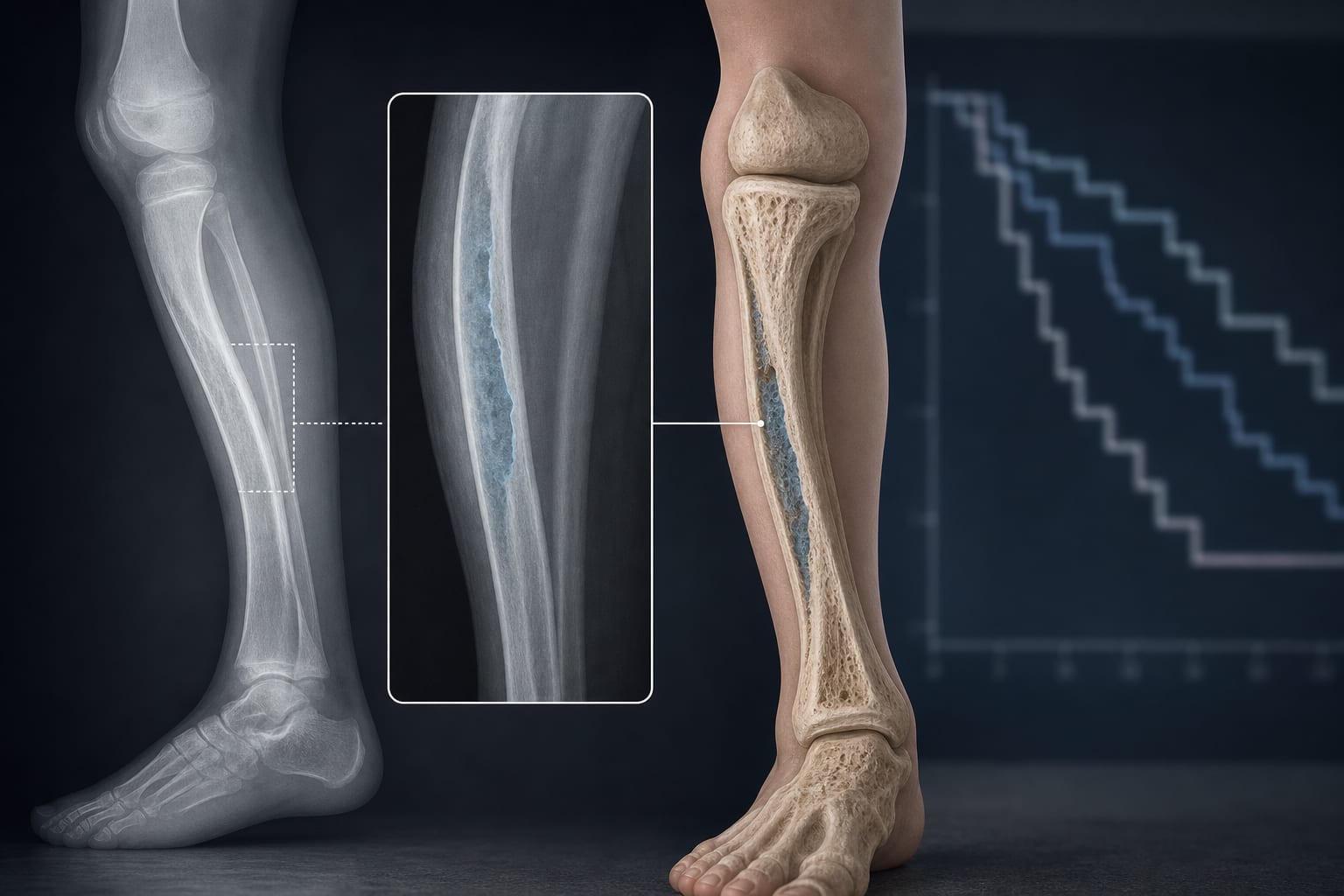
Extent of the low-density line is associated with time to fracture in children with congenital anterolateral bowing of the tibia: a retrospective survival analysis - Summary - MDSpire
Advertisement
Extent of the low-density line is associated with time to fracture in children with congenital anterolateral bowing of the tibia: a retrospective survival analysis
To evaluate the association between low-density line (LDL) extent and time to fracture in children with congenital anterolateral bowing of the tibia.
Approach:
Key Findings:
Fractures occurred in 31 out of 40 children (77.5%).
61.3% of fractures occurred within 6 months after LDL detection.
Kaplan–Meier analysis showed significant differences in fracture-free survival among LDL proportion groups (P = 0.014).
Median times to fracture were 567 days for 2/3 LDL groups.
Univariable Cox regression indicated larger LDL proportion was associated with shorter time to fracture (P = 0.021).
Interpretation:
The clustering of fracture events within the first 6 months after LDL detection suggests a potential period for closer monitoring.
Limitations:
Study is retrospective and conducted at a single center, which may limit generalizability.
Sample size may limit the generalizability of findings.
Multivariable adjustment attenuated the association between LDL proportion and fracture timing.
Conclusion:
LDL proportion may be associated with earlier fracture timing in pediatric ALBT patients, highlighting the need for further validation in larger prospective studies.