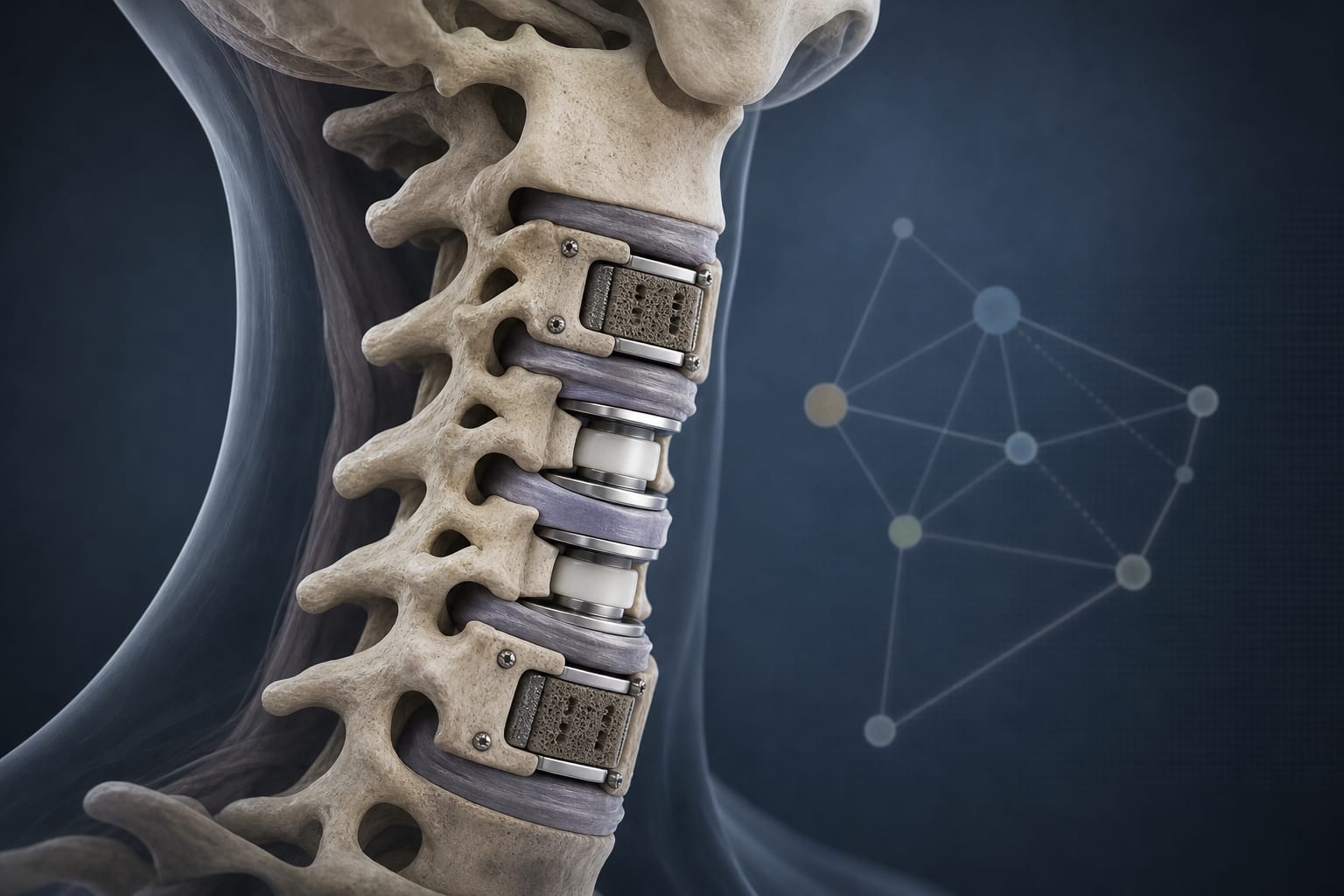
Comparison of hybrid surgeries for the treatment of three-level cervical degenerative disease: a systematic review and network meta-analysis - Summary - MDSpire
To compare the safety and efficacy of two types of hybrid surgery (HS1 and HS2) and anterior cervical discectomy and fusion (ACDF) for three-level cervical degenerative disease (CDD).
Approach:
Study Design: Systematic review and network meta-analysis conducted according to PRISMA guidelines.
Data Sources: Comprehensive search of Web of Science Core Collection, PubMed, and Embase from inception to December 19, 2025.
Inclusion Criteria: Studies involving patients with clinically confirmed three-level CDD, comparing safety and outcomes of ACDF, HS1, and HS2.
Key Findings:
HS1 resulted in a significantly lower Neck Disability Index (NDI) compared to ACDF.
C2-7 range of motion (ROM) was significantly greater in HS1 and HS2 than in ACDF.
HS1 had a significantly lower C2-7 ROM compared to HS2.
ROMs of upper and lower segments in HS1 and HS2 were significantly lower than in ACDF.
No significant difference in ROM of upper or lower segments between HS1 and HS2.
Interpretation:
HS1, HS2, and ACDF are all safe and effective options for three-level CDD, with HS1 and HS2 better preserving C2-7 ROM compared to ACDF.
Limitations:
Limited number of studies included in the meta-analysis.
Variability in study designs and patient populations.
Conclusion:
HS1 and HS2 may offer advantages in preserving cervical motion compared to ACDF, with similar incidences of adjacent segment degeneration.