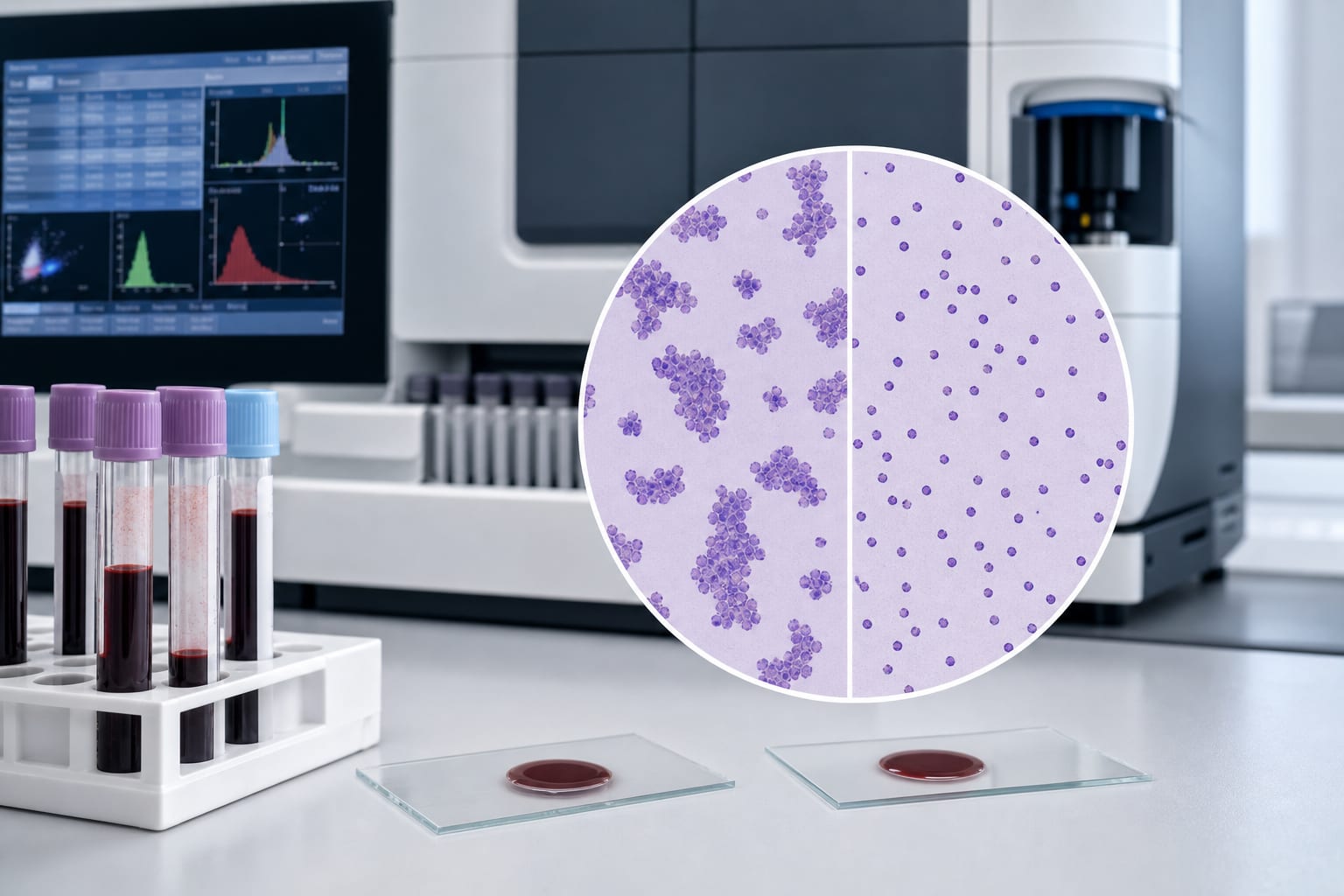
To evaluate an integrated strategy of 1:7 pre-dilution of fresh EDTA blood with optical/fluorescent platelet counting to correct pseudothrombocytopenia (PTCP).
Approach:
Sample Analysis: 21 PTCP samples were analyzed using impedance platelet counting (PLT-I), conventional PLT-O/PLT-F, and pre-diluted PLT-O/PLT-F on Mindray BC-7500 CS and Sysmex XN20 analyzers, with manual counting (PLT-M) as the reference.
Assessment Metrics: Evaluated anti-interference efficacy (aggregation interference rejection, outlier rate) and accuracy (recovery rate, mean bias rate, root mean square error, non-parametric bias analysis, correlation/agreement tests).
Key Findings:
Pre-dilution significantly improved anti-interference, with DIL BC7500 PLT-O showing the highest aggregation interference rejection (95.24%) and the lowest outlier rate (19.05%).
Conventional modes exhibited significant negative bias, while pre-diluted modes eliminated bias, with recovery rates within an acceptable range (90–110%) and low RMSE (23.15%).
Non-parametric analysis indicated no significant difference between DIL PLT-O/F and PLT-M (p > 0.05), with strong correlation and agreement.
Interpretation:
Limitations:
Small sample size.
Single-center data.
Testing limited to two analyzers.
Conclusion:
The study presents a pilot solution for laboratory PTCP management.