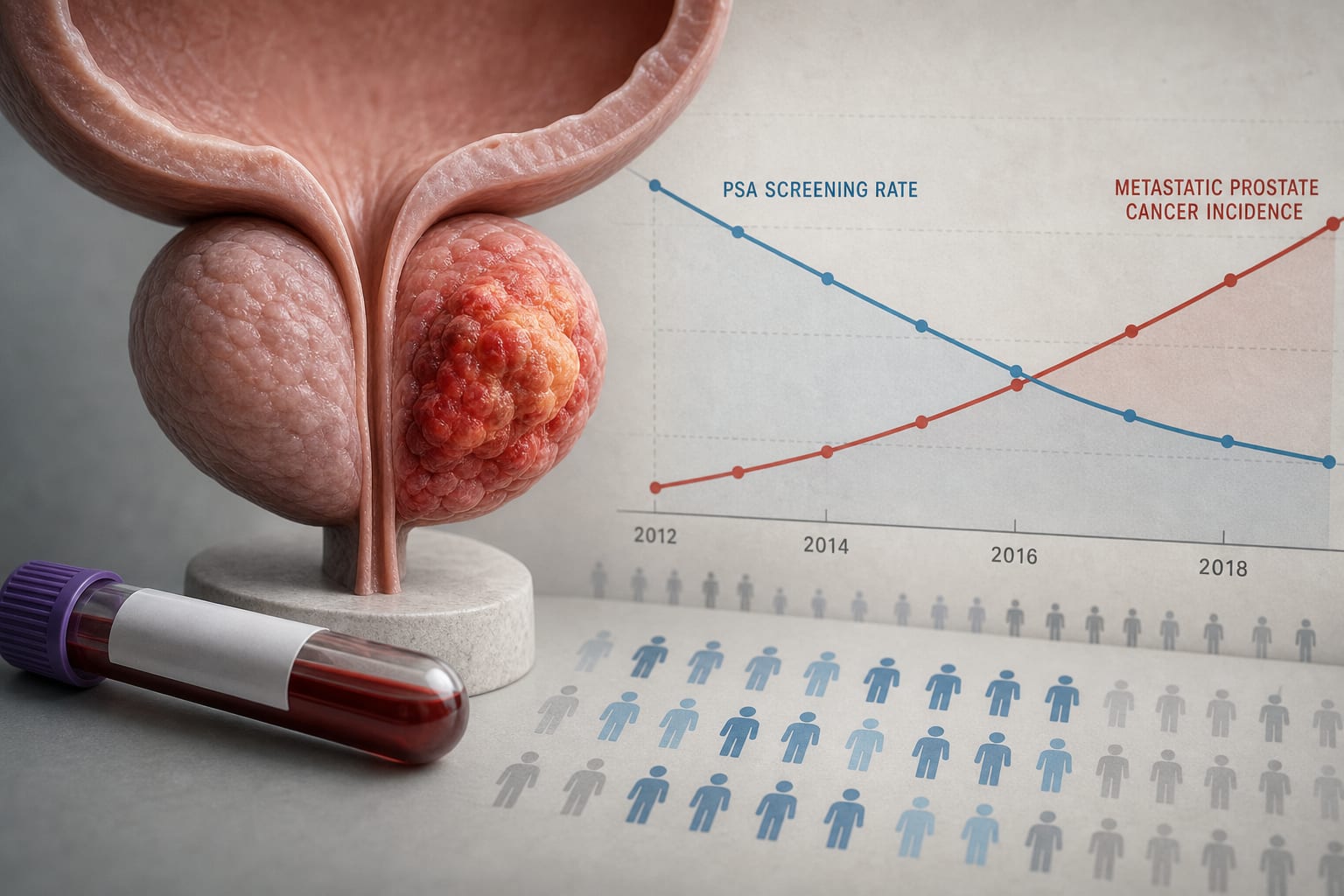
Prostate-Specific Antigen Screening Patterns and Metastatic Prostate Cancer in US Veterans - Summary - MDSpire

Prostate-Specific Antigen Screening Patterns and Metastatic Prostate Cancer in US Veterans

  • By

  • Mehrnaz Siavoshi

  • Stephen Frochen

  • Mary Fakunle

  • Ananta Wadhwa

  • Ashley-Marie Y. Green-Lott

  • Anissa V. Bailey

  • Lorna Kwan

  • Candace Haroldsen

  • Atim Effiong

  • Brent S. Rose

  • Timothy R. Rebbeck

  • Hari S. Iyer

  • Isla P. Garraway

  • July 6, 2026

  • 0 min

Share

Objective:

To study associations of prostate-specific antigen (PSA) screening patterns with metastatic prostate cancer (PC) at diagnosis within the Veterans Administration (VA) health care system.

Approach:
  • Study Design: Retrospective cohort study using data from the VA Multi-OMICS Analysis Platform for Prostate Cancer (VA-MAPP) database, analyzing men with at least 2 VA visits from 2005 to 2020.
  • Data Collection: Clinical, laboratory, pathological, demographic, and socioeconomic data were collected, focusing on PSA tests and prostate needle biopsies.
  • Screening Parameters: Evaluated three PSA screening factors: age at first PSA test, first PSA test value, and longest PSA test interval prior to biopsy.
  • Statistical Analysis: Cox proportional hazards models were used to estimate associations of PSA screening parameters with metastatic PC at diagnosis.
Key Findings:
  • Thestudyincluded103,419individualswhounderwenttheirfirstVAdiagnosticprostateneedlebiopsybetween2015and2023.PSAscreeningpracticesandthresholdsvariedbypatient,clinician,andhealthfacilitycharacteristics.Theprimaryoutcomewascategorizedasmetastaticprostatecancer,localizedprostatecancer,orbenignbasedonICD-10codes.
Interpretation:

Limitations:
  • The study may not generalize to non-veteran populations.
  • Variability in screening practices may affect the consistency of results.
Conclusion:

Original Source(s)

Related Content