Efficacy and safety of transoral incisionless fundoplication in non-obese and obese adults: a population-based cohort study from the United States - Summary - MDSpire
Conexiant’s news site is now MDSpire News. Learn more
Advertisement
Effectiveness and safety of transoral incisionless fundoplication in adults with varying body weights: findings from a U.S. population-based cohort study
To study the real-world effect of BMI on TIF outcomes in adults with class I obesity compared to non-obese patients.
Approach:
Data Source: Utilized the TriNetX US Research Network, a database of electronic medical records from over 70 healthcare organizations.
Study Design: Retrospective cohort study analyzing adult patients diagnosed with GERD who underwent TIF, stratified by BMI.
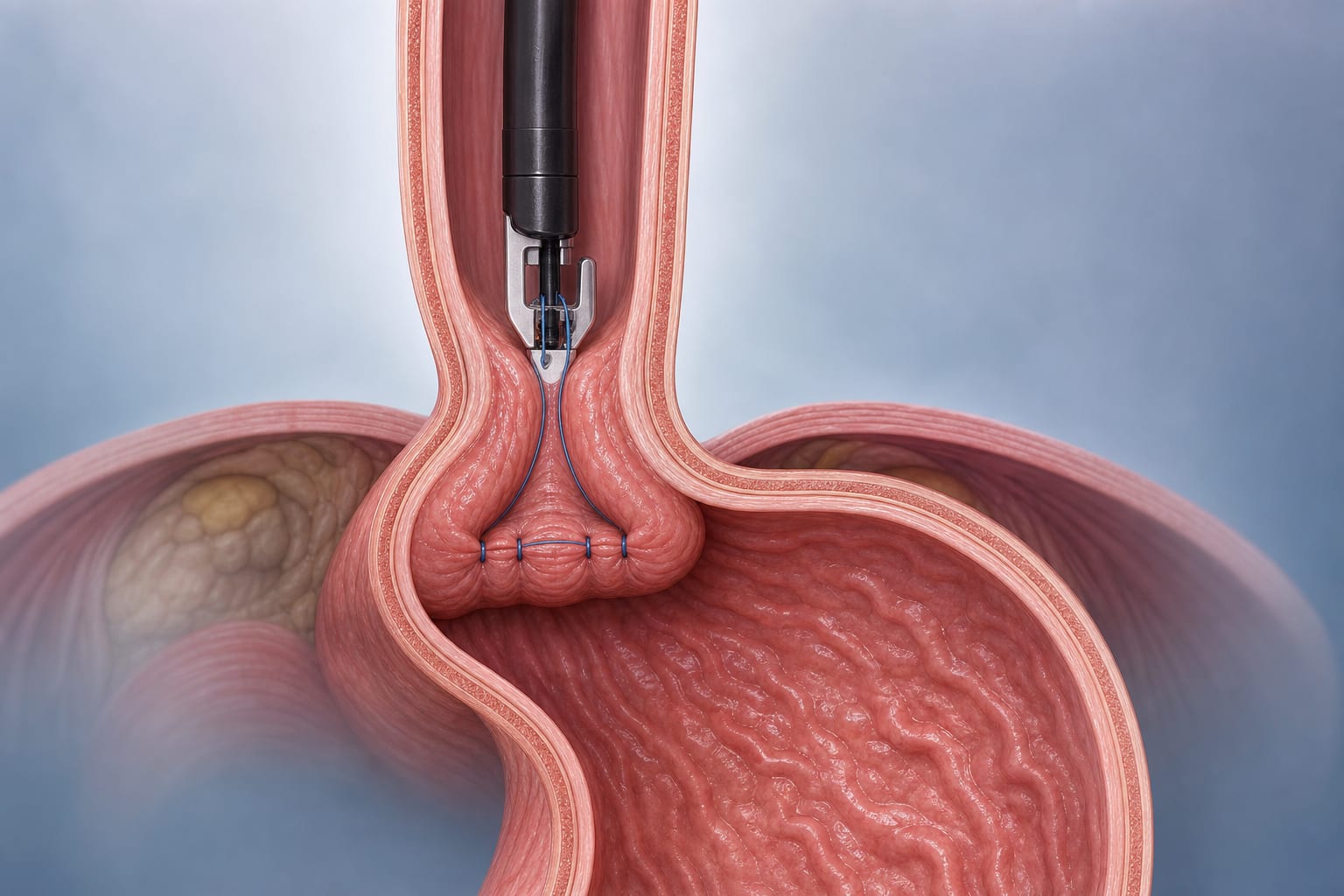
TIF Procedure Overview: Performed under general anesthesia using the EsophyX device, involving fundoplication techniques to repair the anti-reflux barrier.
Statistical Analysis: Conducted using the TriNetX Live platform, including propensity score matching to minimize confounding.
Method: The study concluded that TIF is effective in patients with class I obesity, with outcomes comparable to non-obese patients, emphasizing the importance of careful patient selection. TIF has shown efficacy with low adverse event rates in patients with axial hernia < 2 cm. Combining TIF with cruroplasty demonstrates comparable short-term efficacy and an excellent safety profile. However, obesity is a limitation for TIF, with BMI ≥ 35 kg/m2 being a relative contraindication.
Key Findings:
TIF has shown efficacy with low adverse event rates in patients with axial hernia < 2 cm.
Combining TIF with cruroplasty demonstrates comparable short-term efficacy and an excellent safety profile.
Obesity is a limitation for TIF, with BMI ≥ 35 kg/m2 being a relative contraindication.
Interpretation:
The study provides valuable insights into the effectiveness and safety of transoral incisionless fundoplication (TIF) for patients with class I obesity, a demographic often underrepresented in surgical studies. The findings indicate that TIF can achieve satisfactory outcomes in this population, suggesting that the procedure may be a viable option for managing GERD in patients with a BMI in the range of 30-34.9 kg/m². The comparable results between class I obese patients and their non-obese counterparts highlight the potential for TIF to address GERD symptoms effectively, which is particularly important given the rising prevalence of obesity and its associated complications. Furthermore, the study underscores the necessity for meticulous patient selection, as the presence of obesity can complicate surgical outcomes. The relative contraindication for patients with a BMI ≥ 35 kg/m² suggests that further research is needed to explore alternative strategies or modifications to TIF that might accommodate higher BMI patients. Overall, this research contributes to a growing body of evidence advocating for tailored treatment approaches that consider individual patient characteristics, including body weight, to optimize surgical interventions for GERD.
Limitations:
Exclusion of patients with BMI > 35 kg/m2 and those with major esophageal motility disorders limits the generalizability of the findings.
Limited literature on the outcomes of TIF in patients with higher BMI.
Conclusion:
The findings underscore that while TIF is effective for patients with class I obesity, careful patient selection is crucial, especially considering the significant number of patients with class I obesity experiencing GERD. Understanding the impact of BMI on TIF outcomes is essential for optimizing treatment strategies.
by Fouad Jaber, Saltenat Moghaddam Adames, Mohamed Jaber, Kinan Obiedat, Kalpesh Patel, Teminioluwa A. Ajayi, Roy Tomas DaVee, Fares W. Ayoub, Nirav Thosani, Wasseem Skef