Joint effects of severe obesity and inflammation on mortality in critically ill non−ST−segment elevation myocardial infarction patients: a cohort study with external validation - Summary - MDSpire
Advertisement
Joint effects of severe obesity and inflammation on mortality in critically ill non−ST−segment elevation myocardial infarction patients: a cohort study with external validation
To investigate the association between body mass index (BMI) and both in-hospital and 10-year all-cause mortality in critically ill non−ST−segment elevation myocardial infarction (NSTEMI) patients, and to evaluate the incremental value of C-reactive protein (CRP) in risk stratification.
Approach:
Study Design: A retrospective, multicohort study including 7,815 critically ill NSTEMI patients from three cohorts: TAMI (n = 5,010), MIMIC-IV (n = 1,208), and eICU-CRD (n = 1,597).
Data Analysis: BMI was categorized according to WHO criteria, and CRP was dichotomized at 2 mg/L. Multivariable Cox regression and restricted cubic splines were used to assess mortality risks.
Key Findings:
Severe obesity (BMI ≥ 35 kg/m2) was associated with increased risks of in-hospital (HR 1.69; p = 0.022) and 10-year (HR 1.68; p < 0.001) all-cause mortality.
Overweight and obesity I were associated with lower mortality risk compared to normal weight.
The absolute in-hospital mortality rate was 8.36% in the severe obesity group versus 1.55% in the overweight group.
Severe obesity combined with elevated CRP identified a high-risk clinical profile.
Adding CRP to the base model improved risk prediction (AUC increased from 0.764 to 0.768; p = 0.021).
Interpretation:
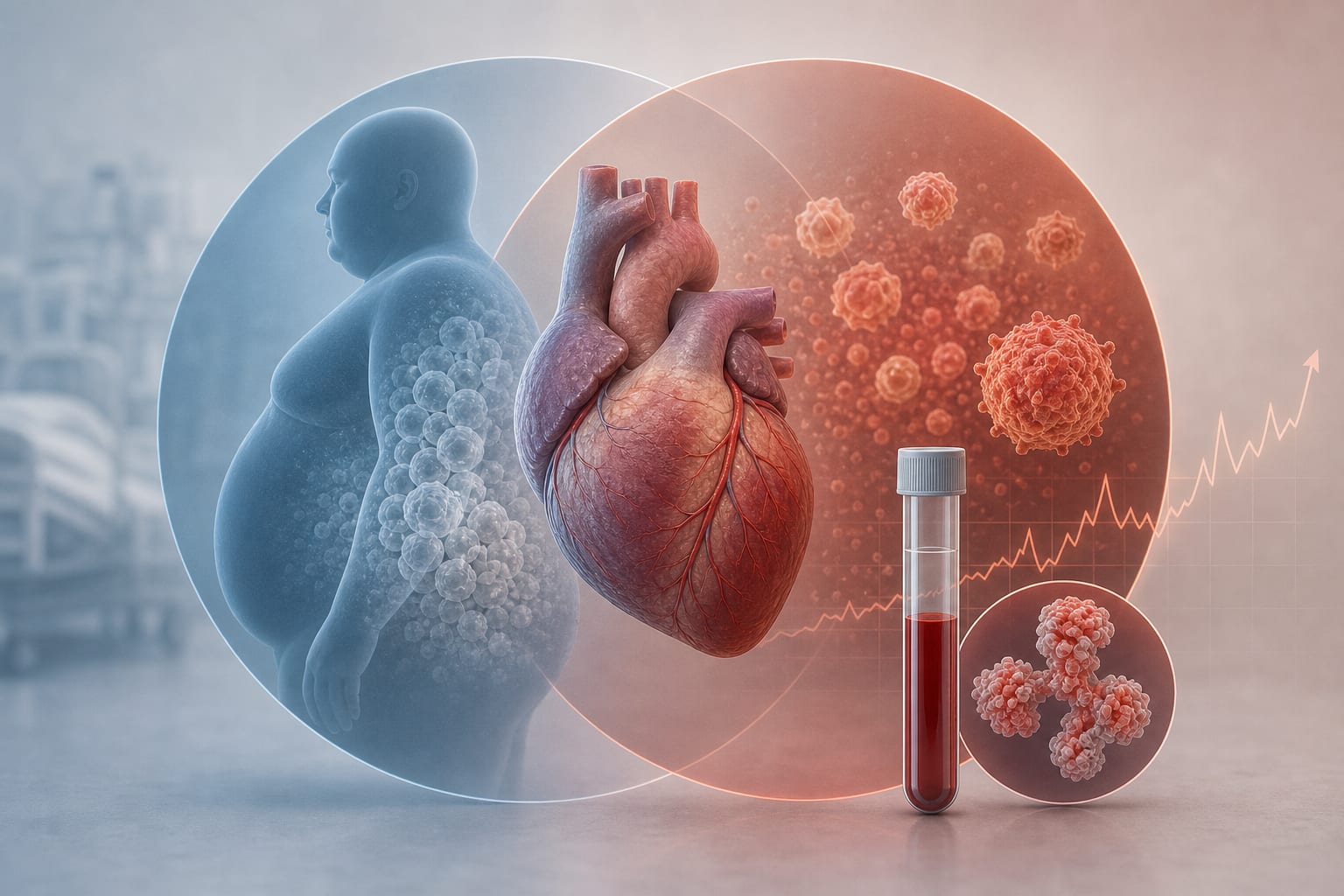
BMI exhibits a U-shaped association with mortality in critically ill NSTEMI patients, with severe obesity and elevated inflammation indicating a high-risk clinical profile.
Limitations:
The study's retrospective design may limit causal inferences.
Potential confounding factors not accounted for in the analysis.
Conclusion:
The findings support integrated metabolic-inflammatory risk stratification in critically ill NSTEMI patients.
A four-factor staging system stratified response rates from 90.9% to 37.5% in a retrospective cohort study, although the model showed only moderate discrimination (C statistic, 0.68) and requires external validation
In a target-trial emulation of more than 600,000 veterans, GLP-1 RA initiators saw fewer new substance use disorders—and patients with existing SUDs had fewer overdoses, hospitalizations, and deaths.