Utilizing conditional generative adversarial network to generate head MRA based on nonvascular sequences: comparative study of single-modality and multi-modality methods - Summary - MDSpire
Advertisement
Utilizing conditional generative adversarial network to generate head MRA based on nonvascular sequences: comparative study of single-modality and multi-modality methods
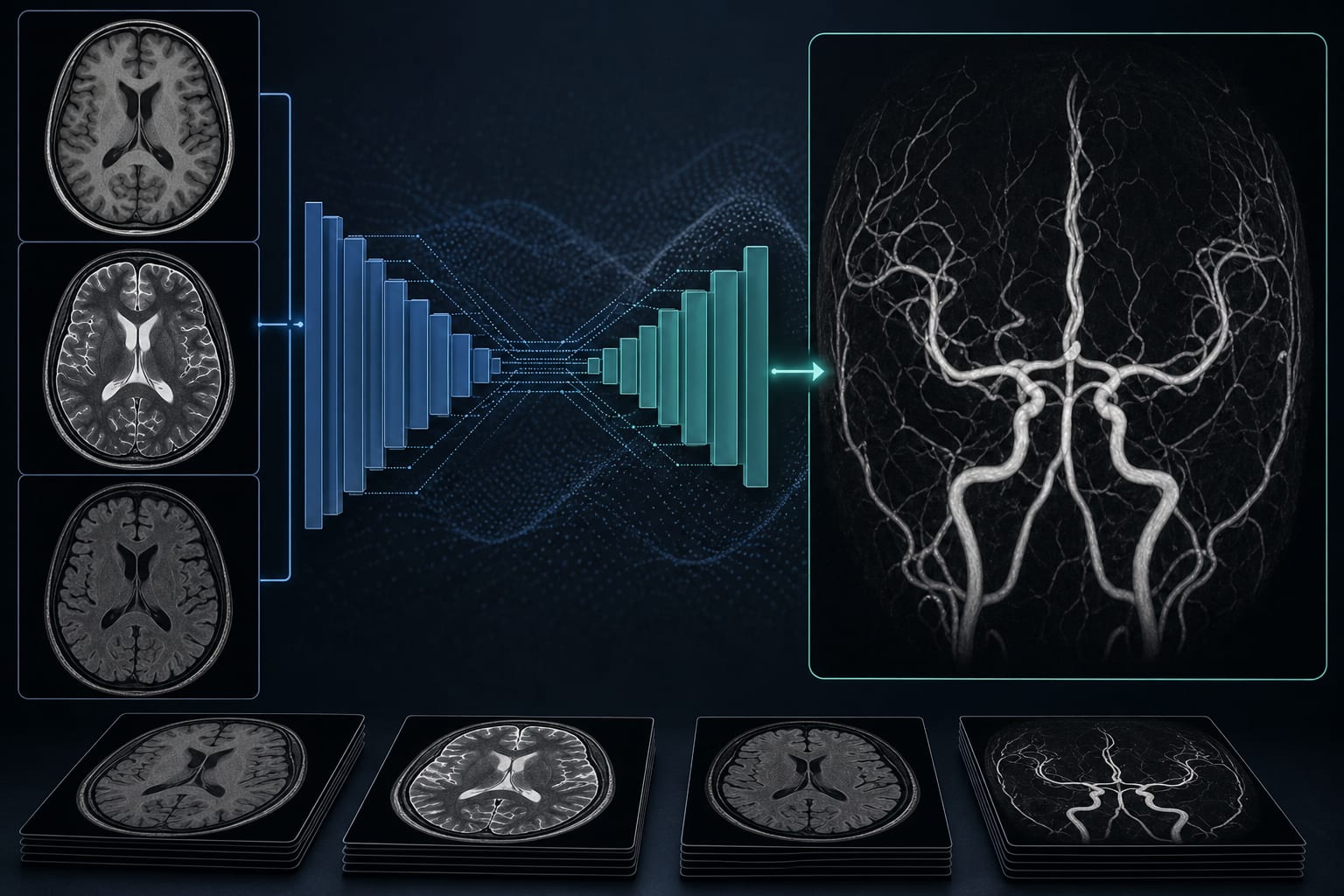
To develop a deep learning model synthesizing head MRA images from T1W, T2W, and FLAIR nonvascular sequences and evaluate the diagnostic performance of synthetic MRA.
Approach:
Study Design: Retrospective study including geriatric inpatients who underwent multimodal MRI.
Model Development: Constructed three single-modality cGAN models and one multi-modality model for MRA synthesis.
Evaluation Metrics: Used quantitative metrics and Likert scales for image quality assessment by radiologists, including evaluations of diagnostic confidence.
Key Findings:
The MIX model outperformed single-modality models in image quality metrics, achieving a structural similarity index measure of 0.880 and a peak signal-to-noise ratio of 33.18 dB.
Syn-MRA from all models showed higher signal-to-noise and contrast-to-noise ratios compared to real MRA.
MIX model achieved 92.2% diagnostic accuracy at the vessel level.
Interpretation:
The MIX model demonstrated comparable overall image quality and diagnostic performance to real MRA.
Limitations:
Study limited to a specific patient population (geriatric inpatients), which may not generalize to other demographics.
Potential biases in image assessment due to subjective evaluation by radiologists, which could affect the reliability of the results.
Conclusion:
The MIX model outperformed single-modality models, with image quality and diagnostic performance comparable to real MRA.