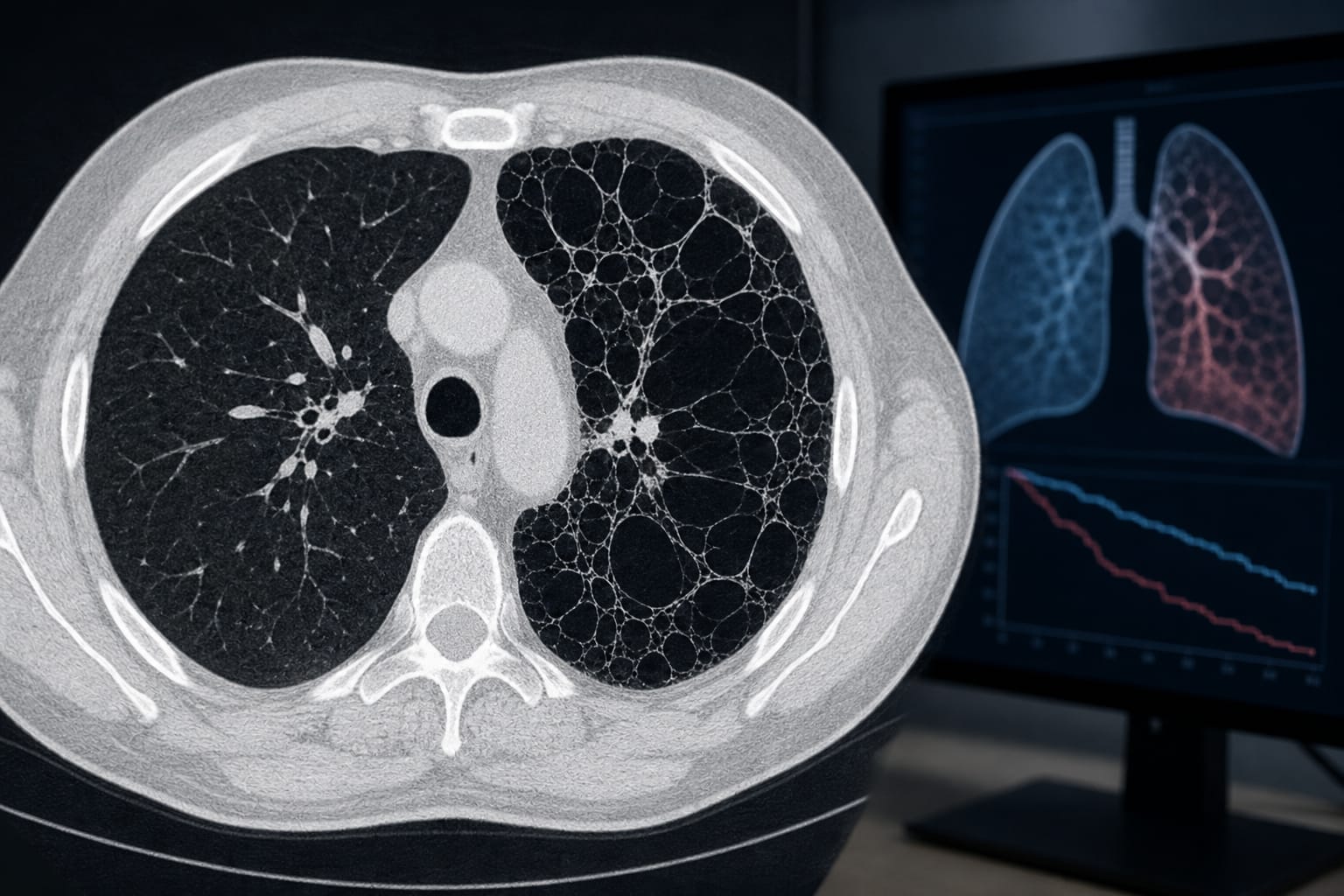
To evaluate differences in baseline characteristics and long-term prognosis between patients hospitalized with mild to moderate AECOPD with and without emphysema.
Approach:
Study Design: Prospective multicenter cohort study analyzing data from the MAGNET AECOPD Registry.
Participants: Included patients hospitalized with mild-to-moderate AECOPD who underwent chest CT within 24 hours of admission.
Outcomes: Primary outcome was 3-year all-cause mortality; secondary outcomes included rehospitalization and in-hospital events.
Analysis: Propensity score matching was used to balance baseline characteristics.
Key Findings:
Among 5,713 eligible patients, 4,558 (79.8%) had emphysema.
The emphysema group had higher rates of respiratory failure (12.1% vs. 3.4%, p < 0.001) and elevated inflammatory markers.
The emphysema group exhibited lower 3-year all-cause mortality (24.8% vs. 30.2%, log-rank p = 0.048).
The non-emphysema group had a higher burden of cardiovascular comorbidities, including hypertension (41.5% vs. 32.7%, p < 0.001) and heart failure (18.7% vs. 13.6%, p = 0.001).
Interpretation:
The emphysema phenotype predicts higher acute morbidity yet lower long-term mortality in mild-to-moderate AECOPD.
Limitations:
The study is limited to a specific population and may not be generalizable.
Data was collected from a registry, which may introduce selection bias.
Conclusion:
The findings suggest distinct pathophysiological pathways and support further investigation of CT-based phenotyping for personalized management in COPD.