Dynamic evolution of readmission risk factors across short-, medium-, and long-term horizons in type 2 diabetes: a machine learning-based predictive modeling study with SHAP interpretability - Summary - MDSpire
Advertisement
Dynamic evolution of readmission risk factors across short-, medium-, and long-term horizons in type 2 diabetes: a machine learning-based predictive modeling study with SHAP interpretability
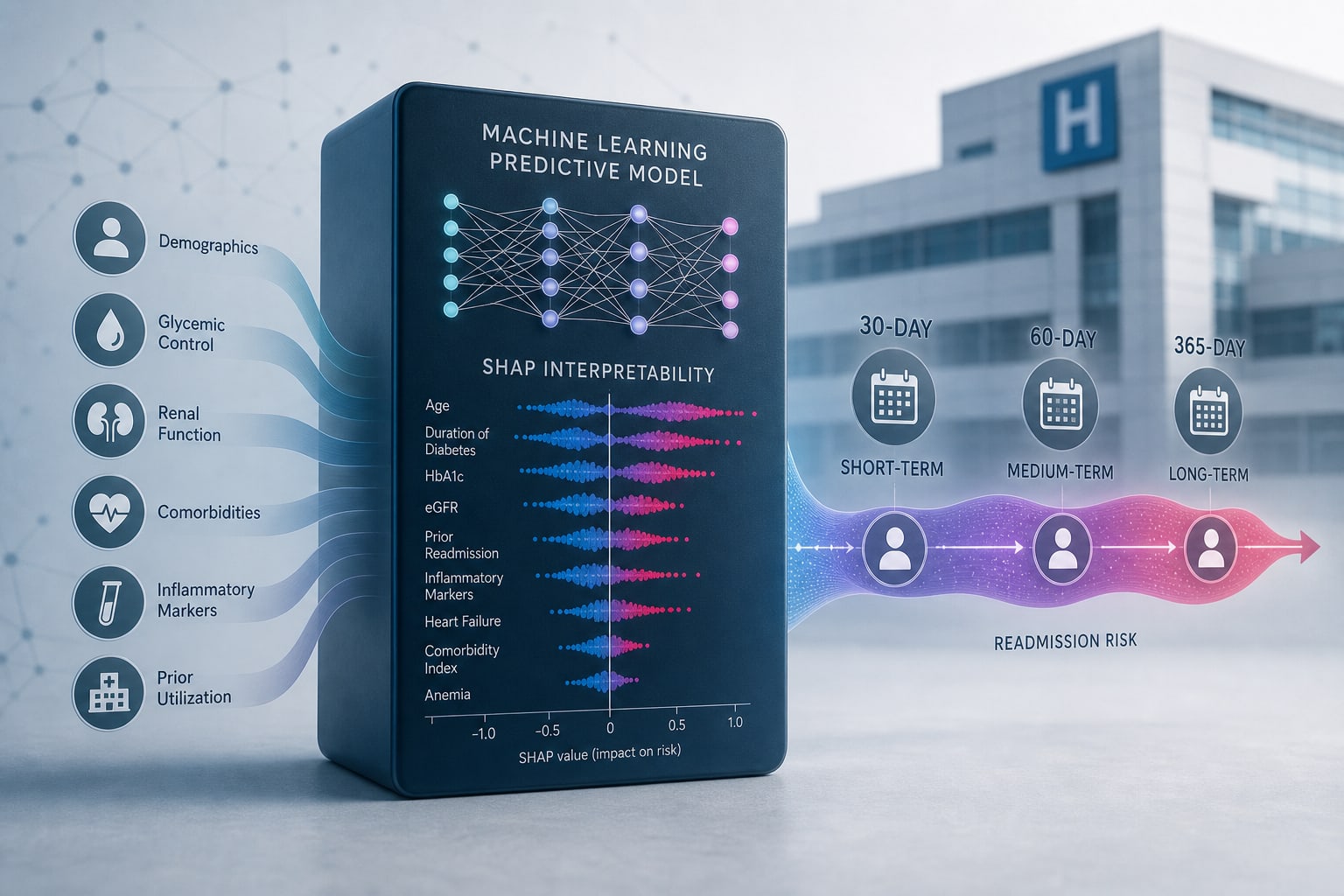
To investigate the evolving readmission risk factors for Type 2 Diabetes Mellitus (T2DM) patients across different time windows using machine learning models.
Approach:
Key Findings:
Artificial Neural Networks (ANN) had the highest AUROC for 30-day and 60-day predictions.
Random forest showed competitive performance for 365-day predictions.
Key predictors evolved: age for 30-day, length of hospital stay and inflammatory markers for 60-day, and chronic complications for 365-day.
Interpretation:
Risk factors for readmission in T2DM patients shift from acute vulnerabilities to chronic complications over time, indicating the need for dynamic risk monitoring.
Limitations:
Study conducted at a single center, which may limit generalizability.
Retrospective design may introduce biases.
Conclusion:
Model selection should be tailored to specific time windows, with ANN preferred for short/medium-term and random forest for long-term predictions.
An artificial intelligence–based optical coherence tomography pathway met noninferiority criteria for false-positive diabetic macular edema referrals and was associated with fewer referral decisions in a randomized clinical trial.