Development and internal validation of a prognostic nomogram incorporating F-NLR and HAGR scores in patients with oral squamous cell carcinoma: a single-center retrospective cohort study - Summary - MDSpire
Conexiant’s news site is now MDSpire News. Learn more
Advertisement
Creation and internal validation of a prognostic nomogram utilizing F-NLR and HAGR scores for patients diagnosed with oral squamous cell carcinoma: a retrospective cohort analysis from a single center
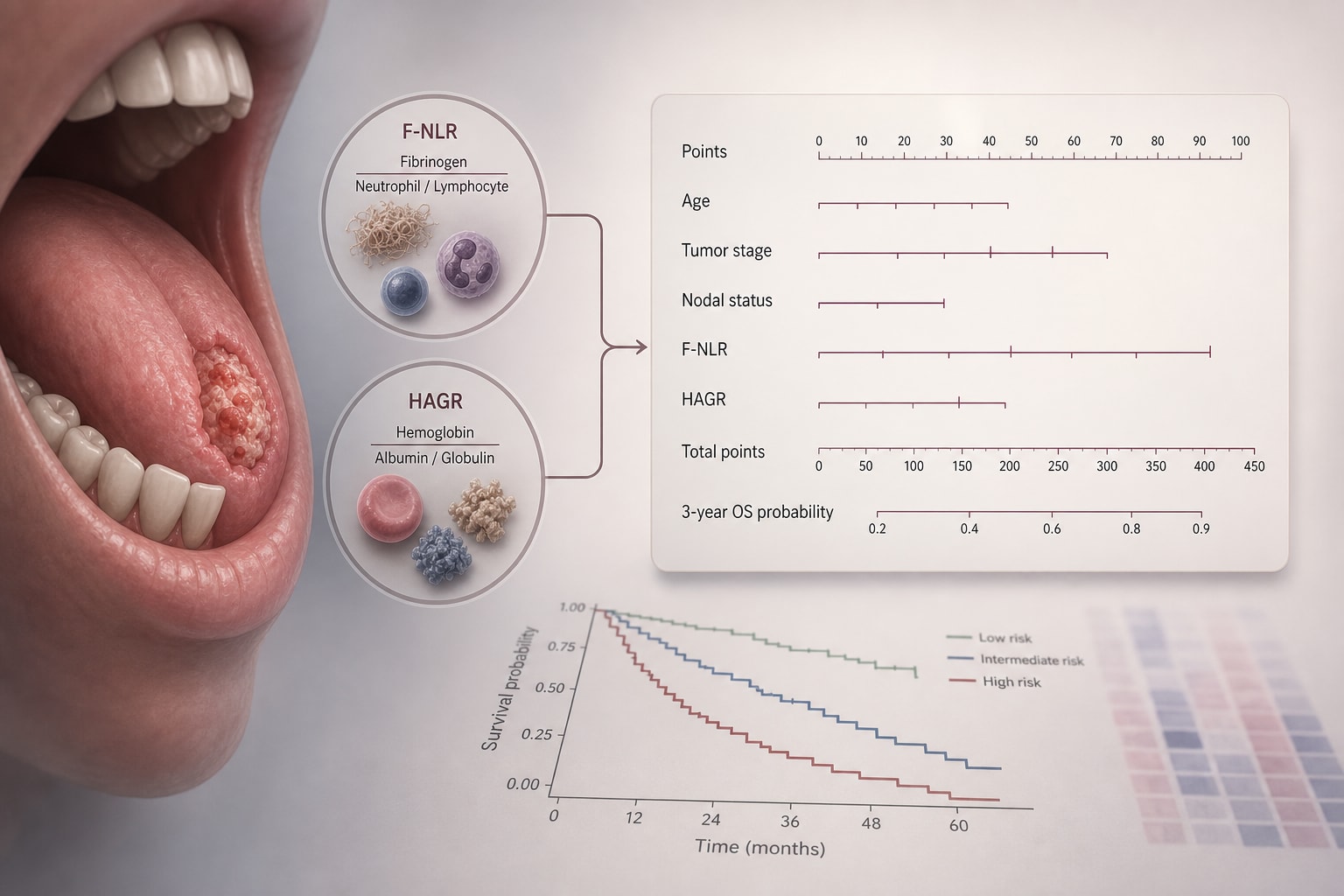
To construct a novel individualized prognostic model for patients with oral squamous cell carcinoma (OSCC) by integrating traditional clinical parameters with F-NLR and HAGR scores, addressing the limitations of the TNM staging system.
Approach:
Study Design: Retrospective analysis of clinical data from 292 OSCC patients who underwent radical surgical resection.
Data Analysis: Determined optimal cut-off values using the Youden index from ROC curves; performed univariate and multivariate Cox regression analyses.
Nomogram Construction: Developed a nomogram predicting 1-, 3-, and 5-year cancer-specific survival (CSS) rates based on identified independent prognostic factors.
Validation: Conducted internal validation of the nomogram; external validation was not performed.
Key Findings:
119 cancer-related deaths observed during a median follow-up of 41 months.
Independent prognostic factors identified: age, history of precancerous lesions, N classification, postoperative adjuvant therapy, F-NLR, and HAGR scores.
Nomogram C-index of 0.73; AUC for predicting 1-, 3-, and 5-year CSS were 0.798, 0.754, and 0.836, respectively, indicating acceptable model discrimination.
Calibration plots showed high consistency between predicted probabilities and actual survival observations.
Interpretation:
The nomogram demonstrates acceptable predictive accuracy for individualized risk stratification in OSCC patients.
Limitations:
Internal validation only; external validation in multi-center cohorts is required.
Conducted at a single center, which may limit generalizability.
Conclusion:
The proposed nomogram integrating F-NLR and HAGR scores with clinical parameters requires further validation before it can be recommended for routine clinical use.
An updated clinical practice guideline from the American Society for Radiation Oncology substantially expands and modernizes recommendations for the use of radiation therapy in pancreatic cancer.