Development and validation of a predictive model for diabetic kidney disease risk in patients with T2DM: a hospital data platform study - Summary - MDSpire
Conexiant’s news site is now MDSpire News. Learn more
Advertisement
Creation and assessment of a predictive model for the risk of diabetic kidney disease in individuals with type 2 diabetes mellitus: a study utilizing hospital data platforms
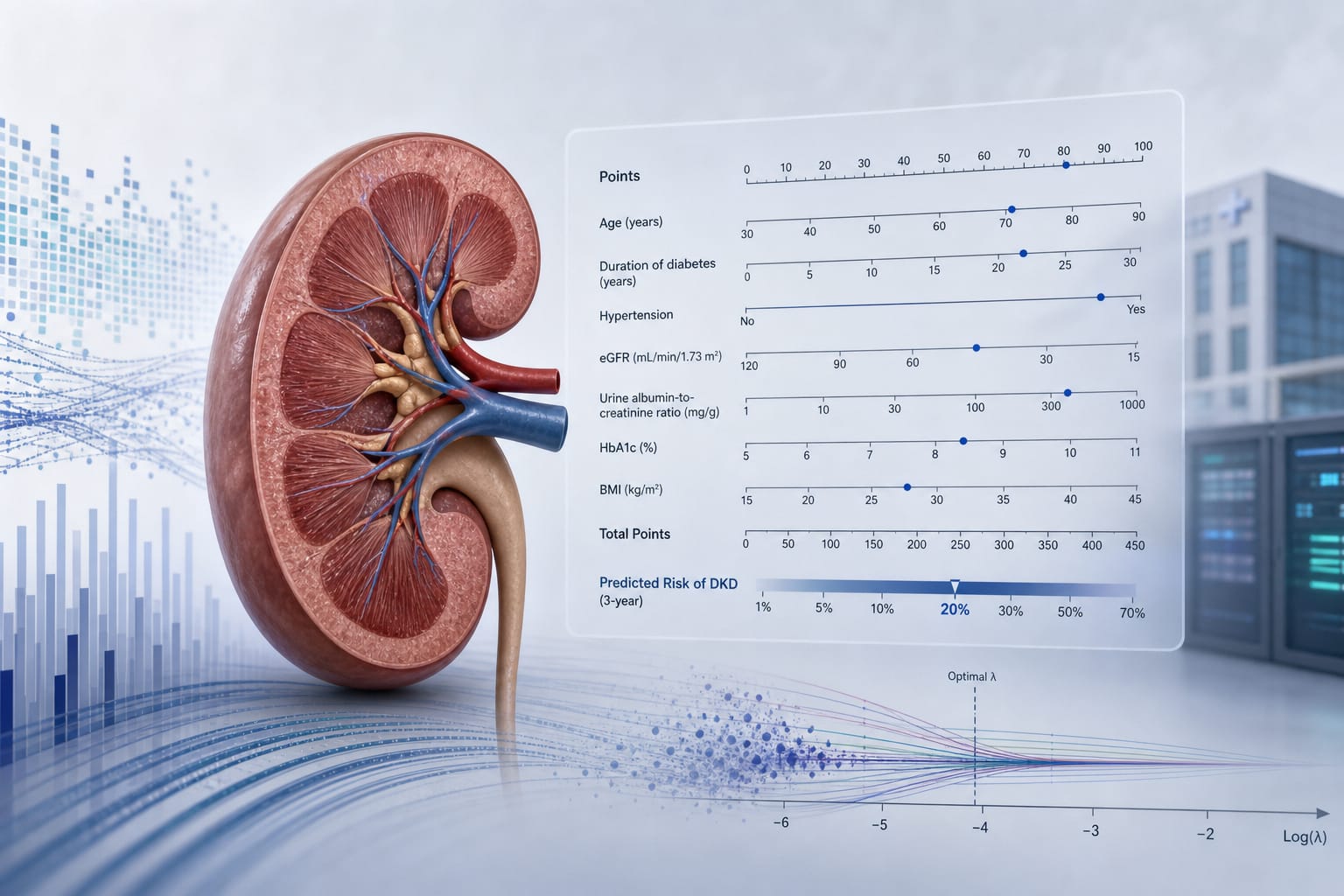
To identify risk factors for diabetic kidney disease (DKD) in patients with type 2 diabetes mellitus (T2DM) and construct a nomogram prediction model for early clinical screening.
Approach:
Data Collection: Clinical data from T2DM patients were collected from January 2020 to December 2023 for model development and from January 2024 to December 2025 for temporal validation.
Key Findings:
Out of 23,152 patients, 5,019 (21.68%) had DKD.
Nine predictors for DKD were identified: hypertension, diabetes duration, HbA1c, eGFR, urine protein, serum creatinine, uric acid, total cholesterol, and homocysteine.
The nomogram achieved an AUC of 0.773 (95% CI: 0.764-0.782) in the training set and 0.758 (95% CI: 0.743-0.774) in the temporal validation set.
Interpretation:
The model demonstrated moderate discrimination and calibration, indicating its potential utility for identifying high-risk DKD patients.
Limitations:
The model requires multicenter external validation before broad implementation to confirm its effectiveness across diverse populations.
AUC values indicate moderate discrimination rather than strong, suggesting limitations in predictive accuracy.
Conclusion:
The study developed a practical nomogram for estimating DKD risk in T2DM patients, which may assist in early screening and monitoring.